COD Digestion Reactor
A dry heating block that holds sealed glass tubes at 150 °C for two hours so that potassium dichromate can oxidise the organic matter in water and wastewater samples. It is the heart of the closed reflux COD test.
- Environmental testing laboratories
- Municipal water and wastewater utilities
- Chemical and pharmaceutical effluent treatment
- Food and beverage processing
- Textile, pulp and paper, and distilleries
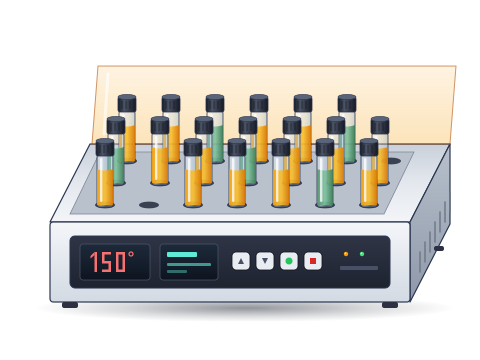
How COD digester works
Organic matter is oxidised by a known excess of potassium dichromate in hot, strongly acidic solution with silver sulphate as a catalyst. The block holds the sealed tubes at 150 °C for two hours. The dichromate that is used up is proportional to the oxygen demand of the sample and is measured afterwards by titration or colorimetry.
The path of a sample
- 01
Pre-heat
The block is switched on and allowed to reach 150 °C and stabilise.
- 02
Load tubes
Sample, digestion solution (dichromate with mercuric sulphate) and sulphuric acid with silver sulphate are added to a tube, which is capped tightly and mixed.
- 03
Digest
Tubes are placed in the block and heated at 150 °C for 2 hours.
- 04
Cool
Tubes are removed to a rack and cooled to room temperature, letting any precipitate settle.
- 05
Measure
The remaining dichromate is titrated with ferrous ammonium sulphate, or the absorbance is read on a spectrophotometer.
Main parts and what they do
Aluminium heating block
Holds the tubes in close-fitting wells and spreads heat evenly.
Heater and temperature controller
Brings the block to the set point (150 °C for COD) and holds it within a narrow band.
Temperature sensor (Pt100 or thermocouple)
Measures block temperature for the controller.
Timer
Counts the 2-hour digestion and often switches the heater off at the end.
Thermometer well
A hole for an independent calibrated thermometer or probe used in temperature checks.
Safety cover / shield
Protects the analyst if a tube cracks or leaks during digestion.
Digestion tubes and caps
Borosilicate glass tubes with PTFE-lined screw caps that survive hot acid.
Terms every analyst should know
Dichromate oxidation
Dichromate (Cr₂O₇²⁻, orange) is reduced to chromium(III) (Cr³⁺, green) while organic carbon is oxidised to carbon dioxide. Each mole of dichromate accepts six electrons, equivalent to 1.5 moles of oxygen.
Silver catalyst
Silver sulphate helps oxidise straight-chain aliphatic compounds that would otherwise react only partly.
Chloride masking
Mercuric sulphate binds chloride as a stable complex so it does not consume dichromate. A ratio of about 10 : 1 HgSO₄ : Cl⁻ is commonly used, and very saline samples need special methods.
Closed reflux
Because the tube is sealed, volatile compounds condense and stay in contact with the oxidant, similar to refluxing under a condenser.
Theoretical COD of KHP
Potassium hydrogen phthalate (KHP) is oxidised completely. Its theoretical COD is about 1.175 mg O₂ per mg KHP (often quoted as 1.176), so 425 mg/L KHP gives about 500 mg/L COD. It is used to check the whole digestion.
Keep every COD digester in control: usage logs, calibration and maintenance schedules, and automatic blocking of overdue instruments.