Environmental monitoring
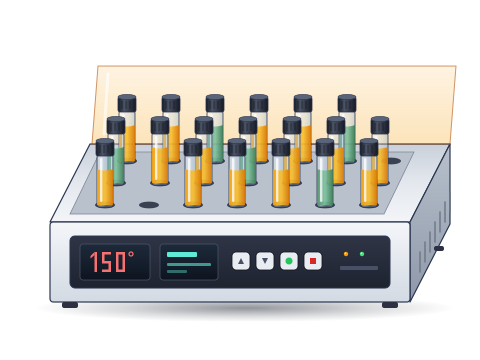
COD Digestion Reactor
A dry heating block that holds sealed glass tubes at 150 °C for two hours so that potassium dichromate can oxidise the organic matter in water and wastewater samples. It is the heart of the closed reflux COD test.
- Environmental testing laboratories
- Municipal water and wastewater utilities
- Chemical and pharmaceutical effluent treatment
- Food and beverage processing
- Textile, pulp and paper, and distilleries
TROUBLESHOOTING
Common problems, causes and fixes
KHP standard recovers low
Likely causes
- • Block temperature below 150 °C
- • Digestion time too short
- • Old or wrongly prepared digestion reagent
What to do
- • Check block temperature with a calibrated thermometer
- • Confirm the timer runs a full 2 hours
- • Prepare fresh reagents or use a new vial lot
Results erratic between replicate tubes
Likely causes
- • Sample not homogenised
- • Poor mixing of tube contents before digestion
- • Uneven temperature between wells
What to do
- • Blend samples with solids before sub-sampling
- • Invert tubes thoroughly after capping
- • Run a well-to-well temperature uniformity check
Tube cracks or leaks during digestion
Likely causes
- • Scratched or reused damaged tube
- • Cap not tight or liner damaged
What to do
- • Discard damaged tubes
- • Replace caps or liners; tighten firmly
Positive bias in saline effluents
Likely causes
- • Chloride not fully masked
What to do
- • Check mercuric sulphate dose against chloride content
- • Dilute the sample or use a high-chloride method
Block will not reach set point
Likely causes
- • Heater or sensor fault
- • Controller set wrongly
What to do
- • Check set point and program
- • Call service to check heater and sensor
In LimsPulse · Calibration Management
Keep every COD digester in control: usage logs, calibration and maintenance schedules, and automatic blocking of overdue instruments.