Environmental monitoring
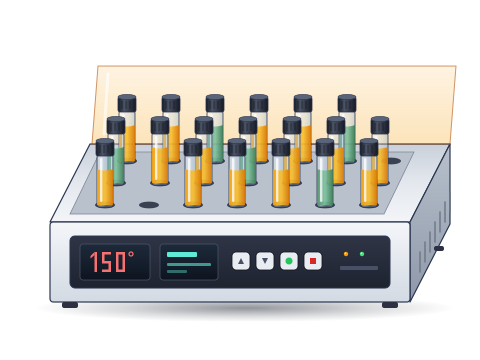
COD Digestion Reactor
A dry heating block that holds sealed glass tubes at 150 °C for two hours so that potassium dichromate can oxidise the organic matter in water and wastewater samples. It is the heart of the closed reflux COD test.
- Environmental testing laboratories
- Municipal water and wastewater utilities
- Chemical and pharmaceutical effluent treatment
- Food and beverage processing
- Textile, pulp and paper, and distilleries
Follow your site SOP
This is a typical operating sequence for learning. Your instrument model and approved SOP take precedence.
STAGE 1
Before you start
- 1Check the reactor is within its temperature check due date.
- 2Inspect tubes for chips or scratches; discard any damaged tube.
- 3Switch on and set 150 °C. Allow the block to reach set point (often 20–30 minutes).
- 4Homogenise samples with suspended solids in a blender so a small aliquot is representative.
- Damaged tubes may crack under heat and acid. Always use the safety shield.
STAGE 2
Loading
- 1Pipette the digestion solution and the sulphuric acid–silver sulphate reagent into each tube as per the method (or use pre-filled vials).
- 2Add the sample carefully down the inside of the tube so it forms a layer, then cap tightly.
- 3Invert each tube several times to mix. The tube becomes very hot because acid is mixing with water.
- 4Prepare a reagent blank (purified water) and a KHP check standard with each batch.
- Hold tubes by the cap and wear a face shield and acid-resistant gloves when mixing.
- Never add sample to an uncapped tube and then shake.
STAGE 3
Digestion
- 1Place tubes in the pre-heated block and start the 2-hour timer.
- 2Keep the safety cover closed.
- 3At the end, switch off or let the timer end the program.
- Do not open hot tubes; pressure builds up inside.
STAGE 4
Cooling and measurement
- 1Move tubes to a rack and let them cool to room temperature (some methods invert once while still warm).
- 2Wipe the outside of tubes before placing them in a spectrophotometer, or transfer contents for titration.
- 3Record block temperature, start and end times in the log.
In LimsPulse · Calibration Management
Keep every COD digester in control: usage logs, calibration and maintenance schedules, and automatic blocking of overdue instruments.