COD standard (KHP) recovery
Digests a potassium hydrogen phthalate (KHP) standard of known theoretical COD and checks that the measured COD is recovered within limits.
Why this is checked
The KHP check proves that the whole COD system works: block temperature, digestion time, reagents, and the final titration or spectrophotometer reading. KHP is fully oxidised by dichromate, so its theoretical COD is known.
Typically with every batch of COD samples, and as a formal calibration check monthly or when a new reagent lot is used, as defined in your SOP.
Learn how the COD digester worksStandards & tools
- Potassium hydrogen phthalate (KHP), primary standard grade, dried at about 110–120 °C and cooled in a desiccator
- KHP stock: 425 mg KHP per litre in purified water gives a theoretical COD of about 500 mg O₂/L (KHP theoretical COD ≈ 1.175 mg O₂/mg, often quoted as 1.176)
- Calibrated analytical balance and Class A volumetric flasks and pipettes
Prerequisites
- Block temperature check is current
- Digestion reagents within expiry, or a new vial lot recorded
- Spectrophotometer zeroed with a reagent blank, or FAS titrant standardised the same day
Step by step
- 1Weigh 425 mg of dried KHP accurately and dissolve to 1000 mL with purified water (or prepare a lower standard by dilution for low-range tests).
- 2Pipette the standard into three digestion tubes, and purified water into a blank tube, exactly as for samples.
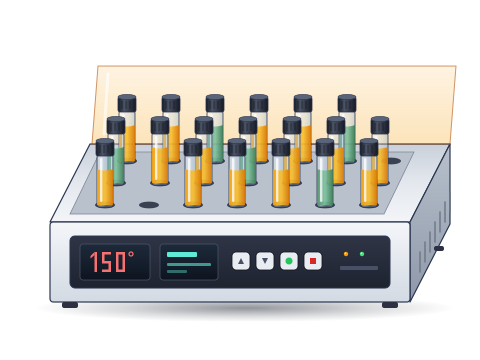
- 3Digest at 150 °C for 2 hours with the routine samples.
- 4Cool and measure COD by titration or colorimetry.
- 5Calculate recovery of each replicate and the mean against the theoretical value.
Example observation table
| Replicate | Theoretical COD (mg/L) | Measured COD (mg/L) | Recovery (%) |
|---|---|---|---|
| 1 | 499.4 | 492.0 | 98.5 |
| 2 | 499.4 | 488.5 | 97.8 |
| 3 | 499.4 | 495.5 | 99.2 |
| Mean | 499.4 | 492.0 | 98.5 |
How to calculate the result
- 1
KHP oxidation: 2 KC₈H₅O₄ + 15 O₂ + H₂SO₄ → 16 CO₂ + 6 H₂O + K₂SO₄, so 1 mol KHP needs 7.5 mol O₂
- 27.5 × 32.00 ÷ 204.22 = 1.175 mg O₂ per mg KHP
- 3
Theoretical COD = 425 × 1.175 = 499.4 mg/L (commonly rounded to 500 mg/L)
- 4Replicate 1 recovery = 492.0 ÷ 499.4 × 100 = 98.5%
- 5Mean recovery = 492.0 ÷ 499.4 × 100 = 98.5%
Pass if
- Mean recovery typically within 90–110% of the theoretical value; many labs use tighter control chart limits (for example 95–105%), as defined in your SOP
- Replicates agree within the precision limit of the method
- Reagent blank within the expected range for the lot
What to do
- Do not report COD results from the affected batch.
- Check standard preparation (KHP dried, correct mass, correct dilution) and reagent expiry.
- Check block temperature and timer, and the spectrophotometer or FAS standardisation.
- Repeat the KHP check with fresh standard; re-digest samples within holding time once the check passes.
Other COD digester calibrations
LimsPulse schedules this calibration, records the result against limits, and blocks the instrument everywhere if it fails or goes overdue.