COD digester · Calibration procedure
Block temperature check
Confirms that the COD reactor block holds 150 °C in every well used for digestion.
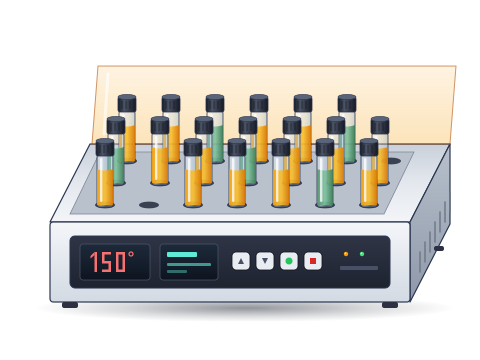
PURPOSE
Why this is checked
Dichromate oxidation is strongly temperature dependent. If the block runs cool, organic matter is not fully oxidised and COD results are low; if it runs hot, tubes can leak. The check shows that the displayed temperature and the actual well temperature agree.
Frequency
Typically monthly and after repair or relocation, with a full multi-well check at least annually, as defined in your SOP.
Learn how the COD digester worksYOU WILL NEED
Standards & tools
- Calibrated digital thermometer with a thin probe, or a calibrated thermometer, traceable to national standards (resolution 0.1 °C)
- Digestion tube filled with silicone oil or glycerol to hold the probe (a 'thermometer tube')
BEFORE YOU START
Prerequisites
- Reactor switched on at 150 °C and stable for at least 30 minutes
- Thermometer calibration certificate valid, with correction known
- Safety shield in place; heat-resistant gloves available
PROCEDURE
Step by step
- 1Fill a clean digestion tube with oil to the same level as a normal sample, insert the thermometer probe and cap or seal it loosely.
- 2Place the thermometer tube in the first test well (for example a corner well) and wait until the reading is steady (often 10–15 minutes).
- 3Record the reference reading, apply the certificate correction, and record the reactor display.
- 4Repeat in other wells, covering corners and centre (for example 5 wells, or all wells at the annual check).
- 5Calculate the deviation of each well from 150 °C and the spread between wells.
RECORD
Example observation table
| Well position | Display (°C) | Reference thermometer, corrected (°C) | Deviation from 150 °C |
|---|---|---|---|
| Front left | 150.0 | 149.2 | −0.8 |
| Front right | 150.0 | 150.4 | +0.4 |
| Centre | 150.0 | 151.1 | +1.1 |
| Back left | 150.0 | 150.6 | +0.6 |
| Back right | 150.0 | 149.8 | −0.2 |
CALCULATION
How to calculate the result
Formula
Deviation = corrected reference reading − 150 °C; Spread = highest − lowest well reading
Worked example
- 1
Centre well: 151.1 − 150.0 = +1.1 °C
- 2Mean of 5 wells = (149.2 + 150.4 + 151.1 + 150.6 + 149.8) ÷ 5 = 150.22 °C
- 3
Spread = 151.1 − 149.2 = 1.9 °C
- 4
All wells within 150 ± 2 °C, so the block passes.
ACCEPTANCE CRITERIA
Pass if
- Every well checked within 150 ± 2 °C (typical limit in standard COD methods; use your SOP limit)
- Display agrees with the reference within the tolerance in your SOP (for example ±2 °C)
- Timer runs 120 minutes within about ±1 minute when checked against a stopwatch
IF IT FAILS
What to do
- Label the reactor 'Out of calibration' and stop using it for COD.
- Check that the thermometer tube was seated fully and the reading was steady, then repeat once.
- If the failure is confirmed, request service or adjust the controller offset as allowed by the manufacturer, then repeat the check.
- Assess COD results since the last passing check, using KHP check standard records to judge impact.
MORE
Other COD digester calibrations
In LimsPulse · Calibration Management
LimsPulse schedules this calibration, records the result against limits, and blocks the instrument everywhere if it fails or goes overdue.