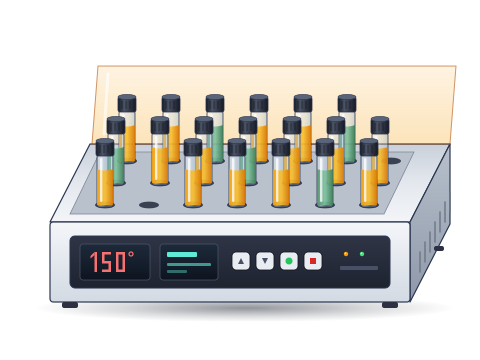
COD Digestion Reactor
A dry heating block that holds sealed glass tubes at 150 °C for two hours so that potassium dichromate can oxidise the organic matter in water and wastewater samples. It is the heart of the closed reflux COD test.
- Environmental testing laboratories
- Municipal water and wastewater utilities
- Chemical and pharmaceutical effluent treatment
- Food and beverage processing
- Textile, pulp and paper, and distilleries
Test your COD digester knowledge
Multiple-choice questions
Pick an answer to see whether you are right and why.
Q1. What temperature and time are standard for closed reflux COD digestion?
basicQ2. Which oxidising agent is used in the standard COD test?
basicQ3. Why is mercuric sulphate added to the COD digestion solution?
intermediateQ4. A 425 mg/L potassium hydrogen phthalate (KHP) solution has a theoretical COD of about:
intermediateQ5. During a block temperature check, one well reads 146.8 °C on a calibrated thermometer. With a limit of 150 ± 2 °C, what should you do?
intermediateQ6. In the titrimetric finish, the blank uses 2.30 mL and the sample 1.45 mL of 0.0985 M FAS for a 2.5 mL sample. What is the COD?
advanced
Viva questions
Think of your answer first, then open it to compare.
1. Why is COD always higher than BOD for the same wastewater?
Dichromate chemically oxidises almost all organic matter, including compounds that bacteria cannot break down in 5 days or at all. BOD only measures the biodegradable part, so COD ≥ BOD. The BOD : COD ratio shows how biodegradable the wastewater is.
2. What does a low KHP recovery tell you, and what would you check?
It shows the COD system is not oxidising or measuring fully. Check the block temperature and timer, reagent expiry and preparation, KHP drying and weighing, FAS standardisation or spectrophotometer calibration. Do not report the batch until the check passes.
3. What safety and waste precautions apply to COD testing?
Reagents contain hexavalent chromium (carcinogen), mercury salts and concentrated sulphuric acid. Wear a face shield and acid-resistant gloves, keep the reactor shield closed, let tubes cool before opening, and collect all digests as hazardous waste for chromium, mercury and silver.
Keep every COD digester in control: usage logs, calibration and maintenance schedules, and automatic blocking of overdue instruments.