Ultra-High Performance Liquid Chromatography (UHPLC)
A high-pressure form of HPLC that uses columns packed with very small particles to give faster runs, sharper peaks and less solvent use. Used in pharma QC for fast assays, impurity profiling and high-throughput testing.
- Pharmaceutical
- Biotech
- Contract research (CRO / CDMO)
- Food & beverage
- Environmental
- Clinical research
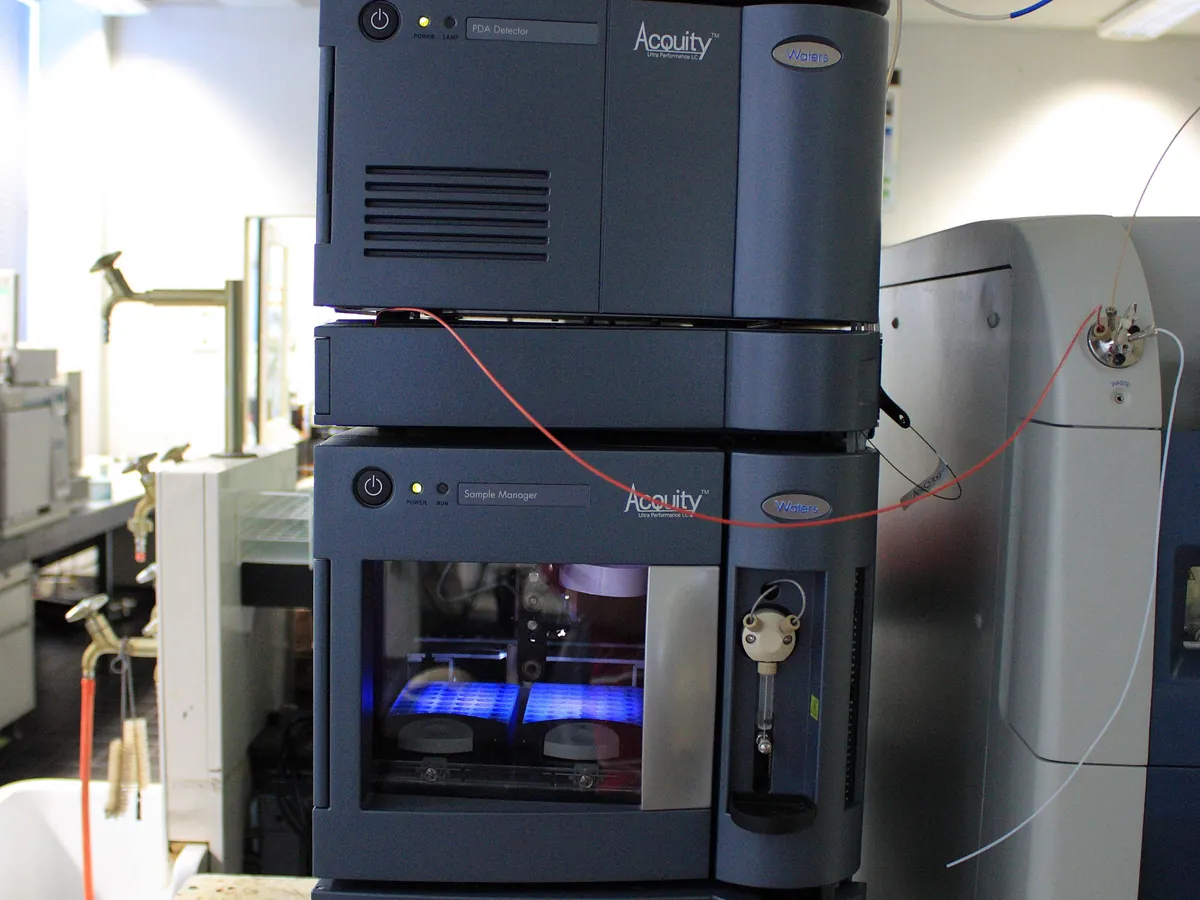
What is UHPLC?
UHPLC works on exactly the same principle as HPLC: a pump pushes a liquid mobile phase through a packed column, the sample components separate, and a detector records them as peaks. The difference is the column. UHPLC columns are packed with much smaller particles, typically sub-2 µm fully porous particles (for example 1.7–1.8 µm) or 2.6–2.7 µm superficially porous (core-shell) particles, instead of the 3–5 µm particles used in conventional HPLC.
Small particles give a more efficient column, so the same separation can be done on a shorter column at a higher flow velocity. A 15-minute HPLC method can often be run in 3–5 minutes. The price is pressure: small particles resist flow far more, so UHPLC systems are built to work at roughly 1000–1300 bar (about 15,000–19,000 psi), compared with about 400 bar for conventional HPLC.
Because UHPLC peaks are very narrow (often only a few seconds wide), the whole system has to be redesigned to keep them narrow: low-volume tubing and connections, small-volume detector flow cells, fast data rates and a small gradient delay (dwell) volume. In a QC lab UHPLC is used for assay, related substances, content uniformity and dissolution testing where speed, sensitivity and lower solvent consumption matter.
Used for
- Fast assay and content uniformity of finished products
- High-resolution impurity profiling and stability testing
- Dissolution sample analysis with short run times
- Method transfer of legacy HPLC methods to shorter columns (within allowed adjustments)
- Front end for LC-MS, where narrow peaks improve sensitivity
- Cleaning validation with low detection limits
How it works
- 01
Mobile phase
Filtered (0.2 µm), degassed solvents are drawn from the reservoirs through low-volume degassers.
- 02
High-pressure pump
A binary pump mixes solvents at high pressure, giving a small dwell volume and accurate gradients up to roughly 1000–1300 bar.
- 03
Autosampler
Injects small volumes (often 0.5–5 µL) with very low carry-over and minimal dispersion.
- 04
Column
A short column (e.g. 50–100 × 2.1 mm, 1.7 µm) in a thermostatted compartment performs the separation.
- 05
Low-dispersion detector
A UV or PDA detector with a small flow cell (about 0.5–1 µL) records narrow peaks at a high data rate.
- 06
Data system
Acquires enough points across each peak (typically at least 15–20) for accurate integration.
Advantages
- Run times often 3–10 times shorter than HPLC
- Higher efficiency and resolution per unit time
- Lower solvent use and waste per sample
- Taller, narrower peaks give better sensitivity
- Small injection volumes save precious sample
Limitations
- Higher instrument and column cost
- Columns block more easily; samples and mobile phases must be very clean (0.2 µm filtration)
- Very sensitive to extra-column volume, poor fittings and the wrong tubing
- Methods do not transfer directly to a conventional HPLC without re-scaling
- Frictional heating at high pressure can change selectivity on wide columns
3 calibration procedures
Methods that use UHPLC
Keep every UHPLC in control: usage logs, calibration and maintenance schedules, and automatic blocking of overdue instruments.