Ultra-High Performance Liquid Chromatography (UHPLC)
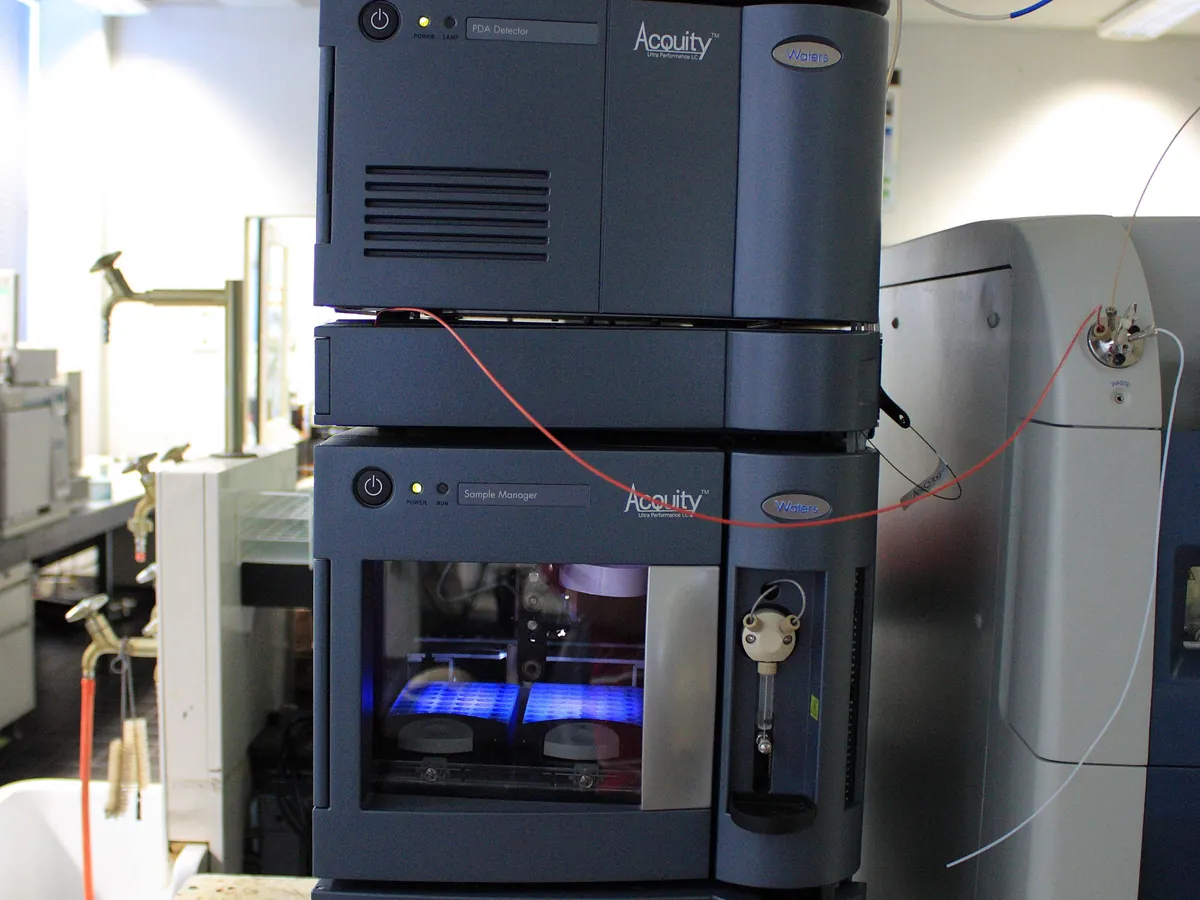
A high-pressure form of HPLC that uses columns packed with very small particles to give faster runs, sharper peaks and less solvent use. Used in pharma QC for fast assays, impurity profiling and high-throughput testing.
- Pharmaceutical
- Biotech
- Contract research (CRO / CDMO)
- Food & beverage
- Environmental
- Clinical research
Test your UHPLC knowledge
Multiple-choice questions
Pick an answer to see whether you are right and why.
Q1. What is the main hardware difference that lets UHPLC run faster than conventional HPLC?
basicQ2. At the same linear velocity, halving the particle size increases back-pressure by about:
intermediateQ3. Why is extra-column volume more critical in UHPLC than in HPLC?
intermediateQ4. Which filter pore size is usually recommended for UHPLC mobile phases and samples?
basicQ5. A gradient method transferred from HPLC to UHPLC shows all peaks eluting earlier than predicted. The most likely cause is:
advancedQ6. UHPLC peaks look flat-topped and jagged. What should you check first?
intermediate
Viva questions
Think of your answer first, then open it to compare.
1. Explain why small particles give better efficiency, using the van Deemter curve.
Smaller particles shorten diffusion paths, which reduces eddy diffusion and mass-transfer resistance. The van Deemter curve becomes lower (smaller plate height) and flatter at high velocity, so the column stays efficient even at fast flow rates.
2. What do you need to consider when transferring an HPLC method to UHPLC?
Keep the column chemistry and a similar column length-to-particle-size ratio, scale flow rate and injection volume to the new column diameter, scale gradient time to column volume, account for dwell-volume differences, and stay within the pharmacopoeial allowed adjustments; otherwise revalidation or verification is needed.
3. Why is UHPLC injector precision checked at small volumes during calibration?
Routine UHPLC injections are often 1–2 µL. At these volumes air bubbles, seal wear or partial blockage cause large relative errors, so precision must be proven at the volume actually used.
Keep every UHPLC in control: usage logs, calibration and maintenance schedules, and automatic blocking of overdue instruments.