Ultra-High Performance Liquid Chromatography (UHPLC)
A high-pressure form of HPLC that uses columns packed with very small particles to give faster runs, sharper peaks and less solvent use. Used in pharma QC for fast assays, impurity profiling and high-throughput testing.
- Pharmaceutical
- Biotech
- Contract research (CRO / CDMO)
- Food & beverage
- Environmental
- Clinical research
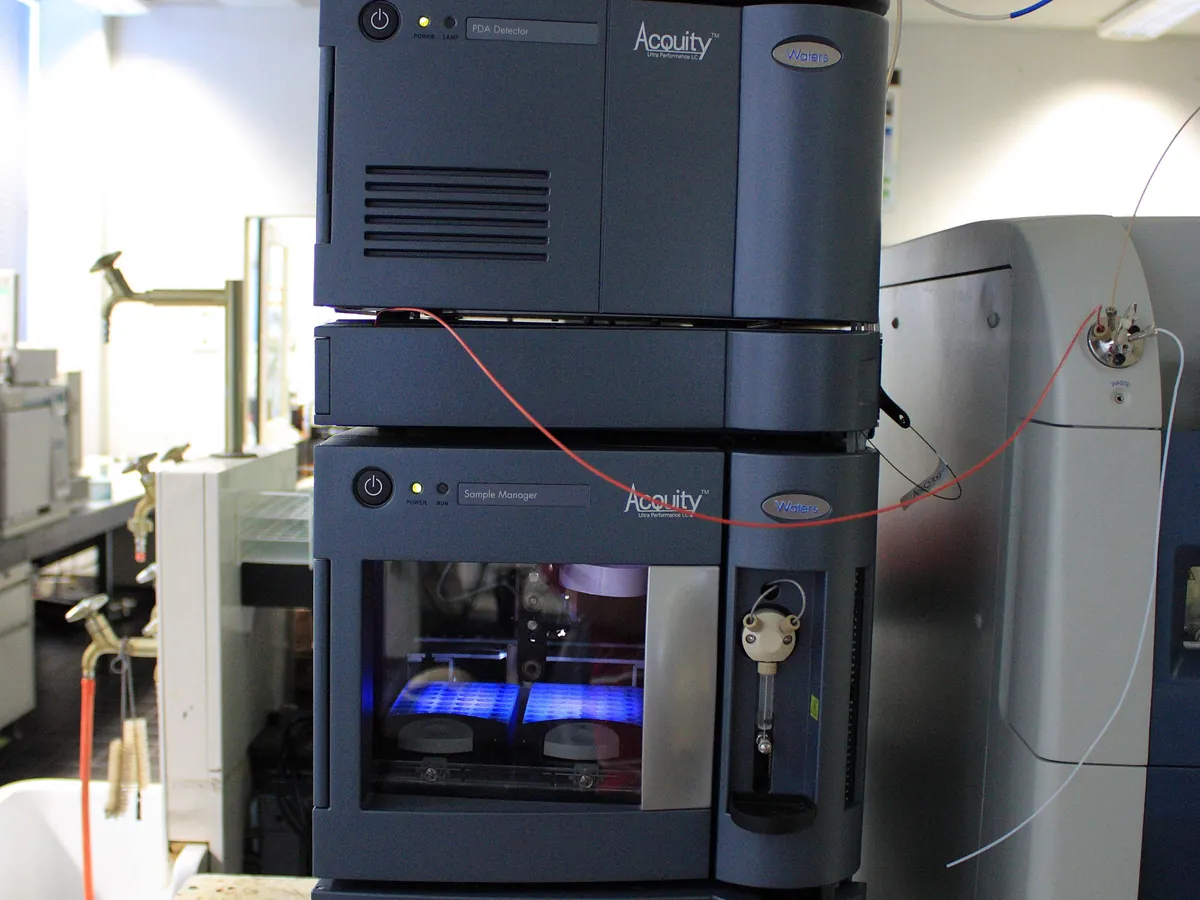
How UHPLC works
Column efficiency improves as particle size falls, because analytes diffuse in and out of smaller particles faster. The van Deemter curve for small particles is also flatter, so high flow velocities can be used without losing efficiency. UHPLC exploits this by combining small particles, short columns and high pressure to give fast, high-resolution separations.
The path of a sample
- 01
Mobile phase
Filtered (0.2 µm), degassed solvents are drawn from the reservoirs through low-volume degassers.
- 02
High-pressure pump
A binary pump mixes solvents at high pressure, giving a small dwell volume and accurate gradients up to roughly 1000–1300 bar.
- 03
Autosampler
Injects small volumes (often 0.5–5 µL) with very low carry-over and minimal dispersion.
- 04
Column
A short column (e.g. 50–100 × 2.1 mm, 1.7 µm) in a thermostatted compartment performs the separation.
- 05
Low-dispersion detector
A UV or PDA detector with a small flow cell (about 0.5–1 µL) records narrow peaks at a high data rate.
- 06
Data system
Acquires enough points across each peak (typically at least 15–20) for accurate integration.
Main parts and what they do
Solvent manager (binary high-pressure pump)
Delivers and mixes two solvents at very high pressure with low pulsation and a small dwell volume.
Low-volume degasser
Removes dissolved gas without adding much volume to the flow path.
Sample manager / autosampler
Injects small, precise volumes from cooled vials or plates, with strong and weak needle washes to control carry-over.
Column and column heater
Short, narrow-bore column packed with sub-2 µm or core-shell particles, held at a stable temperature (often with an active pre-heater).
UV / PDA detector with low-volume cell
Measures absorbance in a flow cell of around 0.5–1 µL; PDA also records spectra for peak purity.
High-pressure tubing and fittings
Narrow-bore (e.g. 0.1–0.13 mm i.d.) stainless steel or MP35N tubing with zero-dead-volume fittings rated for UHPLC pressure.
Chromatography data system (CDS)
Controls the system, acquires data at high rates, integrates peaks and keeps the audit trail.
Terms every analyst should know
Particle size and efficiency
Halving the particle size roughly doubles the plate number per unit column length, but increases back-pressure about four times at the same linear velocity.
Van Deemter curve
Plots plate height against flow velocity. Smaller particles give a lower and flatter curve, so faster flow loses little efficiency.
Extra-column volume
All volume outside the column (tubing, injector, flow cell). It broadens peaks and matters much more in UHPLC than in HPLC.
Dwell (gradient delay) volume
Volume between the point where solvents mix and the column inlet. It delays the gradient and must be considered when transferring methods between systems.
Data acquisition rate
Peaks a few seconds wide need fast sampling (often 20–80 Hz); too slow a rate flattens and distorts peaks.
Method scaling
Changing column length, diameter and particle size needs flow, injection volume and gradient time to be scaled; pharmacopoeias define which changes are allowed without revalidation.
Keep every UHPLC in control: usage logs, calibration and maintenance schedules, and automatic blocking of overdue instruments.