Thermogravimetric Analyser (TGA)
Weighs a sample continuously while it is heated, and records mass loss against temperature. Used to measure water and solvent content, decomposition and residue.
- Pharmaceutical
- Polymers
- Materials science
- Minerals
- Chemicals
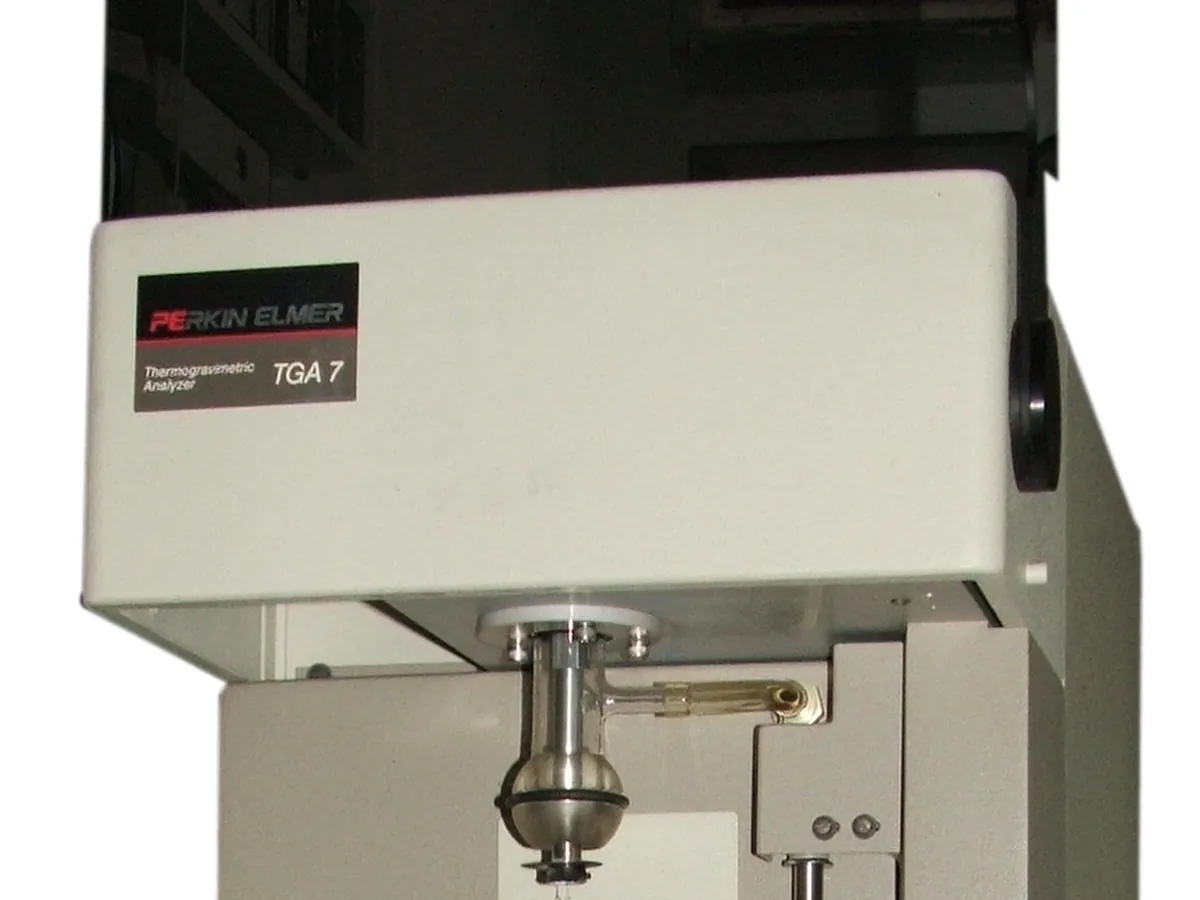
What is TGA?
A TGA is a very sensitive balance with the sample pan hanging inside, or sitting on a beam inside, a small furnace. As the furnace heats at a set rate, the instrument records the sample mass. Any loss of water, solvent or decomposition products, or any gain from oxidation, shows as a step in the mass curve.
The curve of mass (%) against temperature is called a thermogram. The first derivative (DTG) shows the rate of mass change and makes overlapping steps easier to separate. The size of each step tells you how much was lost.
In pharma, TGA is used alongside DSC to tell whether a DSC peak involves mass loss, to identify hydrates and solvates, to measure volatile content on small samples and to study thermal stability.
Used for
- Water and solvent content of hydrates and solvates
- Decomposition temperature and thermal stability
- Supporting DSC interpretation (melting versus desolvation)
- Residue and inorganic content
- Compositional analysis of polymers and excipients
How it works
- 01
Tare
Tare the empty pan in the instrument.
- 02
Load
Add 5–20 mg of sample to the pan.
- 03
Purge
Flow nitrogen (or air) through the furnace and balance.
- 04
Heat
Heat at a set rate, commonly 10 °C/min.
- 05
Record
The balance records mass continuously against temperature.
- 06
Evaluate
Measure each step in % and its onset using the curve and DTG.
Advantages
- Quantitative mass change on a few milligrams of sample
- Shows the temperature at which each loss occurs
- Can be coupled with FTIR or MS to identify evolved gases
- Inert or oxidising atmospheres can be selected
Limitations
- Does not show events without a mass change (for example melting)
- Does not identify what is lost unless coupled to a gas analyser
- Buoyancy and gas flow effects must be corrected
- Small sample size may not represent a non-uniform batch
2 calibration procedures
Keep every TGA in control: usage logs, calibration and maintenance schedules, and automatic blocking of overdue instruments.