Thermogravimetric Analyser (TGA)
Weighs a sample continuously while it is heated, and records mass loss against temperature. Used to measure water and solvent content, decomposition and residue.
- Pharmaceutical
- Polymers
- Materials science
- Minerals
- Chemicals
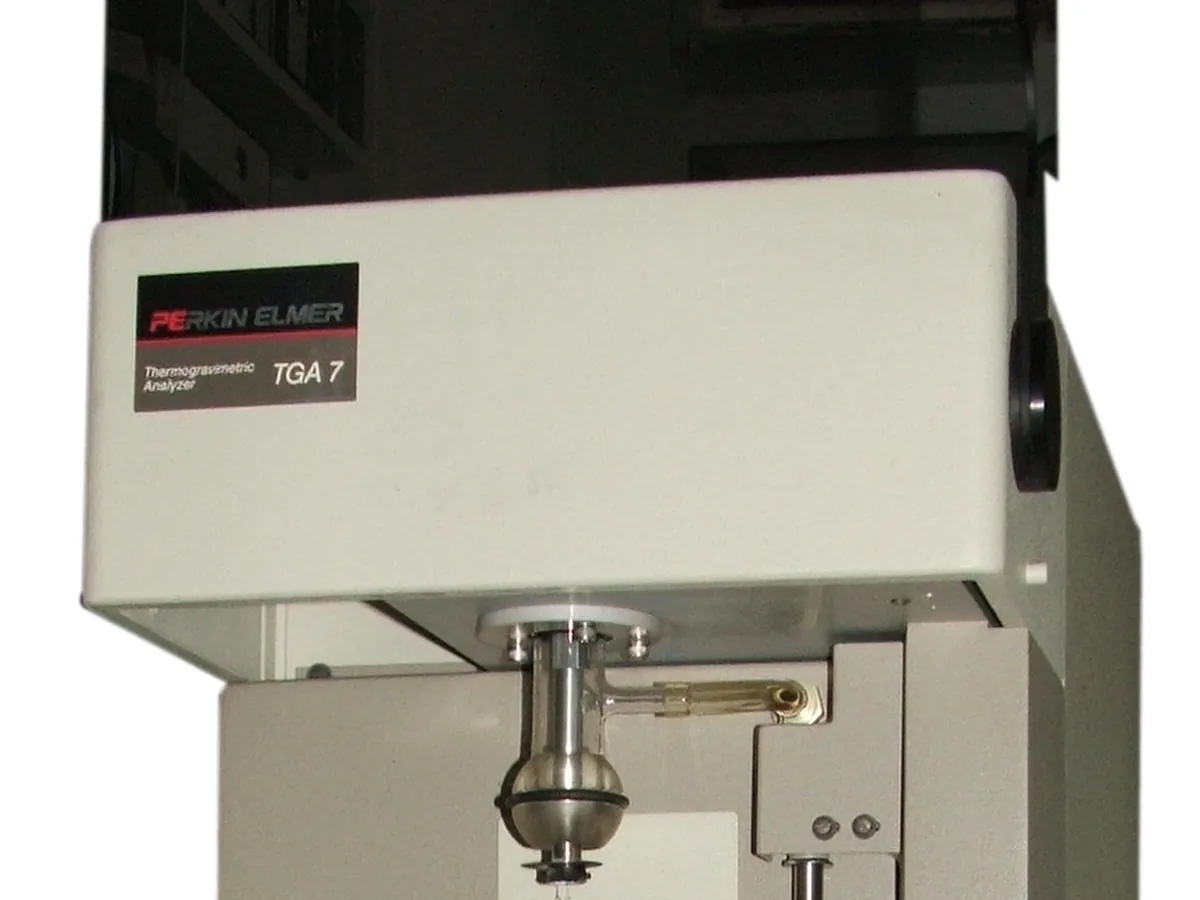
How TGA works
The sample mass is recorded by a microbalance while the furnace follows a temperature programme in a controlled gas atmosphere. The percentage mass lost in each step, and the temperature at which it happens, describe the composition and stability of the sample. Temperature is calibrated with magnetic Curie point standards and the balance with certified weights.
The path of a sample
- 01
Tare
Tare the empty pan in the instrument.
- 02
Load
Add 5–20 mg of sample to the pan.
- 03
Purge
Flow nitrogen (or air) through the furnace and balance.
- 04
Heat
Heat at a set rate, commonly 10 °C/min.
- 05
Record
The balance records mass continuously against temperature.
- 06
Evaluate
Measure each step in % and its onset using the curve and DTG.
Main parts and what they do
Microbalance
Very sensitive balance (microgram resolution) that weighs the sample throughout the run.
Furnace
Heats the sample from ambient to typically 1000 °C or higher.
Sample pan
Platinum, alumina or aluminium pan, chosen for the temperature and sample.
Thermocouple
Measures the temperature close to the sample.
Purge gas system
Supplies balance and sample purge gas (nitrogen or air) at controlled flow.
Autosampler (optional)
Loads and unloads pans for unattended operation.
Software
Controls the programme, records mass and temperature and evaluates steps and DTG.
Terms every analyst should know
Mass loss step
A drop in the curve that shows a volatile component leaving or the sample decomposing.
DTG curve
The first derivative of mass against time or temperature. Each peak marks the fastest point of a mass-loss step.
Buoyancy effect
The gas becomes less dense as it warms, so the sample seems to gain mass. A blank run is subtracted to correct for it.
Curie point
The temperature at which a ferromagnetic metal loses its magnetism. It is used to calibrate TGA temperature with a magnet.
Stoichiometric water
For a hydrate, the expected mass loss can be calculated from the formula and compared with the TGA step.
Keep every TGA in control: usage logs, calibration and maintenance schedules, and automatic blocking of overdue instruments.