Stability chamber
A cabinet or walk-in room that holds samples at a controlled temperature and relative humidity for months or years, so that the shelf life of a drug product can be established under ICH storage conditions.
- Pharmaceutical
- Biotech
- Medical devices
- Cosmetics
- Food & nutraceuticals
- Packaging
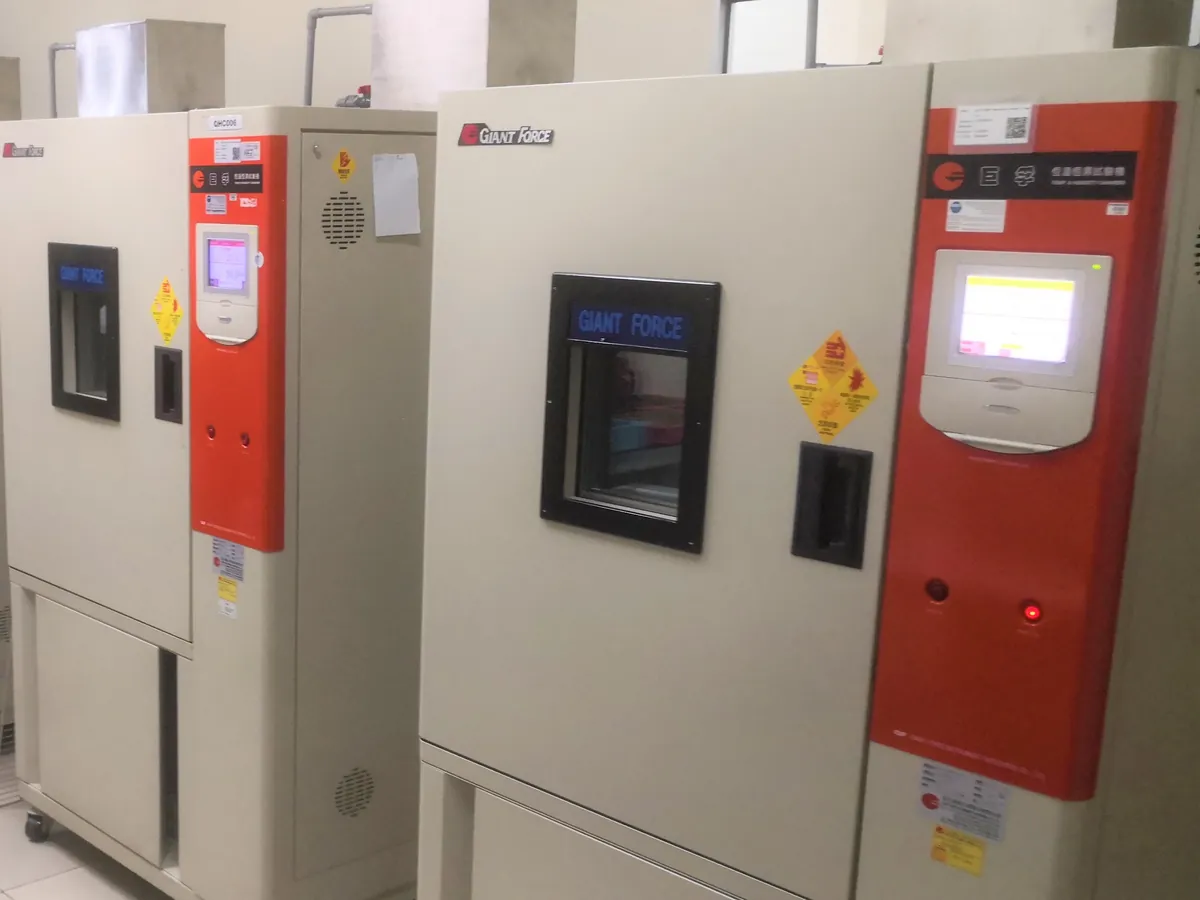
What is Stability chamber?
A stability chamber keeps drug substances and drug products at a fixed temperature and relative humidity (RH) for the whole length of a stability study. Samples are pulled at set time points (for example 0, 3, 6, 9, 12, 18, 24 and 36 months) and tested to see how quality changes over time.
The storage conditions come from ICH Q1A(R2). The most common are long-term 25 °C/60% RH or 30 °C/65% RH, intermediate 30 °C/65% RH and accelerated 40 °C/75% RH, each with typical tolerances of ±2 °C and ±5% RH. Results from these studies support the shelf life and storage statement printed on the label.
Because a chamber may hold samples worth months of work and regulatory submissions, it is a GMP-critical system. It is qualified with temperature and RH mapping, its sensors are calibrated, alarms are tested, and conditions are recorded continuously by an independent monitoring system.
Used for
- Long-term, intermediate and accelerated stability studies (ICH Q1A(R2))
- Ongoing (commitment) stability of commercial batches
- Stress and forced-degradation studies at elevated temperature and humidity
- Packaging comparison studies (e.g. blister versus bottle)
- Holding-time studies for bulk and in-process material
How it works
- 01
Sense
A temperature sensor (often a Pt100) and an RH sensor (often capacitive) measure conditions in the air stream.
- 02
Compare
The PID controller compares the readings with the set points, e.g. 40 °C and 75% RH.
- 03
Heat or cool
Electric heaters add heat; a refrigeration coil removes it.
- 04
Humidify or dry
A steam or ultrasonic humidifier adds moisture; the cold coil condenses moisture out to dry the air.
- 05
Circulate
Fans and ducts move conditioned air evenly across every shelf.
- 06
Record and alarm
An independent monitoring system logs conditions and raises an alarm if they go outside limits.
Advantages
- Holds temperature and humidity steady for months or years
- Simulates the climatic zones a product will be marketed in
- Continuous electronic records support data integrity
- Reach-in and walk-in sizes suit small and large study loads
Limitations
- Humidity control needs a clean water supply and regular maintenance
- Uniformity worsens if shelves are overloaded or air paths blocked
- Power or compressor failure can put a whole study at risk
- Mapping, calibration and monitoring add ongoing cost
3 calibration procedures
Methods that use Stability chamber
Keep every Stability chamber in control: usage logs, calibration and maintenance schedules, and automatic blocking of overdue instruments.