Stability chamber
A cabinet or walk-in room that holds samples at a controlled temperature and relative humidity for months or years, so that the shelf life of a drug product can be established under ICH storage conditions.
- Pharmaceutical
- Biotech
- Medical devices
- Cosmetics
- Food & nutraceuticals
- Packaging
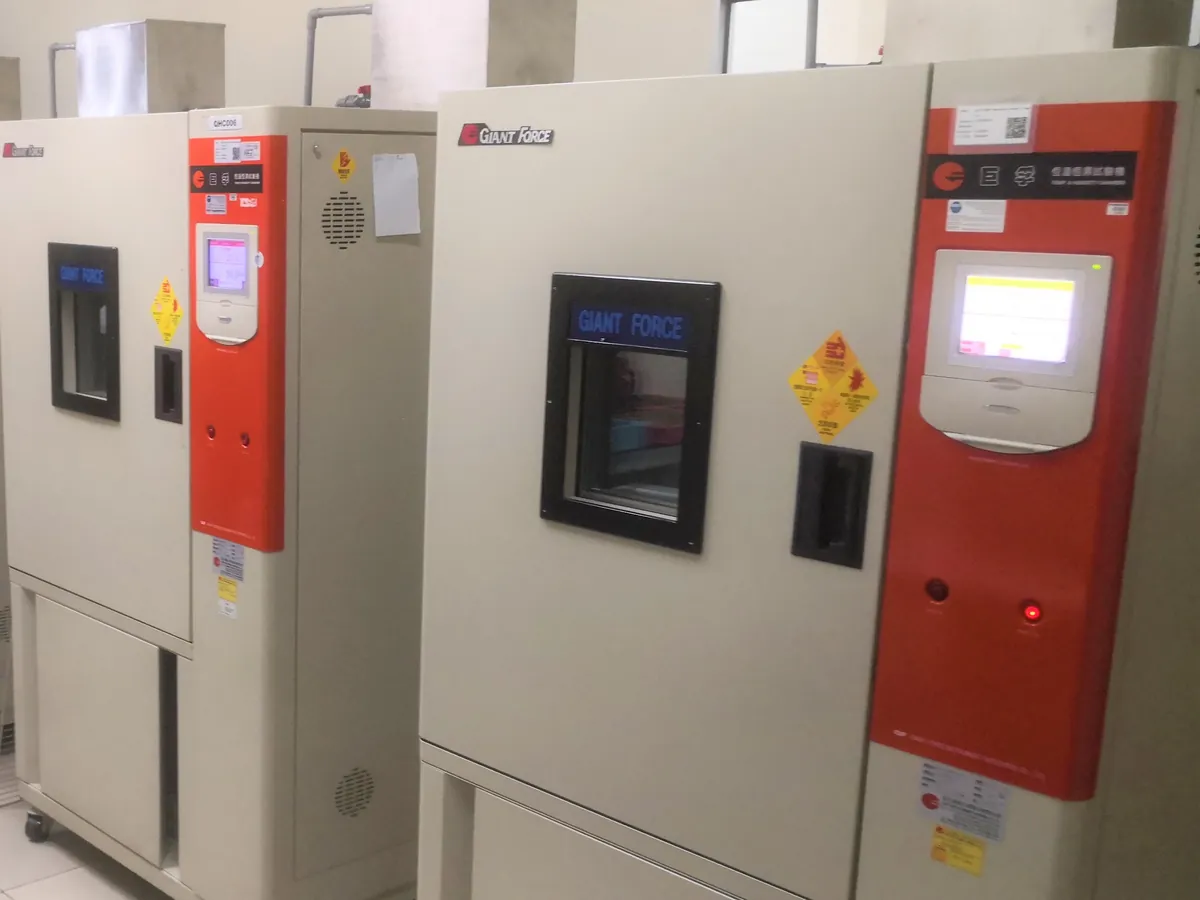
How Stability chamber works
A controller compares the temperature and RH measured by its sensors with the set points and drives heaters, a refrigeration system, a humidifier and a dehumidifier to correct any difference. Fans circulate the air so that every shelf sees the same conditions.
The path of a sample
- 01
Sense
A temperature sensor (often a Pt100) and an RH sensor (often capacitive) measure conditions in the air stream.
- 02
Compare
The PID controller compares the readings with the set points, e.g. 40 °C and 75% RH.
- 03
Heat or cool
Electric heaters add heat; a refrigeration coil removes it.
- 04
Humidify or dry
A steam or ultrasonic humidifier adds moisture; the cold coil condenses moisture out to dry the air.
- 05
Circulate
Fans and ducts move conditioned air evenly across every shelf.
- 06
Record and alarm
An independent monitoring system logs conditions and raises an alarm if they go outside limits.
Main parts and what they do
Insulated cabinet or room
Stainless-steel interior with insulated walls and a sealed door, often with an inner glass door to limit disturbance.
Controller (PID)
Holds the set points and drives heating, cooling, humidifying and drying. Usually with password-protected access and an audit trail.
Temperature and RH sensors
Control sensors in the air stream; calibrated against traceable references.
Refrigeration system
Compressor, condenser and evaporator coil that cool and dehumidify the air.
Humidifier
Steam generator or ultrasonic unit fed with purified water to add moisture.
Air circulation fans and ducts
Move air evenly over shelves to keep the chamber uniform.
Independent monitoring system
Separate probes and software (EMS/BMS) that record conditions and send alarms by sound, SMS or e-mail.
Water supply and drain
Purified-water reservoir or line for the humidifier and a drain for condensate.
Terms every analyst should know
ICH storage conditions
Long-term 25 °C/60% RH or 30 °C/65% RH, intermediate 30 °C/65% RH, accelerated 40 °C/75% RH. Typical tolerances are ±2 °C and ±5% RH.
Climatic zones
The world is divided into zones (I to IVb) by climate. The zone of the target market decides the long-term condition, e.g. 30 °C/75% RH for hot and very humid zone IVb.
Relative humidity
The amount of water vapour in the air as a percentage of the maximum it could hold at that temperature. RH changes with temperature, so both must be controlled together.
Mapping
Placing many calibrated loggers across the chamber to find hot, cold, wet and dry spots and prove the whole usable space is within limits.
Excursion
Any period when conditions go outside the allowed range. Excursions are recorded, assessed for impact on the samples and investigated.
Keep every Stability chamber in control: usage logs, calibration and maintenance schedules, and automatic blocking of overdue instruments.