Real-time PCR (qPCR) system
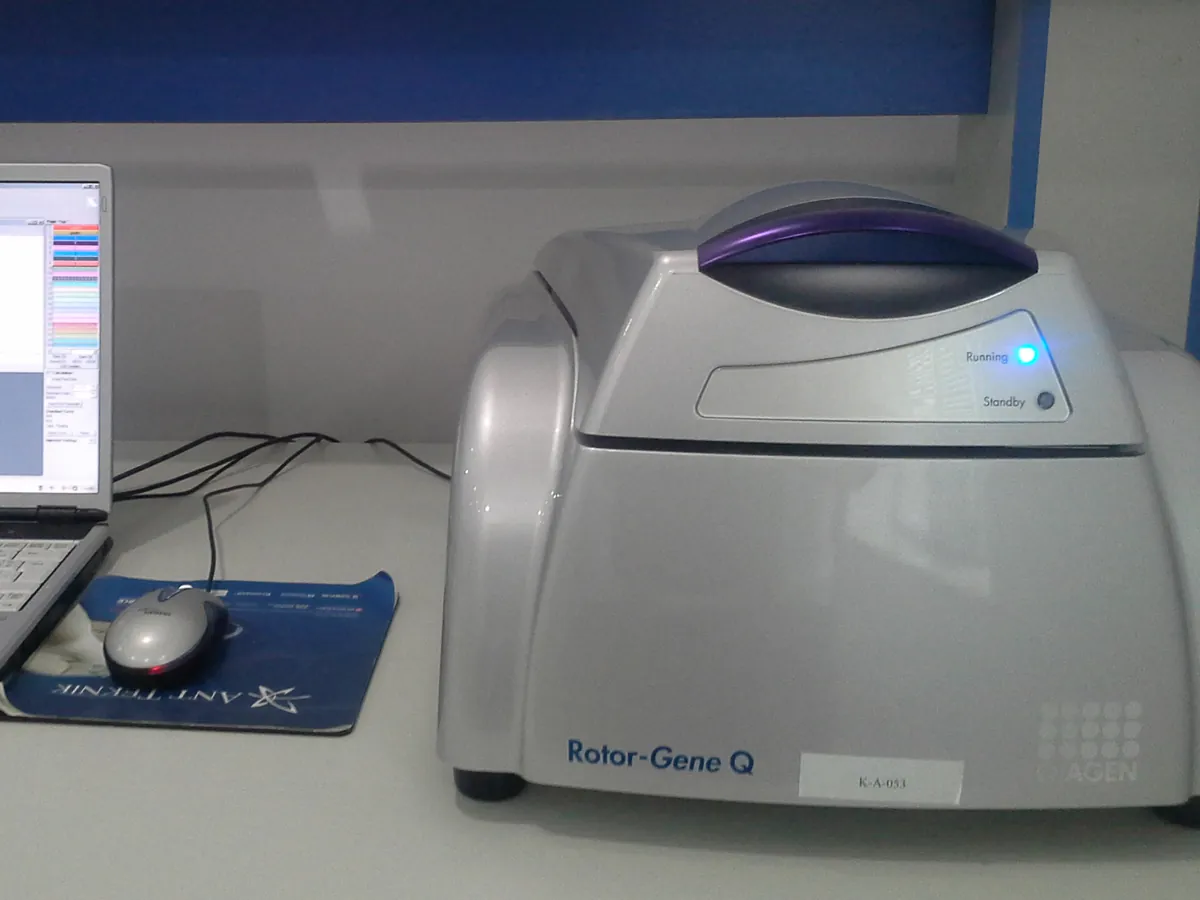
A thermal cycler with a built-in fluorescence reader. It copies a chosen DNA sequence cycle by cycle and measures the fluorescence in every well after each cycle, so the starting amount of DNA can be calculated from a standard curve.
- Biotechnology
- Biopharmaceutical
- Cell and gene therapy
- Academic research
- Agricultural biotech
- Food authenticity
What is qPCR?
The polymerase chain reaction (PCR) doubles a short target DNA sequence in each temperature cycle. In a real-time PCR system the reaction mix also contains a fluorescent dye or probe, and an optical module reads every well at the end of each cycle. The cycle at which a well's fluorescence crosses a set threshold is called the quantification cycle (Cq, often still called Ct). The more target DNA a well started with, the earlier it crosses the threshold.
A qPCR system has three working parts: a Peltier heating block that cycles the plate between about 95 °C and 55–65 °C, an excitation light source with filters, and a detector (camera or photodiodes) that reads several dye colours. Software turns the raw signals into amplification curves, applies the dye calibration to separate overlapping colours, and calculates Cq values and quantities.
In biopharmaceutical QC, qPCR is used mainly for residual host cell DNA in drug substance, for vector and transgene copy number in cell banks and gene therapy products, and for gene expression in development work. Because results depend on block temperature and optical calibration, both are verified regularly. This page covers routine analytical use only; infectious-disease testing is outside its scope.
Used for
- Residual host cell DNA in biologic drug substance (Vero, CHO, E. coli host DNA assays)
- Transgene or vector copy number in cell banks and cell and gene therapy products
- Relative gene expression (RT-qPCR) in process development
- Identity testing of cell lines by species-specific targets
- Genotyping and SNP assays with allele-specific probes
- Melt-curve analysis to confirm a single specific product
How it works
- 01
Set up
Master mix, primers, probe, standards, controls and samples are pipetted into a plate, which is sealed with optical film.
- 02
Activate
A hot-start step (typically 95 °C for 2–10 min) activates the polymerase and fully denatures the DNA.
- 03
Cycle
The block cycles 40–45 times between denaturation and annealing/extension temperatures.
- 04
Read
The optics excite each dye and read emission from every well at the end of each annealing/extension step.
- 05
Analyse
Software sets the baseline and threshold, finds Cq for each well and reads quantities from the standard curve.
- 06
Confirm
Optional melt curve (for dye assays) and review of controls, efficiency and replicate agreement before results are reported.
Advantages
- Very sensitive: can detect a few copies of a target sequence
- Wide dynamic range, typically 6–8 orders of magnitude
- Closed-tube reading reduces the risk of PCR product contamination
- Multiplexing: several targets and an internal control can be read in one well
- Fast: a typical run takes 1–2 hours for 96 or 384 wells
Limitations
- Measures DNA copies, not intact cells or functional molecules
- Inhibitors in the sample (salts, detergents, heparin, proteins) can delay or block amplification
- Quantification is relative to the standard used; the standard must be well characterised
- Extremely sensitive to contamination with template or amplicon from earlier runs
- Results depend on extraction recovery, which must be measured with a spike
2 calibration procedures
Methods that use qPCR
Keep every qPCR in control: usage logs, calibration and maintenance schedules, and automatic blocking of overdue instruments.