Block temperature uniformity verification
Checks that every well position of the qPCR block reaches the set temperature and that the block is even from well to well.
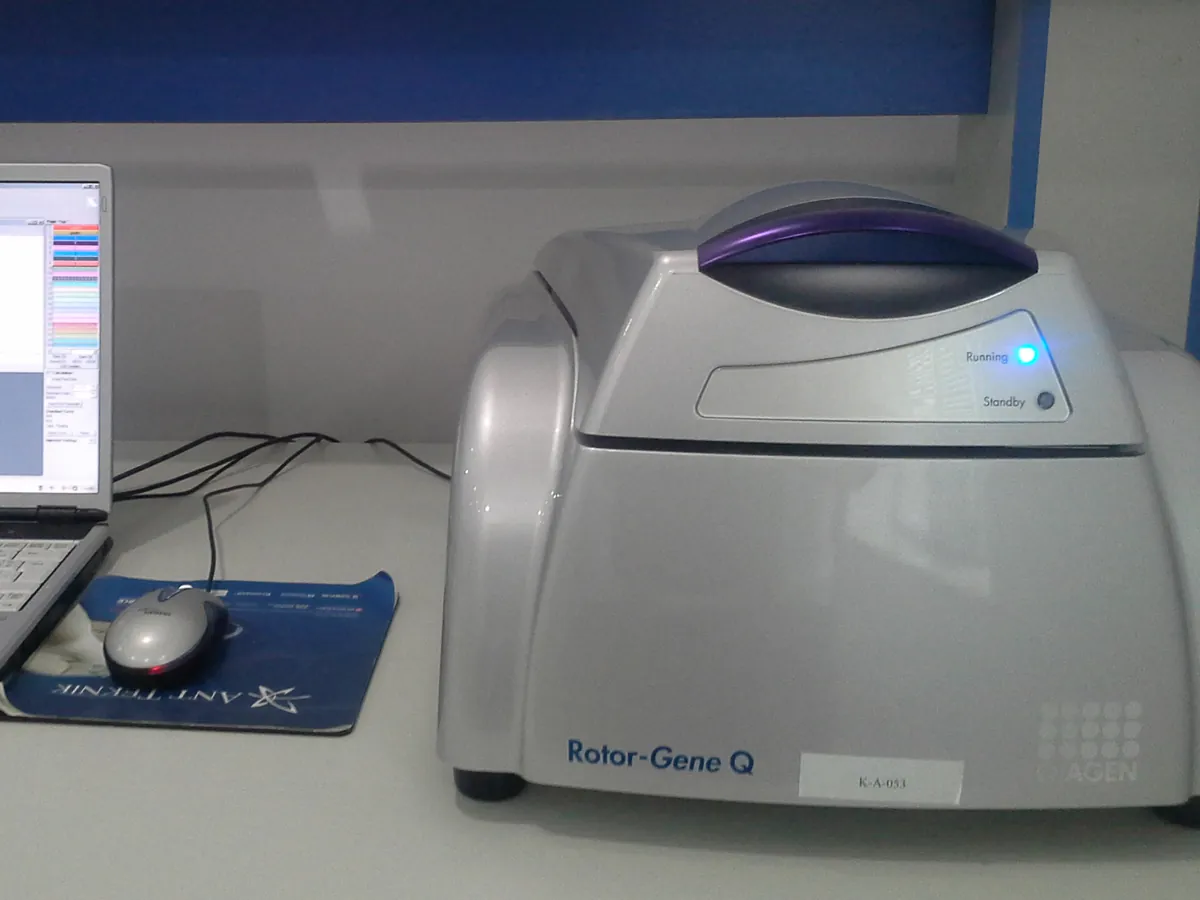
Why this is checked
PCR efficiency depends on accurate denaturation and annealing temperatures. A block that is too cool in some positions gives late or failed amplification there; one that is too hot can reduce primer binding. Edge wells are the most likely to differ, so the check covers corners, edges and centre.
Typically every 6–12 months, after repair or relocation, and when edge effects are suspected, as defined in your SOP.
Learn how the qPCR worksStandards & tools
- Calibrated multi-probe temperature verification kit designed for the block format (traceable to national standards)
- Probe calibration certificate covering about 50–100 °C
- Manufacturer's temperature verification software or test protocol
Prerequisites
- Instrument switched on and warmed up as the manual says
- Block clean and dry
- Probe kit within its calibration date
Step by step
- 1Fit the probe plate or probes in the well positions specified by the kit (typically corners, edges and centre; here 8 positions).
- 2Close the heated lid as instructed by the kit.
- 3Run the verification programme, which holds the block at set points such as 95 °C and 60 °C for a fixed time.
- 4Record the stabilised reading at each position for each set point.
- 5Calculate the mean, the deviation of the mean from set point (accuracy) and the max − min range (uniformity).
- 6Compare with the manufacturer's specification and your SOP.
Example observation table
| Set point (°C) | Positions read | Mean (°C) | Mean − set (°C) | Max − min (°C) | Result |
|---|---|---|---|---|---|
| 95.0 | 8 | 95.03 | +0.03 | 0.38 | Pass |
| 60.0 | 8 | 60.02 | +0.02 | 0.22 | Pass |
How to calculate the result
- 1
Readings at 95 °C: 95.12, 95.05, 94.88, 95.20, 94.95, 95.10, 94.82, 95.08 °C
- 2Mean = 760.20 ÷ 8 = 95.025 ≈ 95.03 °C; accuracy = 95.03 − 95.00 = +0.03 °C
- 3
Uniformity = 95.20 − 94.82 = 0.38 °C
- 4
Readings at 60 °C: mean 60.02 °C, range 60.12 − 59.90 = 0.22 °C
Pass if
- Accuracy typically within about ±0.25–0.5 °C of set point, per the manufacturer's specification
- Uniformity typically within about 0.5–1.0 °C (max − min) at 95 °C, per the manufacturer's specification
- All positions individually within the limits set in your SOP
What to do
- Label the instrument out of use for GMP assays.
- Check the probe fit and repeat once.
- If confirmed, call service for block adjustment or replacement.
- Assess assays run since the last passing check, especially those using edge wells.
Other qPCR calibrations
LimsPulse schedules this calibration, records the result against limits, and blocks the instrument everywhere if it fails or goes overdue.