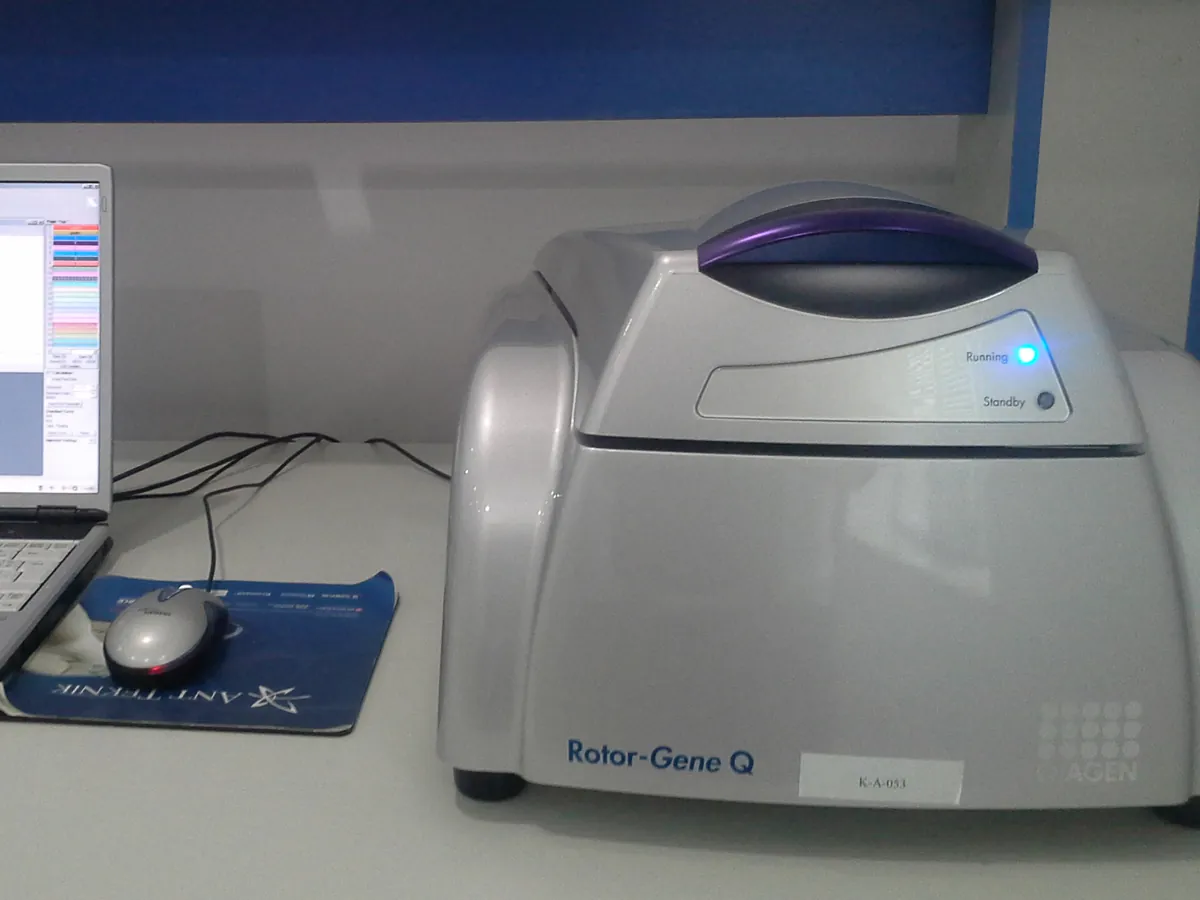
Real-time PCR (qPCR) system
A thermal cycler with a built-in fluorescence reader. It copies a chosen DNA sequence cycle by cycle and measures the fluorescence in every well after each cycle, so the starting amount of DNA can be calculated from a standard curve.
- Biotechnology
- Biopharmaceutical
- Cell and gene therapy
- Academic research
- Agricultural biotech
- Food authenticity
Test your qPCR knowledge
Multiple-choice questions
Pick an answer to see whether you are right and why.
Q1. What does a lower Cq (Ct) value in qPCR indicate?
basicQ2. A standard curve has a slope of −3.32. What is the amplification efficiency?
intermediateQ3. What is the purpose of a no-template control (NTC)?
basicQ4. Why is a passive reference dye such as ROX included in many qPCR master mixes?
intermediateQ5. Why are pure-dye calibrations needed on a multi-channel qPCR instrument?
intermediateQ6. In a block uniformity check at 95 °C, the readings range from 94.82 to 95.20 °C. What is the uniformity (max − min)?
advancedQ7. In a dye-based (SYBR Green) assay, what does a single sharp melt-curve peak show?
basic
Viva questions
Think of your answer first, then open it to compare.
1. How would you design a qPCR run to quantify residual host cell DNA in a drug substance?
Use a validated extraction, a standard curve of host genomic DNA (typically 5 levels, 10-fold steps) in replicate, NTCs, an extraction blank, and samples spiked with a known DNA amount to measure extraction recovery and inhibition. Accept the run on efficiency, r², NTCs and spike recovery, then report DNA per dose or per mg protein against the specification.
2. What steps would you take to prevent contamination in a qPCR lab?
Separate areas (and ideally equipment) for reagent set-up, sample handling and amplification; one-way workflow; aliquoted reagents; filter tips; never open used plates in pre-PCR areas; regular cleaning with DNA-decontaminating solutions; and routine NTCs to detect problems.
3. Edge wells give later Cq values than centre wells for the same sample. How do you investigate?
Check sealing and evaporation, heated lid pressure, and pipetting. Run a block temperature uniformity verification with a calibrated probe kit, and a uniform plate of the same template to map Cq across the block. If uniformity is out of specification, take the instrument out of use and have it serviced, then assess affected results.
Keep every qPCR in control: usage logs, calibration and maintenance schedules, and automatic blocking of overdue instruments.