Polarimeter
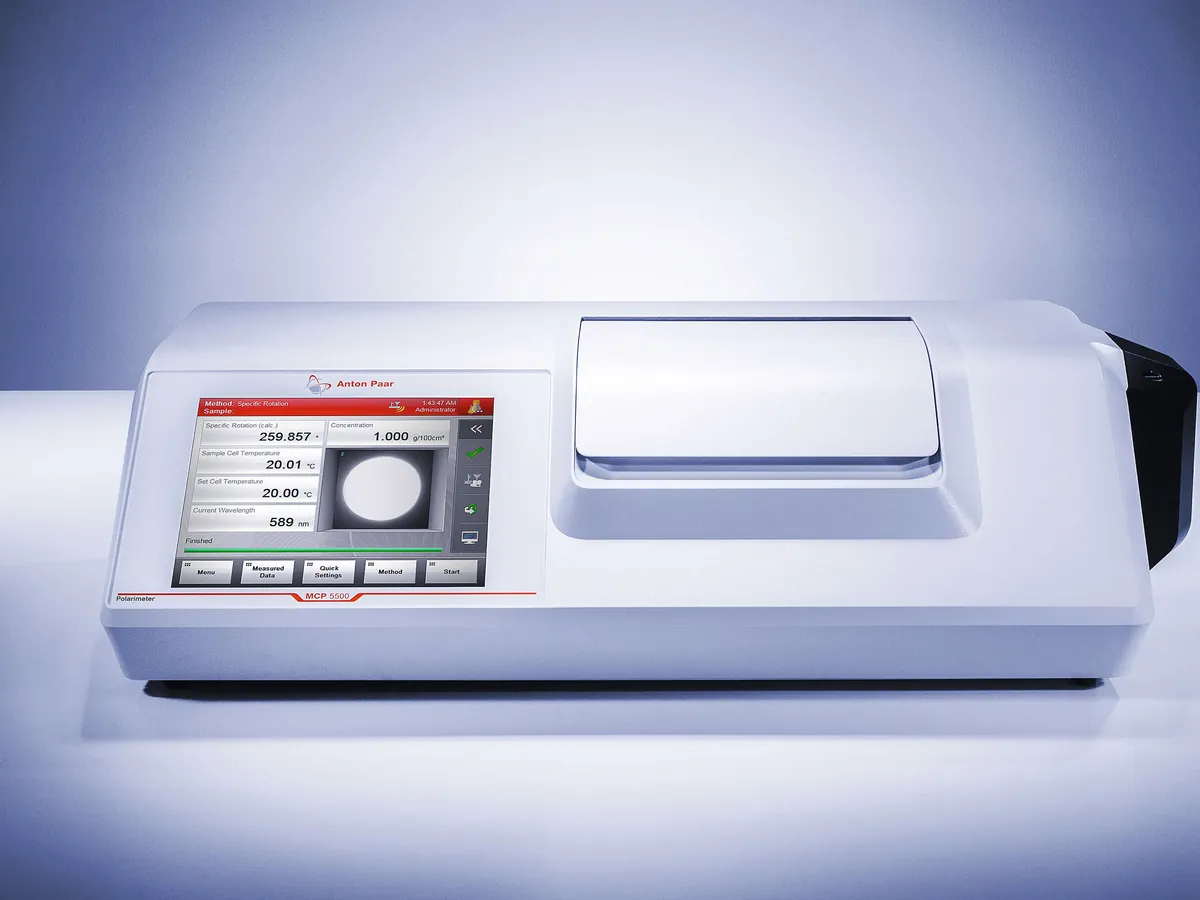
Measures how much a solution of a chiral substance rotates the plane of polarised light. The result is used to calculate specific optical rotation, an identity and purity test for many APIs.
- Pharmaceutical
- Food & sugar
- Flavours & fragrances
- Chemicals
- Academic research
What is Polarimeter?
Many drug substances are chiral: the molecule and its mirror image are different compounds. A solution of one form turns the plane of polarised light in one direction. A polarimeter measures this angle of rotation, in degrees.
In QC the observed rotation is converted into specific optical rotation, [α], which takes account of the concentration and the length of the tube. The monograph gives a range for [α]. A result inside the range helps confirm the identity of the substance and shows that the wrong enantiomer, or a racemic mixture, has not been supplied.
Modern automatic polarimeters use an LED with a filter at the sodium D line (589 nm), a temperature-controlled sample cell and an electronic detector. They read to 0.001° and print or transfer the result directly, replacing the old visual half-shadow instruments.
Used for
- Specific optical rotation of APIs and excipients for identification and purity
- Checking the enantiomeric form of chiral raw materials (for example amino acids and sugars)
- Assay of sugars such as sucrose and dextrose by optical rotation
- Monitoring chiral reactions and resolution steps in API manufacture
- Testing optically active excipients such as dextran or tartaric acid
How it works
- 01
Light source
An LED or sodium lamp gives light at 589 nm (the sodium D line), selected by an interference filter.
- 02
Polariser
A polarising prism or film produces plane-polarised light.
- 03
Sample tube
The light passes through a tube of known length (usually 1 or 2 dm) filled with the solution, held at 20 °C or 25 °C.
- 04
Rotation
The chiral molecules turn the plane of polarisation by an angle α, clockwise (+) or anticlockwise (−).
- 05
Analyser and detector
A motor turns the analyser, or a Faraday modulator measures the angle, until the detector signal matches the null position.
- 06
Result
The instrument displays α in degrees and can calculate [α] from the entered concentration and tube length.
Advantages
- Fast, simple and non-destructive
- Small sample volume with micro tubes
- High resolution (0.001°) and good repeatability on automatic models
- Built-in temperature control removes a major source of error
- Specific to optically active compounds, so a useful identity check
Limitations
- Only works for optically active (chiral) substances
- Rotation depends strongly on temperature, wavelength, solvent and concentration
- Bubbles, particles or turbid solutions scatter light and give wrong readings
- Not very sensitive to small amounts of the other enantiomer; chiral HPLC is better for enantiomeric purity
- Coloured or strongly absorbing solutions reduce the light reaching the detector
2 calibration procedures
Methods that use Polarimeter
Keep every Polarimeter in control: usage logs, calibration and maintenance schedules, and automatic blocking of overdue instruments.