Polarimeter
Measures how much a solution of a chiral substance rotates the plane of polarised light. The result is used to calculate specific optical rotation, an identity and purity test for many APIs.
- Pharmaceutical
- Food & sugar
- Flavours & fragrances
- Chemicals
- Academic research
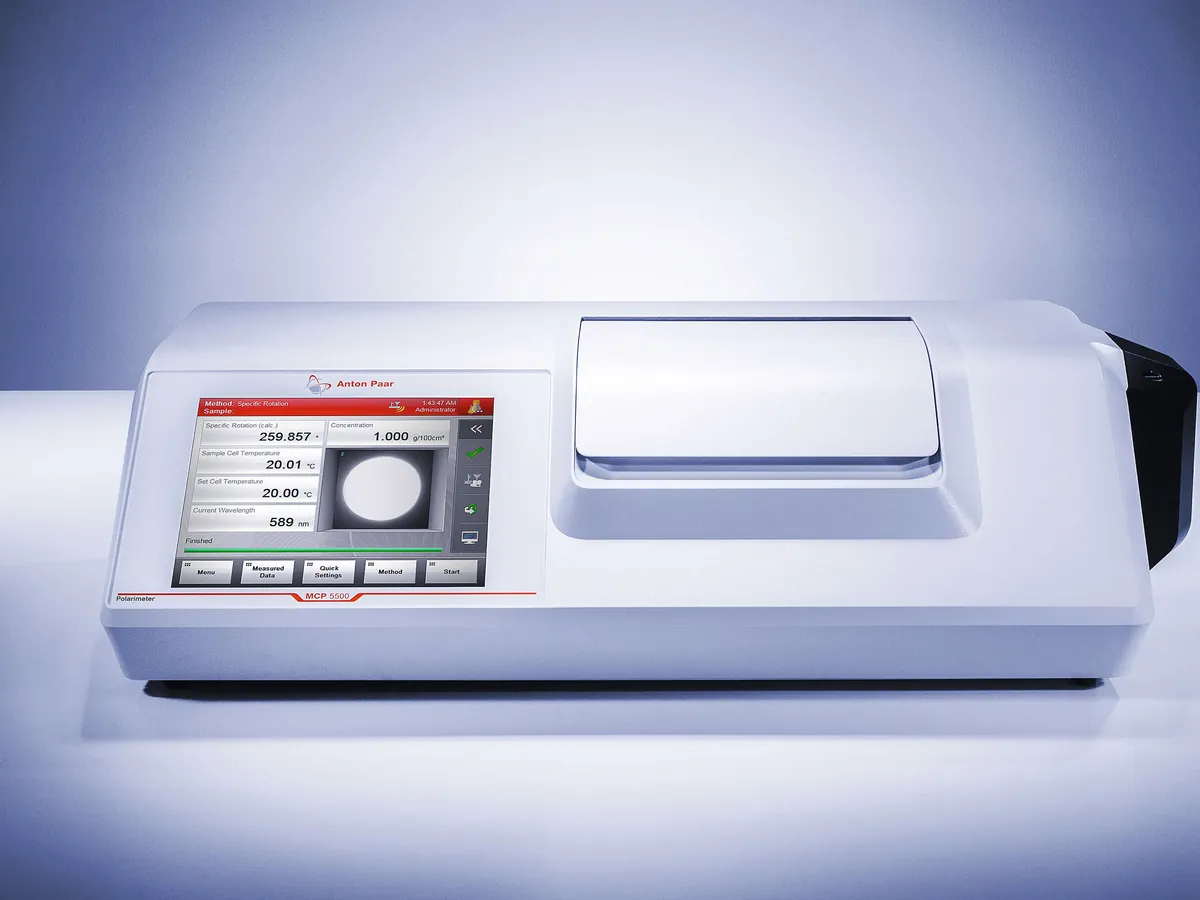
How Polarimeter works
Light from the source passes through a polariser, which lets through only light vibrating in one plane. When this plane-polarised light passes through a solution of a chiral compound, the plane is turned by an angle α. A second polariser, the analyser, is rotated until the light reaching the detector reaches the reference condition. The angle the analyser had to turn is the observed optical rotation.
The path of a sample
- 01
Light source
An LED or sodium lamp gives light at 589 nm (the sodium D line), selected by an interference filter.
- 02
Polariser
A polarising prism or film produces plane-polarised light.
- 03
Sample tube
The light passes through a tube of known length (usually 1 or 2 dm) filled with the solution, held at 20 °C or 25 °C.
- 04
Rotation
The chiral molecules turn the plane of polarisation by an angle α, clockwise (+) or anticlockwise (−).
- 05
Analyser and detector
A motor turns the analyser, or a Faraday modulator measures the angle, until the detector signal matches the null position.
- 06
Result
The instrument displays α in degrees and can calculate [α] from the entered concentration and tube length.
Main parts and what they do
Light source
LED or sodium lamp with filters for 589 nm; some models offer extra wavelengths such as 546 nm.
Polariser
Produces plane-polarised light from the source beam.
Sample tube (cell)
Glass or stainless-steel tube of fixed length, usually 100 mm (1 dm) or 200 mm (2 dm), with glass end windows.
Temperature control
Peltier jacket or water jacket that holds the sample at 20 °C or 25 °C, with a temperature probe.
Analyser
Second polariser that is turned to find the angle of rotation.
Faraday modulator / servo motor
Modulates the polarisation plane and drives the analyser to the null position in automatic instruments.
Detector and electronics
Photodiode or photomultiplier that measures light intensity; electronics calculate and display α.
Quartz control plates
Certified plates for routine checks and calibration of the angular scale.
Terms every analyst should know
Optical rotation (α)
The measured angle, in degrees, by which a sample turns plane-polarised light.
Specific optical rotation [α]
Rotation normalised for tube length and concentration: [α] = 100 × α ÷ (l × c), with l in dm and c in g/100 mL.
Dextrorotatory and laevorotatory
Clockwise rotation, seen by an observer looking towards the light source, is positive (+, dextro). Anticlockwise is negative (−, laevo).
Wavelength and temperature
Rotation changes with wavelength and temperature, so both are stated, for example [α] at 20 °C and 589 nm (D line).
Quartz control plate
A certified quartz plate with a known rotation, used to check the scale of the instrument.
Keep every Polarimeter in control: usage logs, calibration and maintenance schedules, and automatic blocking of overdue instruments.