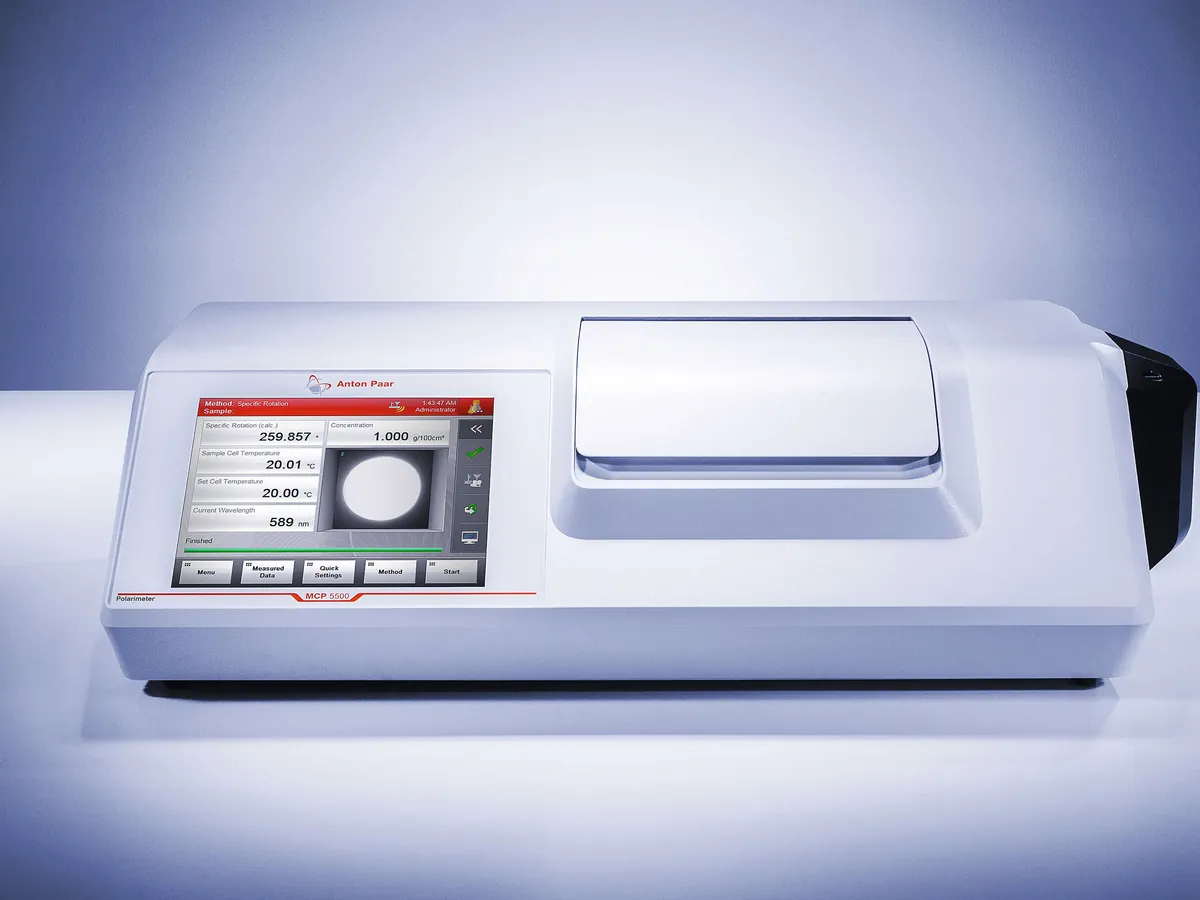
Polarimeter
Measures how much a solution of a chiral substance rotates the plane of polarised light. The result is used to calculate specific optical rotation, an identity and purity test for many APIs.
- Pharmaceutical
- Food & sugar
- Flavours & fragrances
- Chemicals
- Academic research
Test your Polarimeter knowledge
Multiple-choice questions
Pick an answer to see whether you are right and why.
Q1. The usual wavelength for pharmacopoeial optical rotation is:
basicQ2. A substance that rotates polarised light clockwise is called:
basicQ3. In [α] = 100 × α ÷ (l × c), the tube length l is expressed in:
intermediateQ4. What is used to check the angle scale of a polarimeter?
intermediateQ5. A racemic mixture shows an optical rotation of:
intermediateQ6. A sugar solution's rotation changes slowly for some minutes after it is prepared. This is called:
advancedQ7. Which problem most often causes unstable polarimeter readings?
basic
Viva questions
Think of your answer first, then open it to compare.
1. Why is specific optical rotation used instead of the observed rotation?
Observed rotation depends on how much substance is in the light path, which depends on concentration and tube length. Specific rotation divides these out, so it is a property of the substance that can be compared with the monograph range.
2. Which factors affect the optical rotation of a solution?
The nature of the substance, concentration, tube length, wavelength, temperature and solvent. Some substances also change with time (mutarotation) or pH. This is why the monograph fixes all these conditions.
3. Why is a polarimeter a poor tool for measuring a small amount of the wrong enantiomer?
One percent of the opposite enantiomer reduces the rotation by only about two percent, which is close to the normal variation from weighing, temperature and LOD. Chiral HPLC separates the enantiomers and can measure low levels directly.
Keep every Polarimeter in control: usage logs, calibration and maintenance schedules, and automatic blocking of overdue instruments.