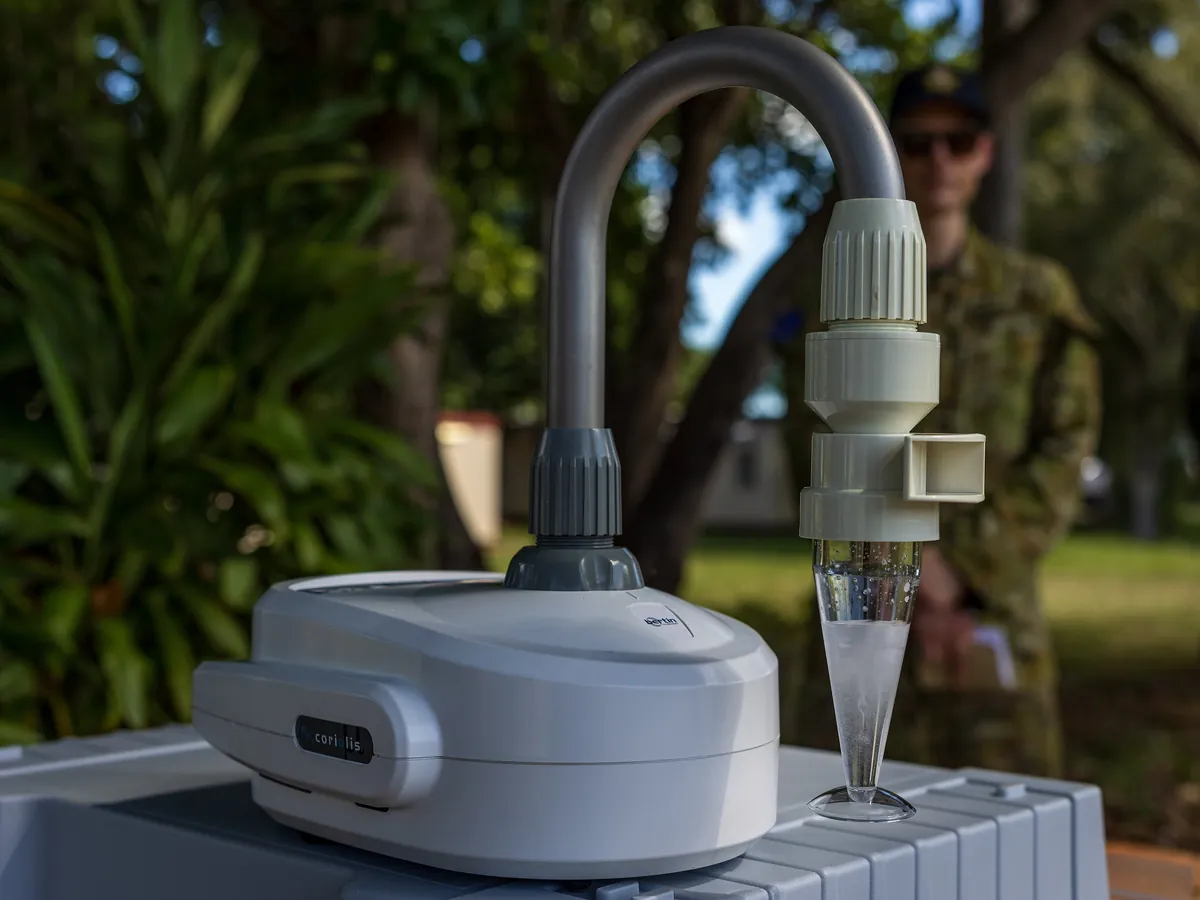
Microbial air sampler (active air sampler)
Draws a known volume of air across an agar plate so that airborne microorganisms are collected and can be counted as cfu per m³. Used for active viable air monitoring of clean rooms, isolators and LAF units.
- Pharmaceutical
- Biotech
- Hospitals and compounding pharmacies
- Medical devices
- Food & beverage
What is Air sampler?
Settle plates show what falls onto a surface over time, but they do not tell you how many organisms are in a given volume of air. An active air sampler pulls a measured volume of air, usually 100 L per minute, through a perforated head. The air jets strike the agar surface and microorganisms carried in the air stick to it. After incubation, colonies are counted and expressed as cfu per m³.
The most common types in pharma are sieve impactors (a lid with several hundred small holes over a contact or Petri plate), slit-to-agar samplers (air passes through a narrow slit onto a rotating plate) and centrifugal samplers (air is spun onto an agar strip). Gelatin membrane filtration samplers are also used, especially in isolators.
EU GMP Annex 1 sets action limits in cfu/m³ for each cleanroom grade (for example no growth in Grade A). Results are only valid if the sampler draws the correct volume, so the airflow is calibrated at regular intervals, and the collection efficiency is shown by the manufacturer for different particle sizes.
Used for
- Routine active air monitoring of Grade A–D areas
- Monitoring inside isolators and RABS during aseptic filling and sterility testing
- Qualification of new or modified clean rooms (viable air counts)
- Investigation of contamination events and trends
- Monitoring of LAF units and biosafety cabinets in the QC lab
How it works
- 01
Prepare
Sanitise the sampler head and fit a sterile agar plate in the LAF or clean area.
- 02
Set
Choose the volume (e.g. 1000 L) and any delay before sampling starts.
- 03
Draw air
The fan pulls air through the head at a controlled rate (often 100 L/min).
- 04
Impact
Air jets hit the agar and particles carrying microorganisms stick to it.
- 05
Incubate
The plate is closed, labelled and incubated at the validated temperatures.
- 06
Count
Colonies are counted, corrected if needed and expressed as cfu/m³.
Advantages
- Gives a quantitative result per volume of air (cfu/m³)
- Portable and battery-powered; can be placed close to critical operations
- Programmable volume and delay start; some have remote heads for isolators
- Results can be compared directly with Annex 1 limits
Limitations
- Agar can dry out during long sampling, reducing recovery
- The air jet can stress or kill sensitive organisms (impaction stress)
- Sampler itself can disturb unidirectional airflow if placed badly
- Collection efficiency falls for very small particles (below the d50 cut-off)
- Heads and plates must be handled aseptically to avoid false positives
1 calibration procedure
Methods that use Air sampler
Keep every Air sampler in control: usage logs, calibration and maintenance schedules, and automatic blocking of overdue instruments.