Microbial air sampler (active air sampler)
Draws a known volume of air across an agar plate so that airborne microorganisms are collected and can be counted as cfu per m³. Used for active viable air monitoring of clean rooms, isolators and LAF units.
- Pharmaceutical
- Biotech
- Hospitals and compounding pharmacies
- Medical devices
- Food & beverage
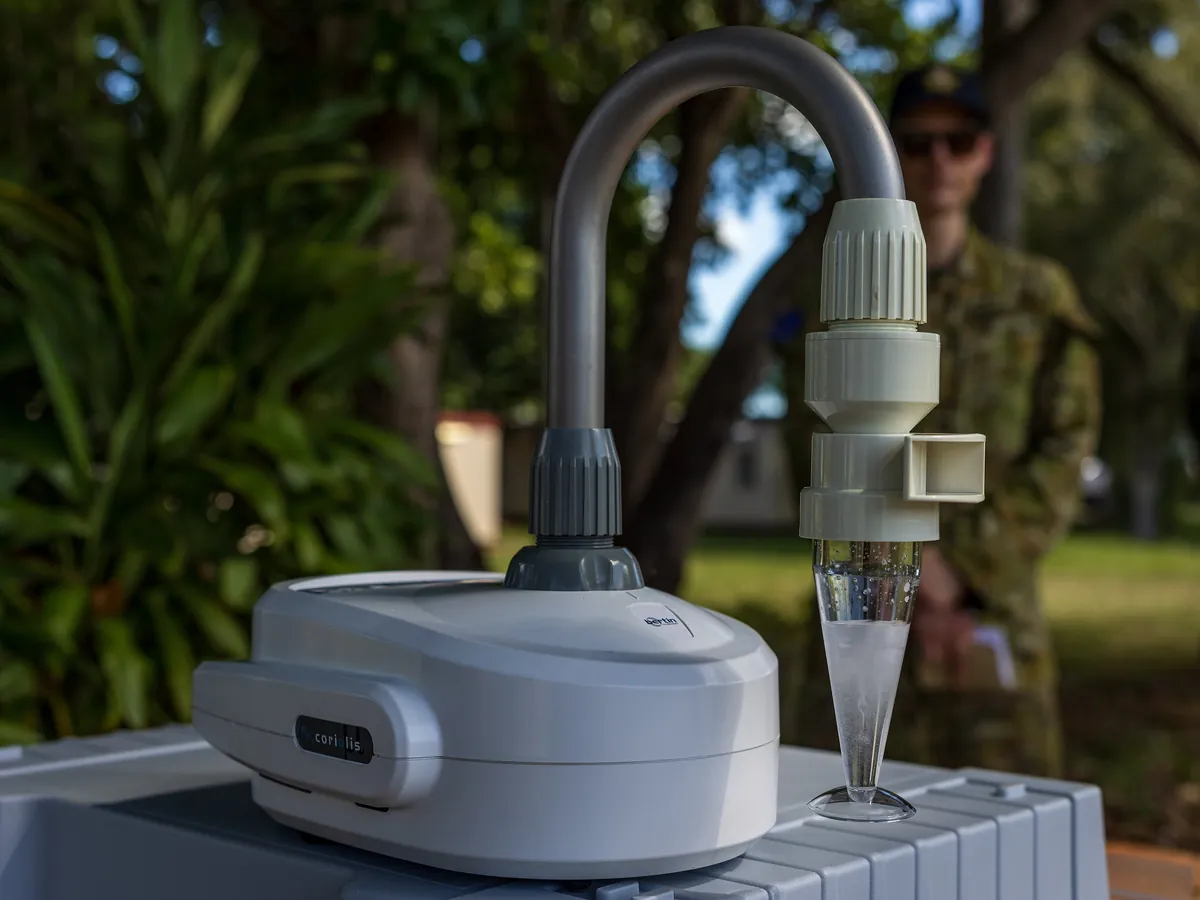
How Air sampler works
A fan pulls air at a controlled flow rate through a perforated head or slit. The air speeds up through the holes and forms jets aimed at the agar. Particles carrying microorganisms are too heavy to follow the air as it turns away, so they impact onto the agar. Volume sampled = flow rate × time, and the count is divided by the volume to give cfu/m³.
The path of a sample
- 01
Prepare
Sanitise the sampler head and fit a sterile agar plate in the LAF or clean area.
- 02
Set
Choose the volume (e.g. 1000 L) and any delay before sampling starts.
- 03
Draw air
The fan pulls air through the head at a controlled rate (often 100 L/min).
- 04
Impact
Air jets hit the agar and particles carrying microorganisms stick to it.
- 05
Incubate
The plate is closed, labelled and incubated at the validated temperatures.
- 06
Count
Colonies are counted, corrected if needed and expressed as cfu/m³.
Main parts and what they do
Perforated head or slit
Creates the air jets that strike the agar; stainless steel or aluminium, autoclavable.
Plate holder
Holds a Petri dish, contact plate or agar strip at a fixed distance from the head.
Fan / pump
Draws air at the set flow rate.
Flow sensor and controller
Measures and holds the flow constant; the part calibrated periodically.
Control panel / display
Sets volume, delay and sample ID; stores sampling records.
Battery and charger
Allows use away from power points in clean areas.
Remote head / isokinetic tubing (some models)
Lets sampling occur inside an isolator while the base stays outside.
Terms every analyst should know
Flow rate and volume
The sampler controls flow, often 100 L/min, so 1 m³ (1000 L) takes 10 minutes. A flow error gives an equal error in cfu/m³.
d50 cut-off
The particle size collected with 50% efficiency. A low d50 (about 1 µm or less) means the sampler catches the small particles that carry bacteria.
Positive-hole correction
In sieve impactors, two organisms passing through the same hole make one colony. A statistical correction table (Feller) converts counts to a probable number; it matters only at high counts.
Impactor types
Sieve, slit-to-agar, centrifugal and filtration samplers differ in efficiency and in stress on organisms; ISO 14698-1 describes how to choose and validate them.
Physical and biological efficiency
Physical efficiency is the share of particles captured; biological efficiency also counts whether organisms survive to grow. Both are part of sampler selection.
Keep every Air sampler in control: usage logs, calibration and maintenance schedules, and automatic blocking of overdue instruments.