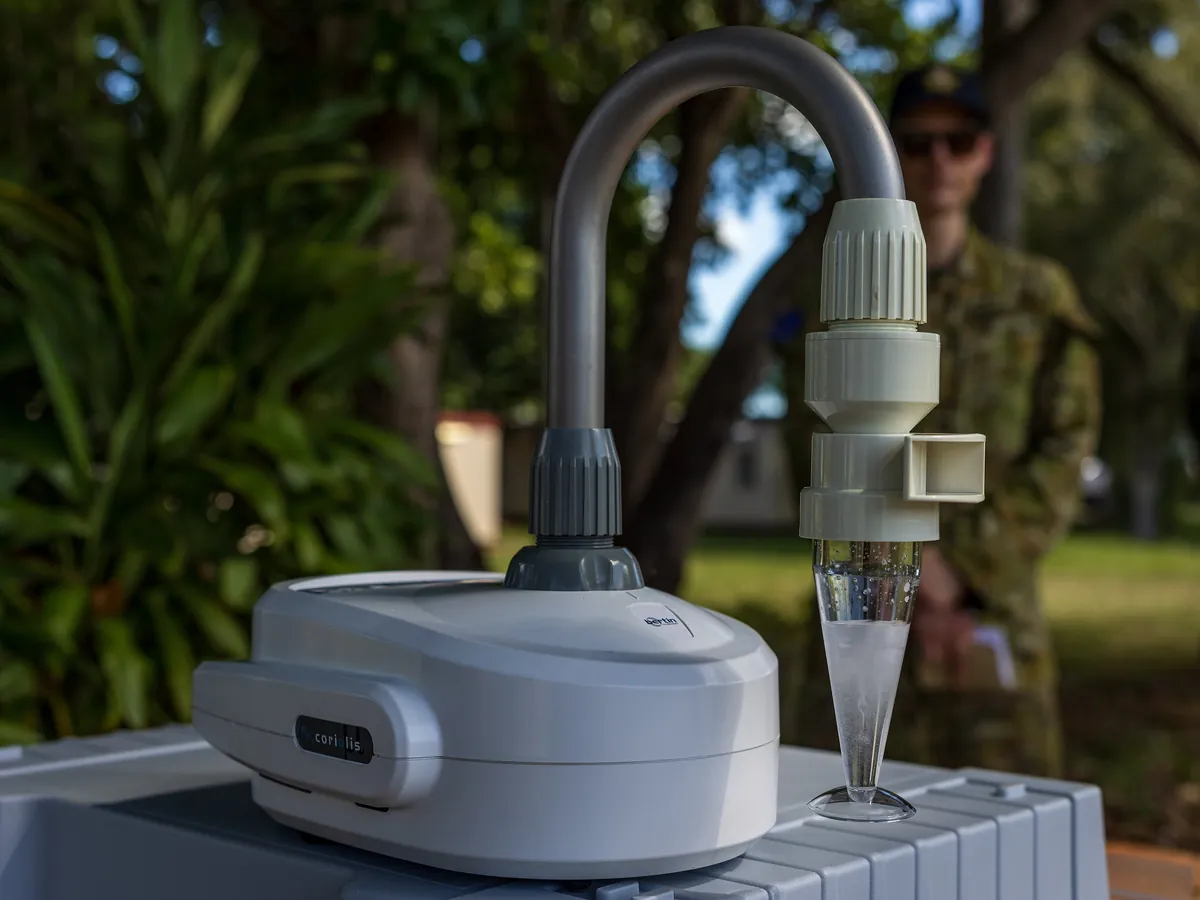
Microbial air sampler (active air sampler)
Draws a known volume of air across an agar plate so that airborne microorganisms are collected and can be counted as cfu per m³. Used for active viable air monitoring of clean rooms, isolators and LAF units.
- Pharmaceutical
- Biotech
- Hospitals and compounding pharmacies
- Medical devices
- Food & beverage
Test your Air sampler knowledge
Multiple-choice questions
Pick an answer to see whether you are right and why.
Q1. Active air sampling results are usually expressed as:
basicQ2. At 100 L/min, how long does it take to sample 1 m³ of air?
basicQ3. If the sampler actually draws 90 L/min instead of 100 L/min, the cfu/m³ result will be:
intermediateQ4. What does the d50 cut-off of an impaction sampler describe?
intermediateQ5. What is the typical Annex 1 action limit for active air samples in Grade A?
basicQ6. Why is a positive-hole correction applied to sieve impactor counts?
advancedQ7. Why must the sampler head be dry after wiping with 70% IPA?
intermediate
Viva questions
Think of your answer first, then open it to compare.
1. Compare settle plates and active air sampling.
Settle plates are passive: they collect organisms that fall onto the agar over up to 4 hours and give cfu per plate per 4 h. Active samplers draw a known volume of air and give cfu/m³. Both are used together in Grade A/B areas because they detect contamination in different ways.
2. How is the airflow of an air sampler calibrated, and why does it matter?
A traceable flow meter is fitted to the head with an adaptor, readings are taken at the nominal flow and compared, typically within ±5%. The cfu/m³ result is calculated from the assumed volume, so any flow error gives an equal error in the result.
3. Calibration shows the sampler flow was 15% low. What do you do?
Take the sampler out of use, adjust or repair and recalibrate. Raise a deviation and assess all results since the last passing calibration: recalculate them for the true volume and check whether any would then exceed alert or action limits, especially in Grade A/B areas.
Keep every Air sampler in control: usage logs, calibration and maintenance schedules, and automatic blocking of overdue instruments.