Melt flow indexer
Melts a thermoplastic in a heated barrel and pushes it through a small standard die under a fixed weight. The mass (or volume) of polymer that flows out in 10 minutes is the melt flow rate, a quick measure of how easily the polymer flows.
- Polymers & plastics
- Packaging
- Pipes & fittings
- Automotive
- Recycling
- Chemicals
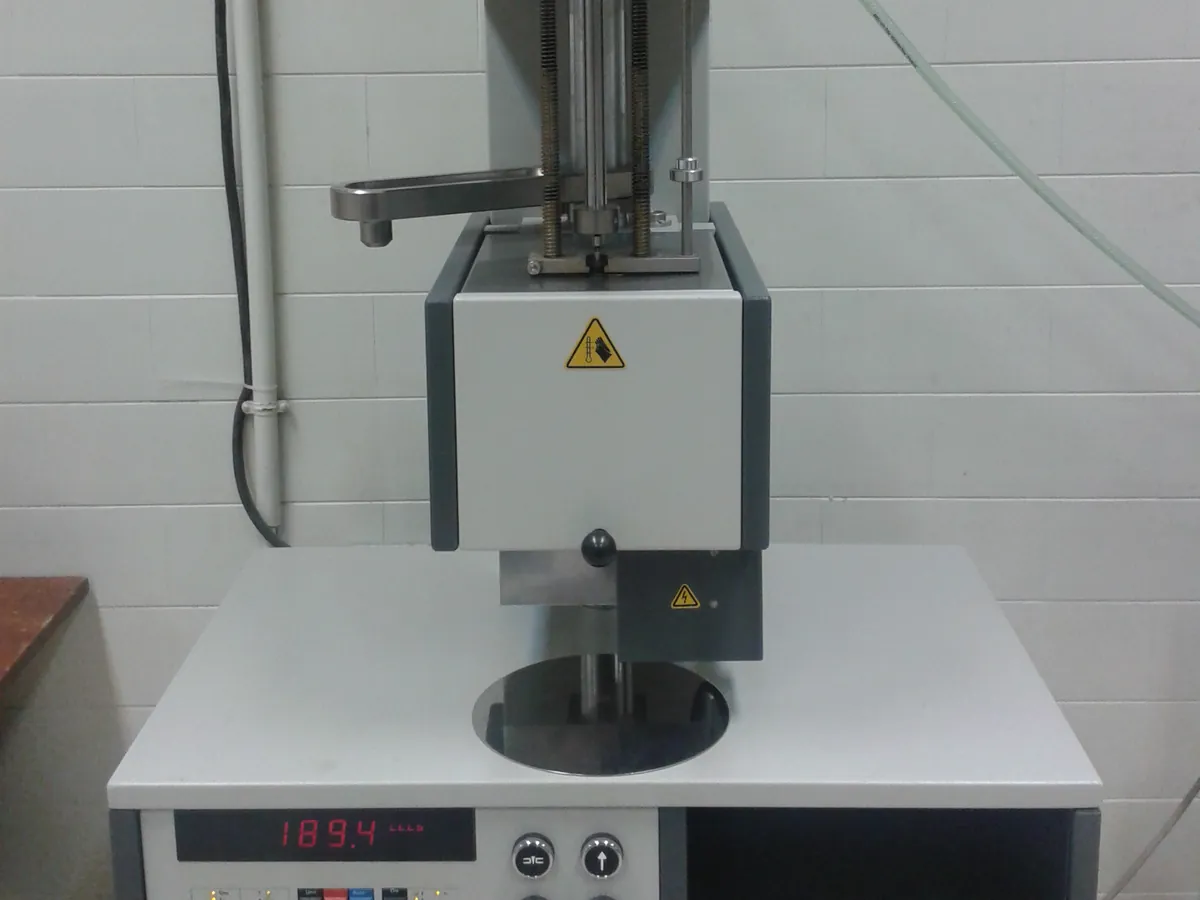
What is MFI tester?
The melt flow indexer, also called an extrusion plastometer, is the most common test instrument in any plastics lab. It measures the melt mass-flow rate (MFR, often called melt flow index or MFI) in grams per 10 minutes, or the melt volume-flow rate (MVR) in cm³ per 10 minutes. The test is described in ISO 1133 and ASTM D1238.
The instrument is simple: a vertical steel barrel held at a precise temperature, a standard die at the bottom, a piston and a set of dead weights. A few grams of granules or powder are loaded, melted for a set preheat time, and then the weight drives the melt through the die. The extrudate is cut at timed intervals and weighed, or the piston travel is measured with an encoder.
MFR is inversely related to melt viscosity and, for a given polymer type, to molecular weight. A high MFR means a low-viscosity, easy-flowing grade (used for injection moulding thin parts); a low MFR means a stiffer, higher-molecular-weight grade (used for pipes, film and blow moulding). Polymer producers print MFR on every certificate of analysis, and converters check it on incoming lots and on regrind.
Used for
- Grade identification and lot release of polyethylene, polypropylene, polystyrene, ABS, polycarbonate and other thermoplastics
- Incoming inspection of resin lots at moulders and extruders
- Checking degradation in regrind, recycled material and moulded parts (MFR rises as chains break)
- Comparing batches of compounds, masterbatches and filled grades
- Flow rate ratio (FRR) at two loads as a simple indicator of molecular weight distribution
- Monitoring the effect of drying, stabilisers or processing temperature on polymer flow
How it works
- 01
Heat
The barrel and die are brought to the test temperature (for example 190 °C for polyethylene, 230 °C for polypropylene) and allowed to stabilise.
- 02
Charge
A weighed charge of a few grams of granules is poured into the barrel and compacted with the packing rod to remove air.
- 03
Preheat
The piston is inserted and the polymer is left to melt and reach the test temperature, typically for 5 minutes.
- 04
Load
The specified weight (for example 2.16 kg) is placed on the piston and the melt starts to flow through the die.
- 05
Cut and time
When the piston reaches its lower reference mark, extrudate cut-offs are taken at fixed time intervals.
- 06
Weigh and calculate
The cut-offs are weighed and the mean mass is scaled to grams per 10 minutes.
Advantages
- Simple, robust and inexpensive compared with a capillary rheometer
- Widely specified, so results are directly comparable with supplier certificates
- Fast: a test typically takes 10–20 minutes including preheat
- Needs only a few grams of sample
- Automatic versions measure MVR and MFR together using piston travel and melt density
Limitations
- A single-point measurement at one low shear rate; it does not describe flow at processing shear rates
- Sensitive to moisture (especially PET, PA and PC), which can cause hydrolysis and bubbles
- Results depend strongly on temperature, load, die condition and cleaning
- Polymers with very different molecular weight distributions can give the same MFR
- Not suitable for thermosets or for materials that degrade quickly at the test temperature
1 calibration procedure
Methods that use MFI tester
Keep every MFI tester in control: usage logs, calibration and maintenance schedules, and automatic blocking of overdue instruments.