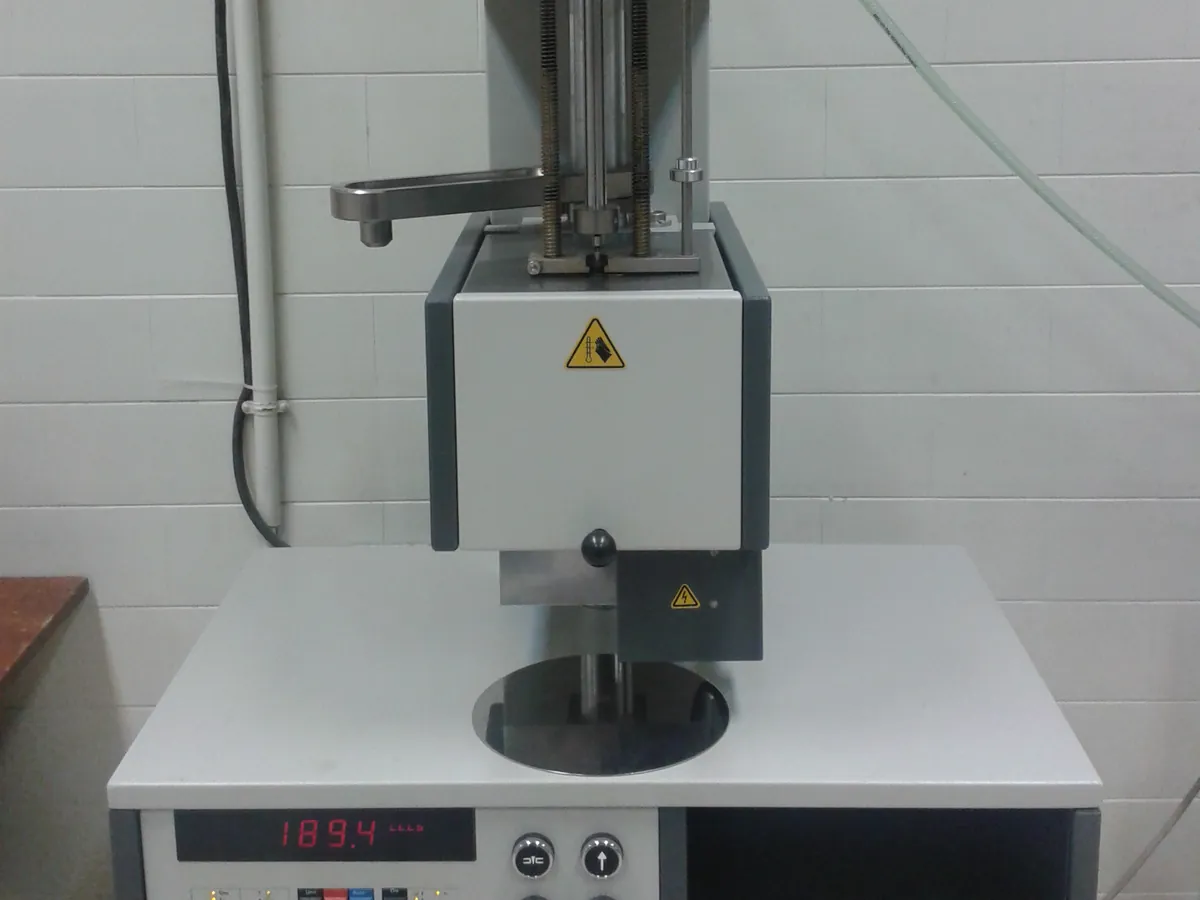
Melt flow indexer
Melts a thermoplastic in a heated barrel and pushes it through a small standard die under a fixed weight. The mass (or volume) of polymer that flows out in 10 minutes is the melt flow rate, a quick measure of how easily the polymer flows.
- Polymers & plastics
- Packaging
- Pipes & fittings
- Automotive
- Recycling
- Chemicals
Test your MFI tester knowledge
Multiple-choice questions
Pick an answer to see whether you are right and why.
Q1. In what units is melt mass-flow rate (MFR) reported?
basicQ2. A polymer grade has a high MFR. What does this usually mean?
basicQ3. What is the standard test condition commonly used for polyethylene?
basicQ4. Cut-offs taken every 20 s have a mean mass of 0.250 g. What is the MFR?
intermediateQ5. What are the nominal bore and length of the standard MFR die?
intermediateQ6. A wet polyamide sample gives a much higher MFR than the CoA. What is the most likely cause?
intermediateQ7. MVR is 10.0 cm³/10 min and melt density is 0.76 g/cm³. What is MFR?
advancedQ8. What does a high flow rate ratio (MFR at 21.6 kg ÷ MFR at 2.16 kg) usually indicate?
advanced
Viva questions
Think of your answer first, then open it to compare.
1. Why is the preheat time strictly controlled in an MFR test?
The polymer must be fully molten and at the test temperature before measuring, but staying hot too long can degrade or crosslink it. A fixed preheat (typically 5 minutes) balances both and makes results comparable.
2. Your MFR result disagrees with the supplier's CoA. What would you check?
Confirm the same condition, procedure (A or B) and standard; check sample drying and representativeness; verify instrument temperature, load and die; run a reference polymer; then exchange samples with the supplier.
3. What does MFR not tell you about a polymer's processing behaviour?
MFR is a single point at a low shear rate. It does not show how viscosity changes at the much higher shear rates in extrusion or moulding, nor elasticity or melt strength. Two grades with the same MFR can process differently; a capillary rheometer gives fuller data.
Keep every MFI tester in control: usage logs, calibration and maintenance schedules, and automatic blocking of overdue instruments.