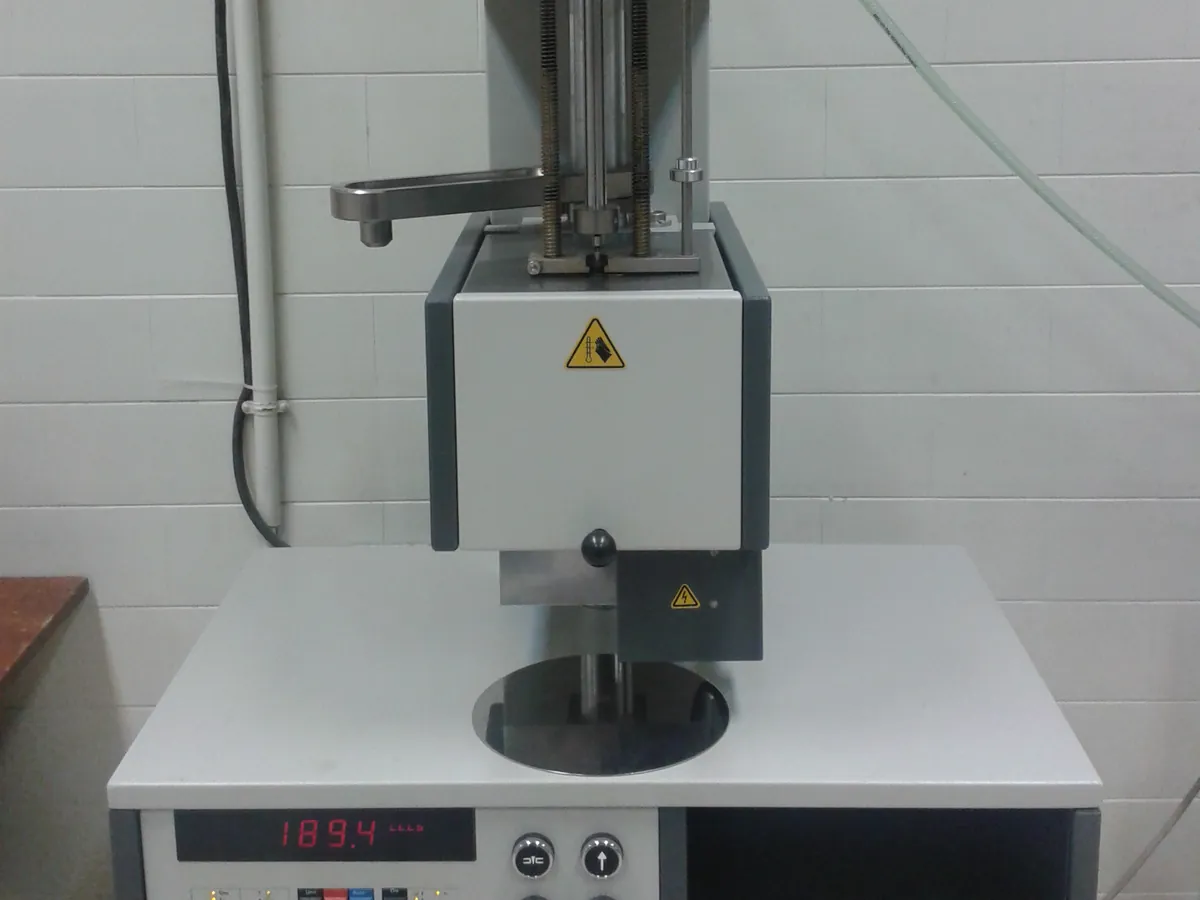
Melt flow indexer
Melts a thermoplastic in a heated barrel and pushes it through a small standard die under a fixed weight. The mass (or volume) of polymer that flows out in 10 minutes is the melt flow rate, a quick measure of how easily the polymer flows.
- Polymers & plastics
- Packaging
- Pipes & fittings
- Automotive
- Recycling
- Chemicals
How MFI tester works
A fixed load acting on a piston produces a fixed pressure on the molten polymer in the barrel. The melt flows through a die of standard length (8.000 mm) and bore (2.095 mm). The mass extruded in a measured time, scaled to 10 minutes, is the MFR. Because the shear stress is fixed by the load, a lower viscosity melt flows faster and gives a higher MFR.
The path of a sample
- 01
Heat
The barrel and die are brought to the test temperature (for example 190 °C for polyethylene, 230 °C for polypropylene) and allowed to stabilise.
- 02
Charge
A weighed charge of a few grams of granules is poured into the barrel and compacted with the packing rod to remove air.
- 03
Preheat
The piston is inserted and the polymer is left to melt and reach the test temperature, typically for 5 minutes.
- 04
Load
The specified weight (for example 2.16 kg) is placed on the piston and the melt starts to flow through the die.
- 05
Cut and time
When the piston reaches its lower reference mark, extrudate cut-offs are taken at fixed time intervals.
- 06
Weigh and calculate
The cut-offs are weighed and the mean mass is scaled to grams per 10 minutes.
Main parts and what they do
Barrel (cylinder)
Hardened steel bore, typically 9.550 mm in diameter, heated by a band heater and well insulated.
Die
Tungsten carbide or hardened steel die with a bore of 2.095 mm and length of 8.000 mm, held at the bottom of the barrel.
Piston
Steel piston with a head slightly smaller than the bore and reference marks that show the measuring zone.
Weights
Dead weights which, with the piston, make up the nominal load (for example 2.16, 5 or 21.6 kg).
Temperature controller and sensor
PID controller with a platinum resistance thermometer near the die to hold the melt temperature.
Cutter and timer
Manual or automatic blade that cuts the extrudate at set intervals.
Displacement encoder (Procedure B)
Measures piston travel against time for automatic MVR calculation.
Cleaning tools
Barrel cleaning rod with cotton patches, die drill/reamer and die plug.
Terms every analyst should know
MFR and MVR
MFR is mass flow in g/10 min. MVR is volume flow in cm³/10 min. They are linked by melt density: MFR = MVR × melt density.
Test condition
Each polymer has a standard temperature and load, written like 190 °C/2.16 kg. Results at different conditions cannot be compared directly.
Inverse link to viscosity
Higher MFR means lower melt viscosity and usually lower average molecular weight within one polymer family.
Flow rate ratio
MFR at a high load divided by MFR at a low load (for example 21.6 kg ÷ 2.16 kg). A higher ratio usually means a broader molecular weight distribution.
Thermal stability
Degradation or crosslinking during the preheat changes the result, so preheat time and drying are strictly controlled.
Procedure A and B
Procedure A cuts and weighs extrudate manually. Procedure B measures piston travel against time and calculates MVR, and MFR if melt density is known.
Keep every MFI tester in control: usage logs, calibration and maintenance schedules, and automatic blocking of overdue instruments.