Liquid Chromatography–Mass Spectrometry (LC-MS / LC-MS/MS)
Couples an HPLC or UHPLC to a mass spectrometer, so each separated component is identified by its mass and measured with very high sensitivity. Used for impurity identification, nitrosamines and other trace impurities, and bioanalysis.
- Pharmaceutical
- Biopharmaceutical
- Clinical and bioanalytical labs
- Food safety
- Environmental
- Forensic and toxicology
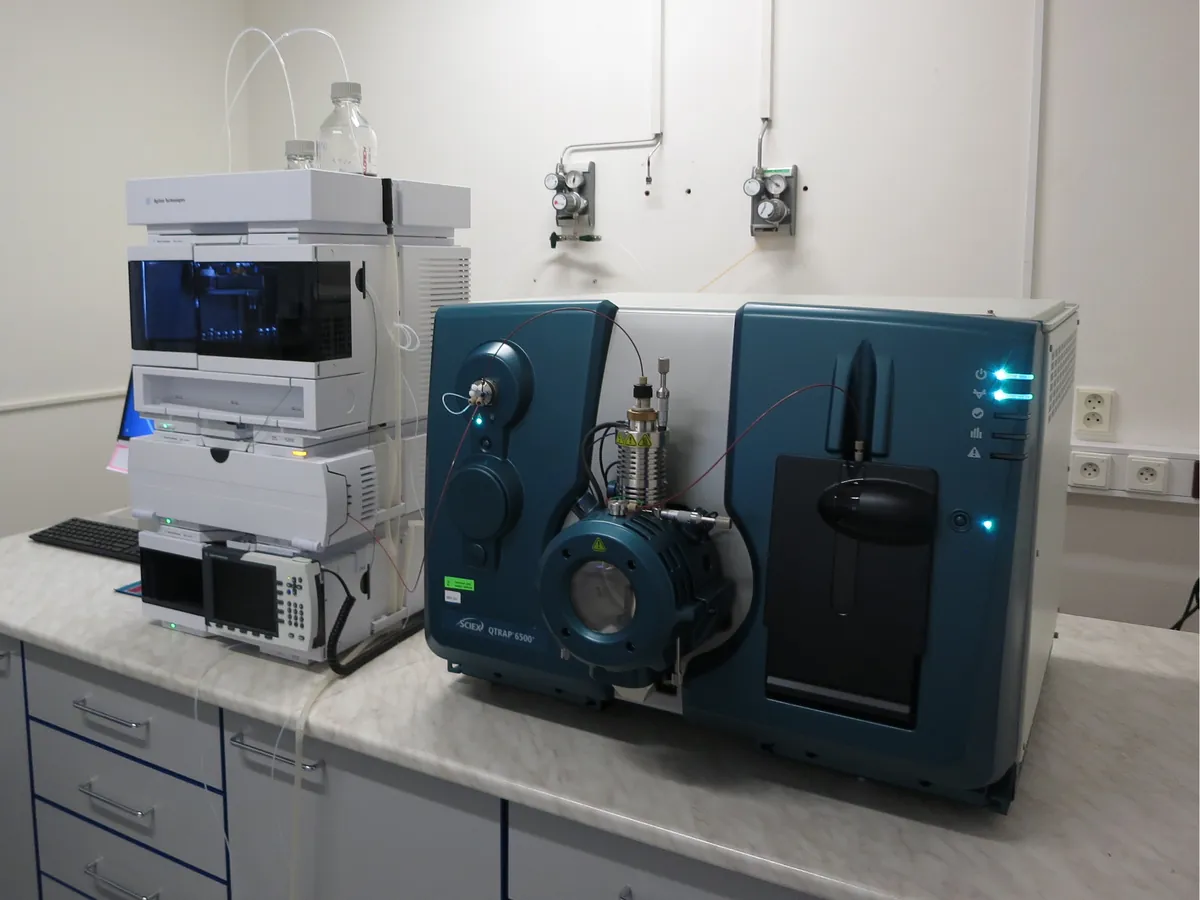
What is LC-MS?
An LC-MS separates the sample by liquid chromatography exactly as an HPLC does, but instead of (or as well as) a UV detector, the column outlet goes into a mass spectrometer. The mass spectrometer turns molecules into gas-phase ions, sorts the ions by their mass-to-charge ratio (m/z) and counts them. The result is a chromatogram where every point also carries a mass spectrum.
The interface between liquid and vacuum is the ion source. Electrospray ionisation (ESI) is by far the most common: the column effluent is sprayed through a charged needle, the droplets evaporate in heated gas, and protonated [M+H]⁺ or deprotonated [M−H]⁻ ions are released. Atmospheric-pressure chemical ionisation (APCI) suits less polar, smaller molecules.
Different mass analysers suit different jobs. A single quadrupole confirms the mass of a peak. A triple quadrupole (LC-MS/MS) in multiple reaction monitoring (MRM) mode is the standard for trace quantitation, such as nitrosamine and mutagenic impurity testing and bioanalysis. High-resolution instruments (Q-TOF, Orbitrap) measure mass to a few ppm and are used to work out the elemental formula of unknown impurities and degradation products.
Used for
- Identification of unknown impurities and degradation products (forced degradation, stability)
- Trace quantitation of nitrosamines and other mutagenic impurities
- Peak identity confirmation during method development and OOS investigations
- Bioanalysis (drug levels in plasma) and pharmacokinetic studies
- Peptide mapping and intact mass of biologics
- Extractables and leachables from packaging and process equipment
How it works
- 01
LC separation
An HPLC or UHPLC separates the sample using volatile mobile phases such as formic acid, ammonium formate or ammonium acetate.
- 02
Ion source
ESI or APCI converts molecules in the effluent into gas-phase ions with the help of heated nitrogen and high voltage.
- 03
Ion optics
Cones, capillaries and ion guides move the ions from atmospheric pressure into high vacuum and remove solvent and neutral molecules.
- 04
Mass analyser
A quadrupole, time-of-flight or Orbitrap analyser separates the ions by m/z.
- 05
Collision cell (MS/MS)
In tandem instruments, selected ions are fragmented with an inert gas and product ions are analysed.
- 06
Detector and software
An electron multiplier or image-current detector records the ions; the software builds chromatograms and spectra.
Advantages
- Identifies compounds by mass, not just retention time
- Very high sensitivity and selectivity (pg levels in MRM mode)
- Measures co-eluting compounds if their masses differ
- High-resolution instruments give elemental formulae of unknowns
- Works for compounds without a UV chromophore
Limitations
- High purchase, service and nitrogen running cost
- Needs volatile mobile phases; phosphate and other non-volatile buffers cannot be used
- Matrix effects (ion suppression or enhancement) affect quantitation
- Response varies greatly between compounds; a standard is needed for each analyte
- Complex instrument needing skilled operators and careful data review
1 calibration procedure
Methods that use LC-MS
Keep every LC-MS in control: usage logs, calibration and maintenance schedules, and automatic blocking of overdue instruments.