Liquid Chromatography–Mass Spectrometry (LC-MS / LC-MS/MS)
Couples an HPLC or UHPLC to a mass spectrometer, so each separated component is identified by its mass and measured with very high sensitivity. Used for impurity identification, nitrosamines and other trace impurities, and bioanalysis.
- Pharmaceutical
- Biopharmaceutical
- Clinical and bioanalytical labs
- Food safety
- Environmental
- Forensic and toxicology
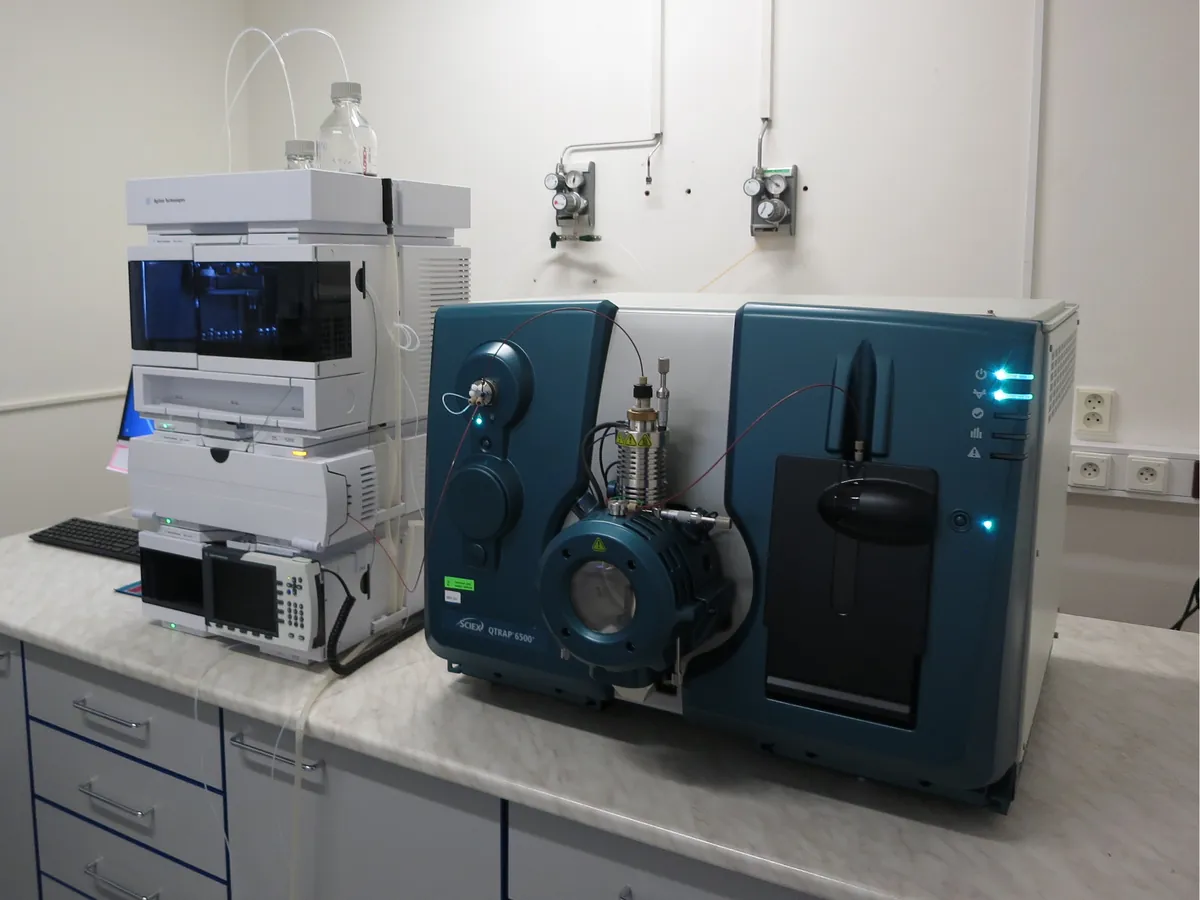
How LC-MS works
Components separated by the LC enter an ion source where they are ionised at atmospheric pressure. The ions are guided into a high vacuum, separated by mass-to-charge ratio in the mass analyser and counted by a detector. In tandem MS, a selected precursor ion is fragmented in a collision cell and specific product ions are monitored for extra selectivity.
The path of a sample
- 01
LC separation
An HPLC or UHPLC separates the sample using volatile mobile phases such as formic acid, ammonium formate or ammonium acetate.
- 02
Ion source
ESI or APCI converts molecules in the effluent into gas-phase ions with the help of heated nitrogen and high voltage.
- 03
Ion optics
Cones, capillaries and ion guides move the ions from atmospheric pressure into high vacuum and remove solvent and neutral molecules.
- 04
Mass analyser
A quadrupole, time-of-flight or Orbitrap analyser separates the ions by m/z.
- 05
Collision cell (MS/MS)
In tandem instruments, selected ions are fragmented with an inert gas and product ions are analysed.
- 06
Detector and software
An electron multiplier or image-current detector records the ions; the software builds chromatograms and spectra.
Main parts and what they do
HPLC / UHPLC front end
Separates the sample; often uses narrow-bore columns and low flows that suit the ion source.
Ion source (ESI / APCI)
Ionises the analytes using high voltage, heated nebuliser and drying gas.
Divert valve
Sends salts and the solvent front to waste so they do not contaminate the source.
Vacuum system
Rough (fore) pumps and turbomolecular pumps keep the analyser at high vacuum.
Mass analyser
Quadrupole, triple quadrupole, Q-TOF or Orbitrap, depending on whether quantitation or identification is the goal.
Detector
Electron multiplier or microchannel plate counts ions; Orbitraps detect an image current.
Gas supply
Nitrogen generator or cylinders for nebulising and drying gas; argon or nitrogen for collision gas.
Data system
Controls tuning and acquisition, processes spectra and quantitation, and keeps a compliant audit trail.
Terms every analyst should know
Mass-to-charge ratio (m/z)
What a mass spectrometer actually measures. Small molecules usually carry one charge, so m/z equals mass plus or minus the added proton.
Electrospray ionisation
A soft ionisation method that produces mostly intact molecular ions; ideal for polar and large molecules.
MRM (multiple reaction monitoring)
A triple-quadrupole mode that monitors a specific precursor-to-product ion transition; extremely selective and sensitive for quantitation.
Mass accuracy
How close the measured m/z is to the true value, usually expressed in ppm for high-resolution instruments.
Resolution (MS)
The ability to separate ions of close m/z; unit resolution for quadrupoles, tens of thousands or more for TOF and Orbitrap.
Matrix effect
Co-eluting matrix components that reduce (ion suppression) or increase the analyte signal; controlled by cleaner samples, better separation or isotope-labelled internal standards.
Keep every LC-MS in control: usage logs, calibration and maintenance schedules, and automatic blocking of overdue instruments.