Karl Fischer Titrator (Volumetric)
Measures the water content of a sample by titrating it with an iodine-containing Karl Fischer reagent from a motorised burette. The standard method for water in APIs, excipients and many finished products.
- Pharmaceutical
- Chemicals
- Food & beverage
- Petrochemicals
- Cosmetics
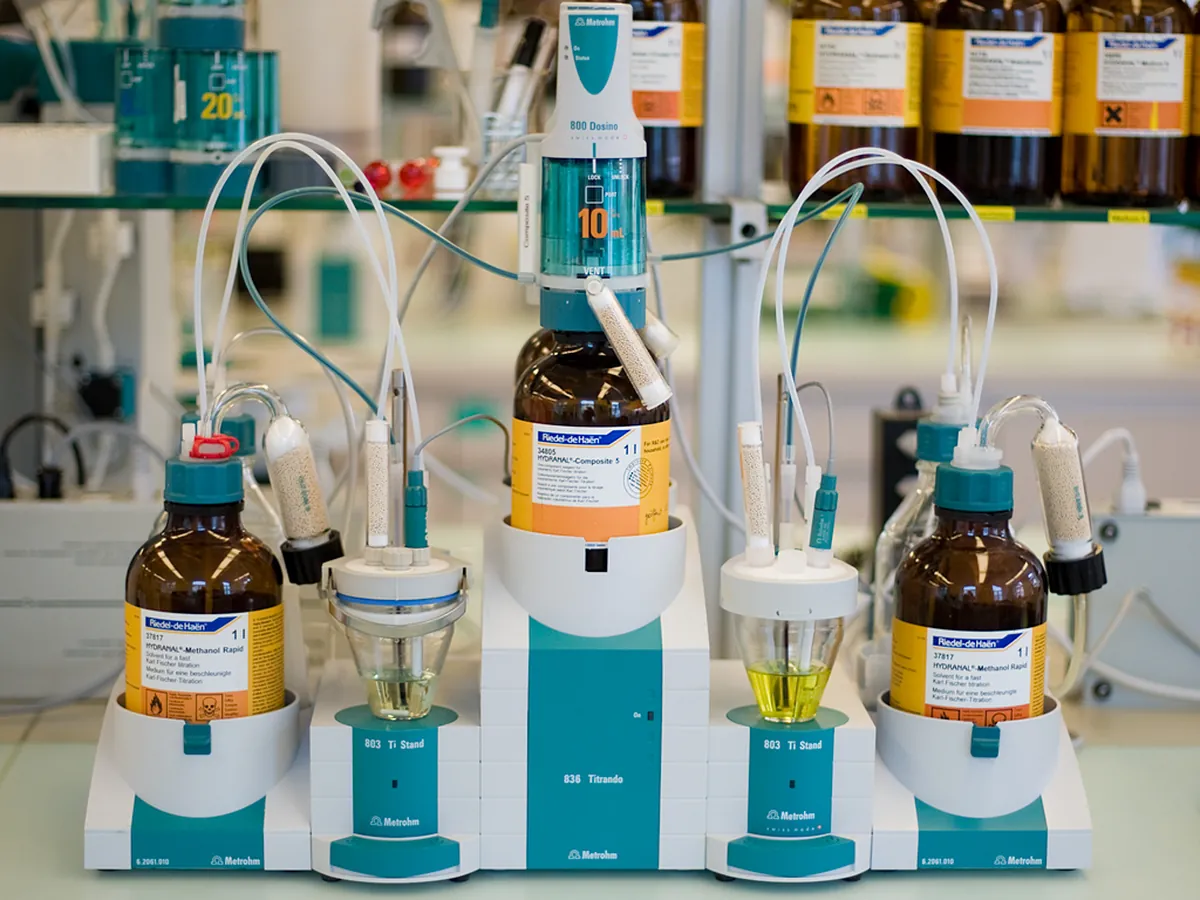
What is KF titrator (volumetric)?
A volumetric Karl Fischer (KF) titrator determines water by a chemical reaction that consumes water and iodine in a fixed ratio. The sample is dissolved or dispersed in a solvent (usually methanol-based) in a closed titration cell, and a KF reagent containing iodine is added from a precision burette until all the water has reacted.
A double platinum electrode in the cell detects the moment a small excess of iodine appears. The volume of reagent used, multiplied by the reagent's titre (mg of water per mL), gives the mass of water in the sample.
Unlike loss on drying, KF is specific to water: it does not count residual solvents or other volatiles. Volumetric KF suits samples with roughly 0.1% to 100% water. For trace water (ppm levels) the coulometric technique is preferred.
Used for
- Water content of APIs and excipients (pharmacopoeial 'Water' test)
- Water in hydrates, for example to confirm the hydration state
- Water content of finished products such as tablets, capsules and powders for reconstitution
- Water in solvents and reagents
- Stability studies where water uptake affects degradation
- Water content used to convert assay results to the anhydrous basis
How it works
- 01
Conditioning
The titrator adds reagent to the solvent until the cell is dry, then monitors the drift.
- 02
Sample addition
A weighed sample is added quickly through the septum or sample port.
- 03
Titration
Reagent is dosed from the burette while the solution is stirred, faster at first and slower near the end.
- 04
Endpoint detection
The double platinum electrode senses the first stable excess of iodine.
- 05
Calculation
Volume × titre, corrected for drift, gives water mass and % water.
Advantages
- Specific to water, unlike loss on drying
- Fast: most titrations finish in a few minutes
- Wide working range, from about 0.1% to 100% water
- Small sample size and good precision
- Results are traceable to a water standard through the titre
Limitations
- Reagents are toxic and must be standardised regularly because the titre changes with time
- Some substances interfere: ketones and aldehydes react with methanol, and strong oxidising or reducing agents react with iodine
- Atmospheric moisture enters the cell, so the cell must be tightly sealed and drift monitored
- Not sensitive enough for very low water levels (coulometric KF is better below about 0.1%)
- Insoluble samples may need a KF oven or a different solvent
3 calibration procedures
Methods that use KF titrator (volumetric)
Keep every KF titrator (volumetric) in control: usage logs, calibration and maintenance schedules, and automatic blocking of overdue instruments.