Karl Fischer Titrator (Volumetric)
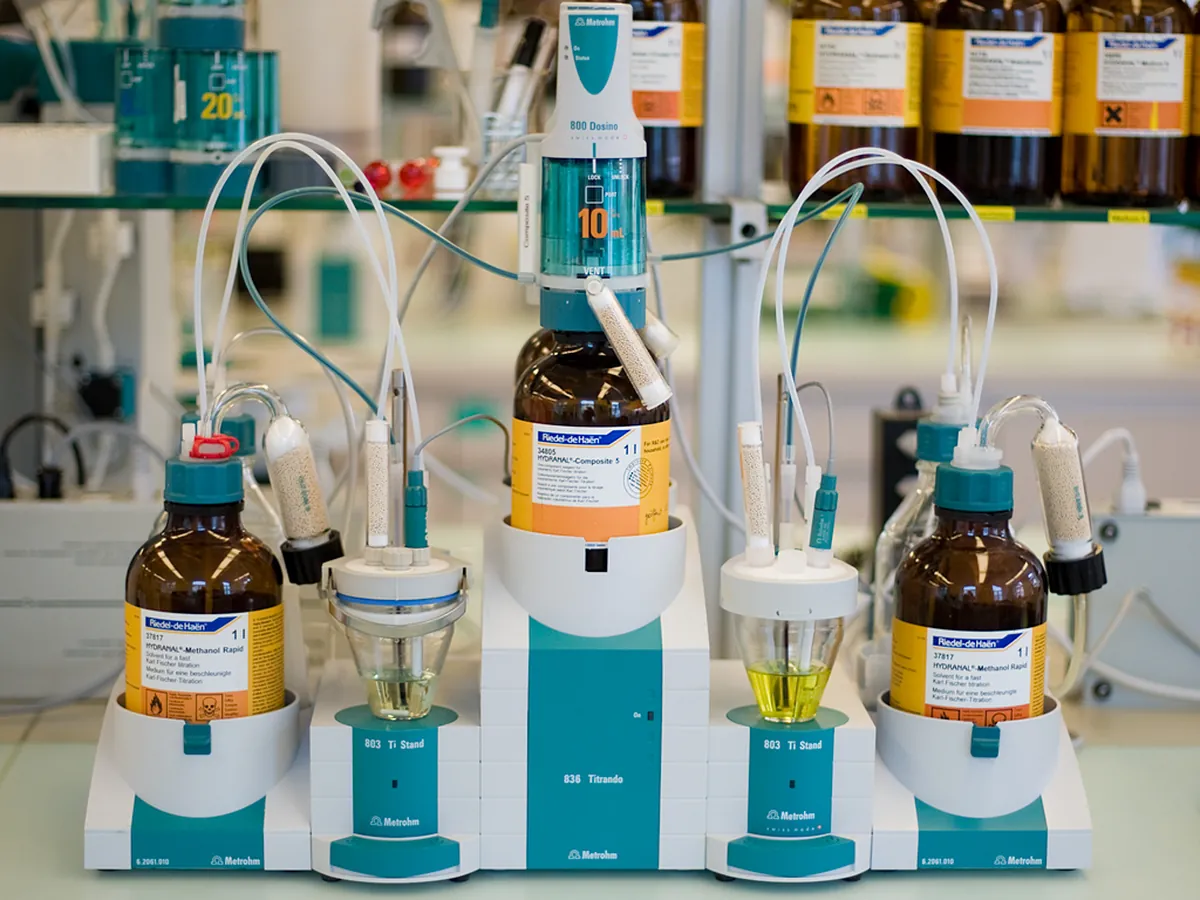
Measures the water content of a sample by titrating it with an iodine-containing Karl Fischer reagent from a motorised burette. The standard method for water in APIs, excipients and many finished products.
- Pharmaceutical
- Chemicals
- Food & beverage
- Petrochemicals
- Cosmetics
Test your KF titrator (volumetric) knowledge
Multiple-choice questions
Pick an answer to see whether you are right and why.
Q1. In the Karl Fischer reaction, how many moles of iodine react with one mole of water?
basicQ2. What does a KF reagent titre of 5.0 mg/mL mean?
basicQ3. Which substance is commonly used to determine the titre of a volumetric KF reagent?
basicQ4. How is the endpoint detected in a volumetric KF titration?
intermediateQ5. Before analysis the drift reads 65 µg/min and keeps rising. What is the most likely cause?
intermediateQ6. A sample of 400.0 mg consumes 2.40 mL of KF reagent with a titre of 5.00 mg/mL. What is its water content?
intermediateQ7. Which type of sample is most likely to give falsely high and drifting results with standard methanol-based KF reagents?
advancedQ8. Why can water by KF differ from loss on drying for the same sample?
advanced
Viva questions
Think of your answer first, then open it to compare.
1. What is drift in Karl Fischer titration and why is it monitored?
Drift is the rate at which background moisture enters the conditioned cell, expressed in µg/min. It is monitored because it shows whether the cell is tight; a low, stable drift can be corrected for, while a high or unstable drift gives unreliable results.
2. When would you choose coulometric KF instead of volumetric KF?
Coulometric KF generates iodine electrically and is suited to very low water contents, roughly from ppm levels up to about 1%, with small samples. Volumetric KF suits higher water contents, from about 0.1% upwards, and larger samples.
3. Why is the KF titre determined every day instead of using the label value?
KF reagents slowly lose strength and absorb atmospheric moisture after opening, so the actual titre falls. Using the label value would bias every result, so the titre is determined against a water standard at the frequency in the SOP.
4. How would you analyse a sample that does not dissolve in methanol or that reacts with the reagent?
Options include adding a co-solvent such as formamide or chloroform, increasing the extraction time, using a homogeniser, or using a KF oven, where the sample is heated and the released water is carried into the cell by a dry gas stream so the sample never contacts the reagent.
Keep every KF titrator (volumetric) in control: usage logs, calibration and maintenance schedules, and automatic blocking of overdue instruments.