Karl Fischer Titrator (Volumetric)
Measures the water content of a sample by titrating it with an iodine-containing Karl Fischer reagent from a motorised burette. The standard method for water in APIs, excipients and many finished products.
- Pharmaceutical
- Chemicals
- Food & beverage
- Petrochemicals
- Cosmetics
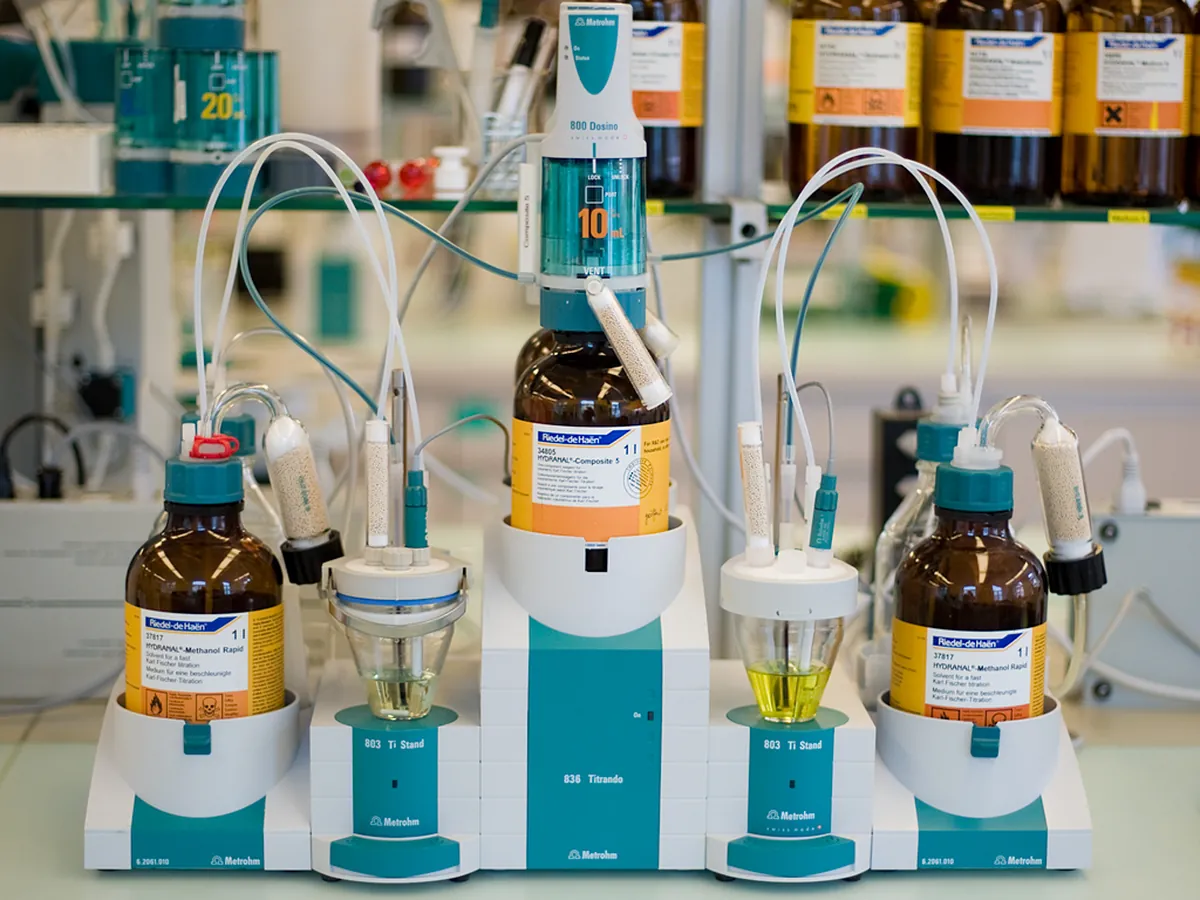
How KF titrator (volumetric) works
Water reacts with iodine and sulphur dioxide in the presence of a base and an alcohol. One mole of iodine is consumed for each mole of water. The end of the reaction is detected electrically when free iodine first remains in the cell, and the volume of reagent used is converted to mass of water through the titre.
The path of a sample
- 01
Conditioning
The titrator adds reagent to the solvent until the cell is dry, then monitors the drift.
- 02
Sample addition
A weighed sample is added quickly through the septum or sample port.
- 03
Titration
Reagent is dosed from the burette while the solution is stirred, faster at first and slower near the end.
- 04
Endpoint detection
The double platinum electrode senses the first stable excess of iodine.
- 05
Calculation
Volume × titre, corrected for drift, gives water mass and % water.
Main parts and what they do
Titration cell
Closed glass vessel holding the solvent and sample, with a lid, septum or sample port, and a drying tube.
Motorised piston burette
Delivers the KF reagent in small, precise increments (typical burette volumes 5, 10 or 20 mL).
Double platinum (bipolarised) electrode
Detects the endpoint by bivoltametric indication.
Magnetic or propeller stirrer
Mixes the sample and reagent quickly without splashing.
Drying tubes (molecular sieve)
Dry the air entering the reagent bottle and the cell so atmospheric moisture does not raise the drift.
Solvent exchange pump (optional)
Removes spent solvent and adds fresh solvent without opening the cell.
Control unit and software
Controls dosing, endpoint criteria and drift correction, calculates results and keeps an audit trail.
KF oven (optional)
Heats samples that do not dissolve or that interfere, and carries the released water to the cell in a dry gas stream.
Terms every analyst should know
Karl Fischer reaction
In simplified form: H₂O + I₂ + SO₂ + CH₃OH + 3 RN → [RNH]SO₄CH₃ + 2 [RNH]I, where RN is a base such as imidazole. One mole of iodine reacts with one mole of water.
Titre (water equivalence factor)
The mass of water, in mg, that 1 mL of reagent reacts with. Common reagents have a nominal titre of about 5 mg/mL or 2 mg/mL, but the actual value is determined against a water standard such as sodium tartrate dihydrate.
Bivoltametric indication
A small constant current (for example 20–50 µA) is passed between two platinum pins. While water is present the voltage between them is high; when excess iodine appears the voltage drops sharply. The endpoint is reached when the voltage stays below a set value for a set stop time.
Drift
The rate at which water enters the conditioned cell from the air, seals and reagent, in µg/min. A low, stable drift shows the cell is tight; the titrator subtracts drift × titration time from the result.
One- and two-component reagents
One-component reagents contain everything in a single titrant used with methanol as solvent. Two-component reagents keep the iodine titrant separate from the base-containing solvent, which gives faster reactions and a more stable titre.
Working pH
The reaction is fastest at about pH 5 to 7. Strongly acidic or basic samples slow the reaction or cause side reactions and may need buffering.
Keep every KF titrator (volumetric) in control: usage logs, calibration and maintenance schedules, and automatic blocking of overdue instruments.