Titration & electrochemistry
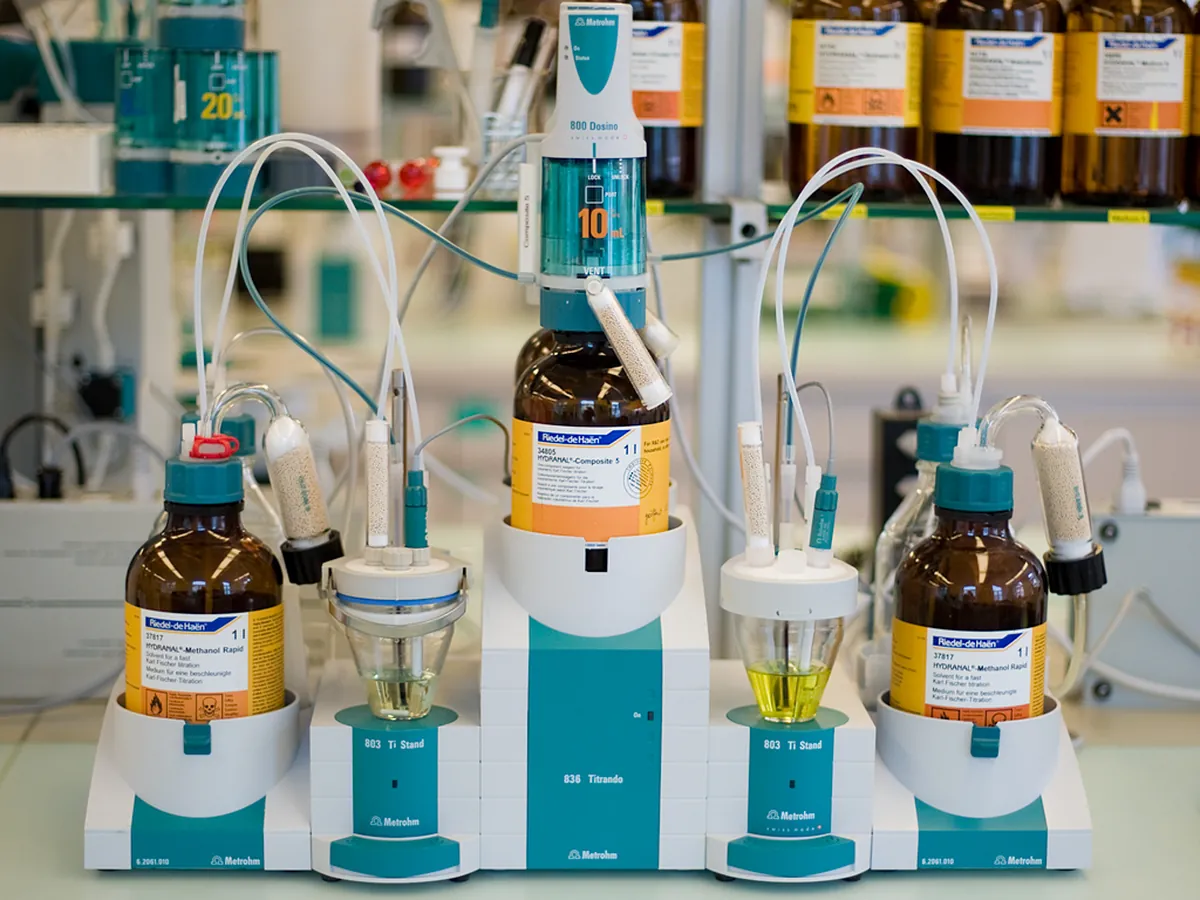
Karl Fischer Titrator (Volumetric)
Measures the water content of a sample by titrating it with an iodine-containing Karl Fischer reagent from a motorised burette. The standard method for water in APIs, excipients and many finished products.
- Pharmaceutical
- Chemicals
- Food & beverage
- Petrochemicals
- Cosmetics
Follow your site SOP
This is a typical operating sequence for learning. Your instrument model and approved SOP take precedence.
STAGE 1
Before you start
- 1Check the titrator is within its calibration due date and the titre of the reagent is current.
- 2Check the molecular sieve in the drying tubes is active (replace or regenerate it as per SOP).
- 3Fill the cell with fresh solvent to cover the electrode pins.
- 4Make sure all joints and the septum are tight.
- KF reagents contain methanol and imidazole or pyridine-type bases: handle them in a fume hood with gloves and eye protection.
STAGE 2
Conditioning and drift
- 1Start conditioning. The titrator adds reagent until the cell solvent is dry.
- 2Wait until the drift is low and stable (commonly below 20 µg/min, or the limit in your SOP).
- 3Record the drift before the first determination.
- A high or unstable drift means moisture is entering the cell. Fix the leak before running samples.
STAGE 3
Titre determination
- 1Determine the titre with a water standard (for example sodium tartrate dihydrate) at the frequency in your SOP, usually daily or before each series.
- 2Use the mean of at least three determinations that meet the precision limit.
STAGE 4
Sample analysis
- 1Weigh the sample by difference, choosing a mass that uses a reasonable part of the burette volume (often aimed at about 10–90% of the burette).
- 2Add the sample quickly through the port to limit exposure to air, and enter the exact mass into the software.
- 3Start the titration and let it run to the endpoint.
- 4Run duplicate determinations and check they agree as required by the method.
- Do not leave the cell open longer than needed.
- Replace the solvent when the cell is about two-thirds full or when titrations slow down, as the solvent capacity is exhausted.
STAGE 5
Shutdown
- 1Drain or exchange the spent solvent into the labelled KF waste container.
- 2Leave the cell closed and conditioned (standby) or clean it as per SOP if it will not be used for a long time.
- 3Complete the instrument usage log.
In LimsPulse · Calibration Management
Keep every KF titrator (volumetric) in control: usage logs, calibration and maintenance schedules, and automatic blocking of overdue instruments.