Flash Point Tester (Pensky-Martens Closed Cup)
Heats a fuel or oil in a closed brass cup while stirring and dips a small flame or electric igniter into the vapour space at set intervals. The lowest temperature at which the vapour flashes is the flash point, a key safety and quality property.
- Petroleum refining
- Fuel terminals and depots
- Lubricant blending
- Marine fuel testing
- Biodiesel production
- Power utilities (transformer oil)
- Independent testing laboratories
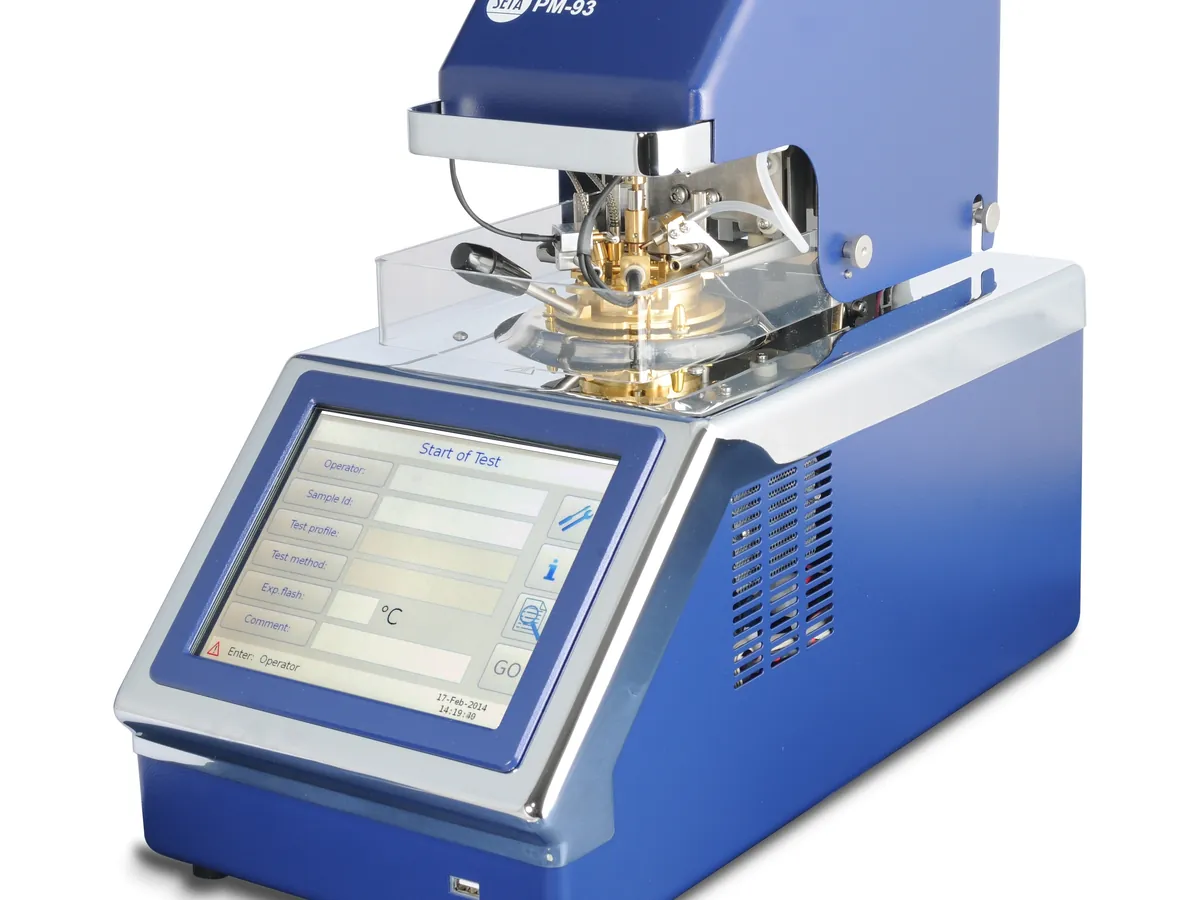
What is PMCC tester?
The flash point is the lowest temperature, corrected to standard atmospheric pressure (101.3 kPa), at which an ignition source makes the vapour above a sample ignite briefly under the conditions of the test. It tells you how easily a liquid can form a flammable mixture with air. Regulators use it to classify liquids for storage and transport, and fuel specifications set a minimum flash point so that diesel, kerosene and fuel oils can be handled safely.
The Pensky-Martens closed cup (PMCC) tester, described in ASTM D93, ISO 2719 and IS 1448 Part 21, is the standard instrument for diesel, biodiesel, heating oils, fuel oils, lubricating oils and other products with flash points from about 40 °C up to about 370 °C. A brass cup with a close-fitting lid is heated at a controlled rate while a stirrer mixes the liquid. At each test temperature the stirrer stops, a shutter in the lid opens and the ignition source is lowered into the vapour space for about one second.
Most labs now use automatic testers. They control heating and stirring, apply the ignition source at the right intervals, detect the flash with a thermocouple or ionisation ring, apply the barometric pressure correction and store the result. Many also have a fire detector and an extinguishing system (for example a nitrogen or CO₂ purge, or a cup cover), because the sample is a heated flammable liquid. Lower-flash products such as petrol or jet fuel use other closed-cup methods (Abel, Tag or small-scale testers).
Used for
- Minimum flash point of diesel, biodiesel (FAME) and blends, kerosene and heating oil
- Flash point of residual fuel oils and marine fuels (Procedure B)
- Flash point of new and used lubricating oils, transformer oils and base oils
- Detecting contamination of a high-flash product by a lighter fuel (for example diesel contaminated with petrol)
- Checking residual alcohol (methanol) in biodiesel, which lowers the flash point
- Hazard classification of liquids for storage, transport and safety data sheets
How it works
- 01
Fill
The cup is filled to the filling mark (about 75 mL) with sample that has been kept cool and sealed.
- 02
Heat and stir
The cup is heated at a set rate (Procedure A: about 5–6 °C per minute, stirring at 90–120 rpm) so the liquid and vapour stay at a uniform temperature.
- 03
Apply ignition source
Starting below the expected flash point, the stirrer stops, the shutter opens and the flame or igniter dips into the vapour space for about 1 s at each test temperature interval.
- 04
Detect flash
A distinct flash across the vapour space is seen by the operator or detected as a sudden temperature or ionisation signal.
- 05
Correct and report
The observed temperature is corrected to 101.3 kPa using the barometric pressure and reported to the nearest 0.5 °C.
Advantages
- Closed cup traps vapour, giving lower and more repeatable flash points than open-cup methods
- Covers a wide flash point range, from about 40 °C to about 370 °C
- Automatic models remove operator judgement in seeing the flash
- Built-in barometric correction and data storage support traceable results
- Small sample (about 75 mL) and a test time of typically 15–30 minutes
Limitations
- Flash point is an empirical value; it depends on cup design, heating rate, stirring and how the flame is applied
- Not suitable for very volatile products such as petrol; other methods are used
- Water in the sample can cause foaming or hide the flash
- Loss of light ends during sampling or handling gives falsely high results
- Results from different methods (PMCC, Abel, Tag, open cup) are not interchangeable
1 calibration procedure
Methods that use PMCC tester
Keep every PMCC tester in control: usage logs, calibration and maintenance schedules, and automatic blocking of overdue instruments.