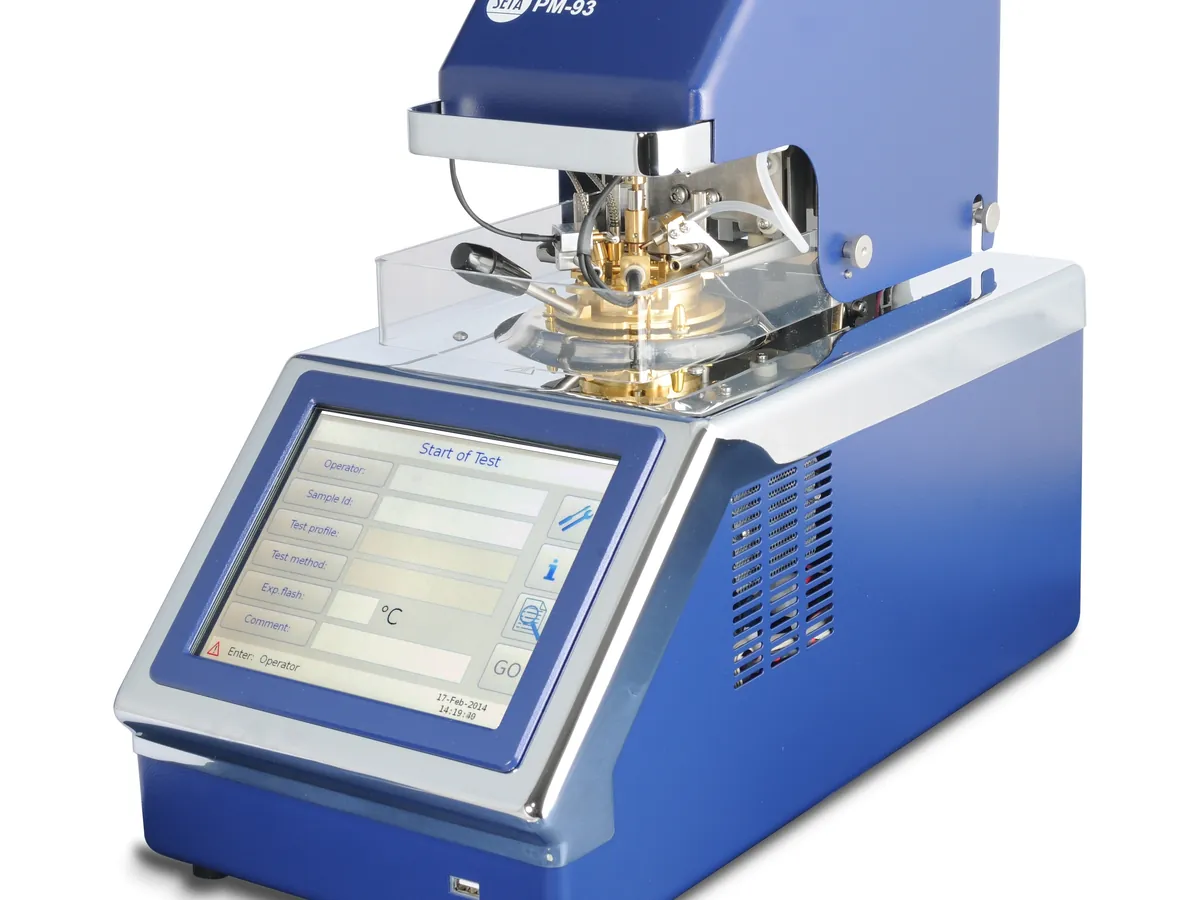
Flash Point Tester (Pensky-Martens Closed Cup)
Heats a fuel or oil in a closed brass cup while stirring and dips a small flame or electric igniter into the vapour space at set intervals. The lowest temperature at which the vapour flashes is the flash point, a key safety and quality property.
- Petroleum refining
- Fuel terminals and depots
- Lubricant blending
- Marine fuel testing
- Biodiesel production
- Power utilities (transformer oil)
- Independent testing laboratories
Test your PMCC tester knowledge
Multiple-choice questions
Pick an answer to see whether you are right and why.
Q1. What is the flash point of a fuel?
basicQ2. Which standard describes the Pensky-Martens closed cup flash point test?
basicQ3. A diesel flashes at 58.0 °C when the barometer reads 97.3 kPa. What is the corrected flash point?
intermediateQ4. A sample was stored warm in a half-empty bottle before testing. What is the likely effect on the flash point?
intermediateQ5. Which D93 procedure is normally used for residual fuel oils and used lubricating oils?
intermediateQ6. If an oil fire starts in the flash point cup, what should you NOT use?
basicQ7. A diesel that normally flashes at about 65 °C now flashes at 38 °C. What is the most likely cause?
advanced
Viva questions
Think of your answer first, then open it to compare.
1. Why is the closed-cup flash point lower than the open-cup flash point for the same sample?
In a closed cup the vapour is trapped in the space above the liquid, so it reaches the lower flammable limit at a lower temperature. In an open cup vapour escapes and mixes with room air, so a higher liquid temperature is needed.
2. Why must the flash point tester be in a draught-free place, and yet the room well ventilated?
Draughts blow vapour away from the ignition source and give falsely high results, so the test area must be still. Good room ventilation is still needed to clear flammable vapour after the test and to keep vapour from building up.
3. How do you verify that a flash point tester is working correctly?
Test a certified reference material as a normal sample, apply the barometric correction and check the result is within the certificate tolerance. Also calibrate the temperature sensor and barometer, check ignition source size and timing, and plot a check sample on a control chart.
Keep every PMCC tester in control: usage logs, calibration and maintenance schedules, and automatic blocking of overdue instruments.