Flash Point Tester (Pensky-Martens Closed Cup)
Heats a fuel or oil in a closed brass cup while stirring and dips a small flame or electric igniter into the vapour space at set intervals. The lowest temperature at which the vapour flashes is the flash point, a key safety and quality property.
- Petroleum refining
- Fuel terminals and depots
- Lubricant blending
- Marine fuel testing
- Biodiesel production
- Power utilities (transformer oil)
- Independent testing laboratories
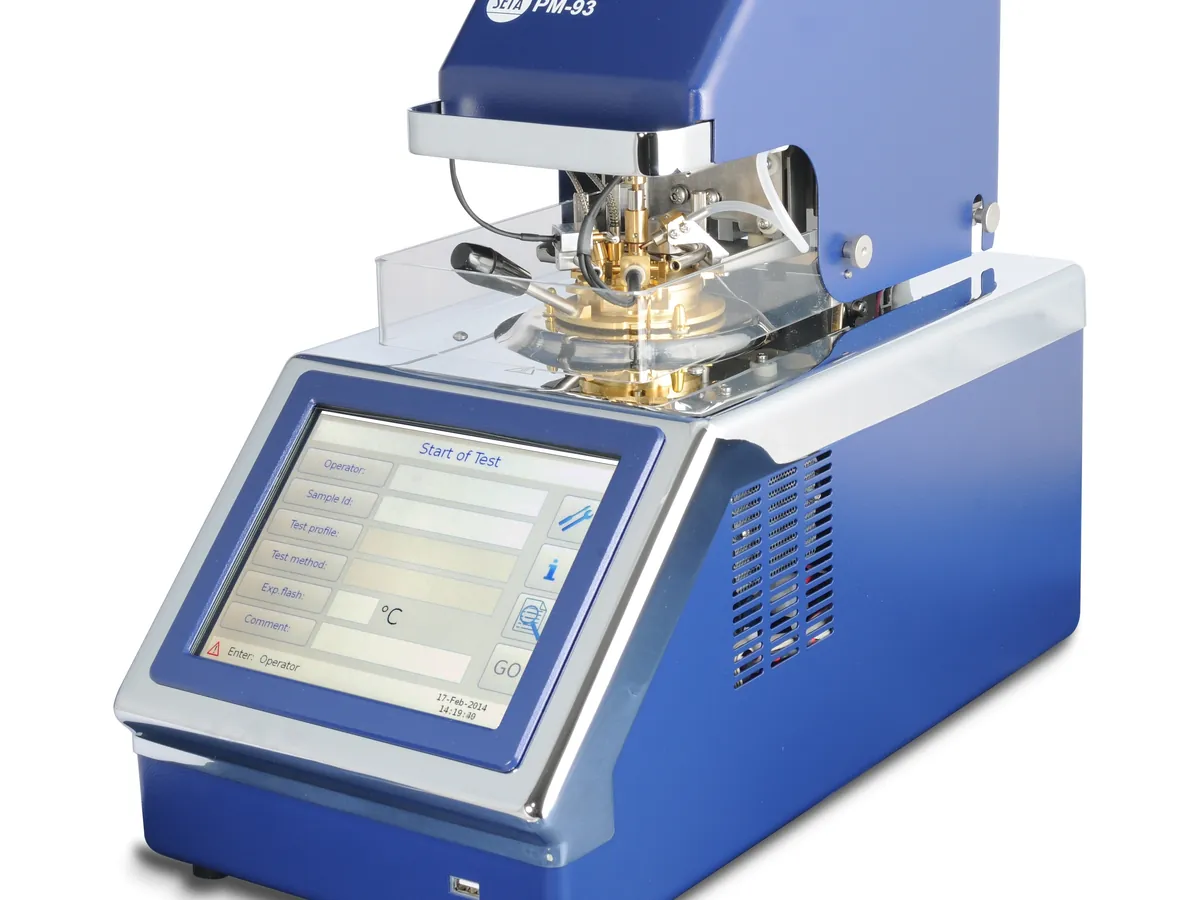
How PMCC tester works
As a flammable liquid warms, its vapour pressure rises and the concentration of vapour in the air above it increases. When that concentration reaches the lower flammable limit, a small ignition source causes a brief flash that does not continue to burn. The temperature at which this first happens, corrected to 101.3 kPa, is the flash point.
The path of a sample
- 01
Fill
The cup is filled to the filling mark (about 75 mL) with sample that has been kept cool and sealed.
- 02
Heat and stir
The cup is heated at a set rate (Procedure A: about 5–6 °C per minute, stirring at 90–120 rpm) so the liquid and vapour stay at a uniform temperature.
- 03
Apply ignition source
Starting below the expected flash point, the stirrer stops, the shutter opens and the flame or igniter dips into the vapour space for about 1 s at each test temperature interval.
- 04
Detect flash
A distinct flash across the vapour space is seen by the operator or detected as a sudden temperature or ionisation signal.
- 05
Correct and report
The observed temperature is corrected to 101.3 kPa using the barometric pressure and reported to the nearest 0.5 °C.
Main parts and what they do
Test cup
Brass cup of specified dimensions with a filling mark on the inside; holds about 75 mL of sample.
Lid with shutter
Fits tightly on the cup. A sliding shutter uncovers openings in the lid when the ignition source is applied.
Stirrer
Two-bladed stirrer driven by a motor (or flexible shaft) that mixes the liquid and the vapour space.
Ignition source
A small gas flame of set size (about 3.2–4.8 mm bead) or an electric hot-wire igniter that dips into the vapour space.
Heater (air bath / heating block)
Heats the cup evenly at the programmed rate.
Temperature sensor
Calibrated thermometer or Pt100 probe immersed in the sample to the specified depth.
Flash detector
Thermocouple or ionisation ring above the cup that senses the flash in automatic testers.
Barometer
Built-in or separate barometer used to correct the observed flash point to 101.3 kPa.
Fire detection and suppression
Sensor that detects a sustained fire and triggers a nitrogen or CO₂ purge, cup cover or heater cut-out.
Controller and display
Sets procedure, expected flash point and heating programme; stores results and audit trail.
Terms every analyst should know
Lower flammable limit (LFL)
The lowest concentration of vapour in air that can burn. The flash point is the liquid temperature at which the vapour above it reaches roughly this level.
Closed cup vs open cup
A closed cup keeps vapour in, so it flashes at a lower temperature than an open cup (such as Cleveland open cup). Closed-cup values are used for fuel specifications and hazard classification.
Procedure A and B
ASTM D93 Procedure A is for distillate fuels and clean oils (faster heating, slower stirring). Procedure B is for residual fuels, used oils and liquids that form a surface film (slower heating, faster stirring, about 250 rpm). Procedure C covers biodiesel.
Barometric pressure correction
At lower pressure a liquid flashes at a lower temperature. The observed value is corrected: corrected = observed + 0.25 × (101.3 − P), with P in kPa.
Flash point vs fire point
At the flash point the vapour burns briefly and goes out. The fire point is a higher temperature at which burning continues for at least 5 s; it is measured in open-cup tests, not in the PMCC.
Expected flash point
Testing starts a set number of degrees below the expected value (about 23 ± 5 °C below in D93). If the flash comes too early the test is repeated with a fresh portion and a lower expected value.
Keep every PMCC tester in control: usage logs, calibration and maintenance schedules, and automatic blocking of overdue instruments.