Flash Point by Pensky-Martens Closed Cup
A 75 mL portion of fuel is heated in a closed brass cup at a set rate while stirred. An ignition source is dipped into the vapour space at set intervals; the lowest temperature that gives a flash is corrected to standard pressure and reported as the flash point.
- Petroleum, oil & gas
- Flash point tester
- PMCC tester
Reference: Typical method based on ASTM D93 (Procedure A for distillate fuels), ISO 2719 and IS 1448 Part 21. Follow the current edition and the product specification.
Why this method works
As the fuel warms, more vapour collects in the closed space above it. When the vapour-air mixture reaches its lower flammable limit, a small flame or igniter makes it flash briefly. Because the vapour concentration depends on the pressure in the room, the observed temperature is corrected to 101.3 kPa. The value is empirical: heating rate, stirring, cup design and ignition timing are all fixed by the method so results are comparable between labs.
Instruments used
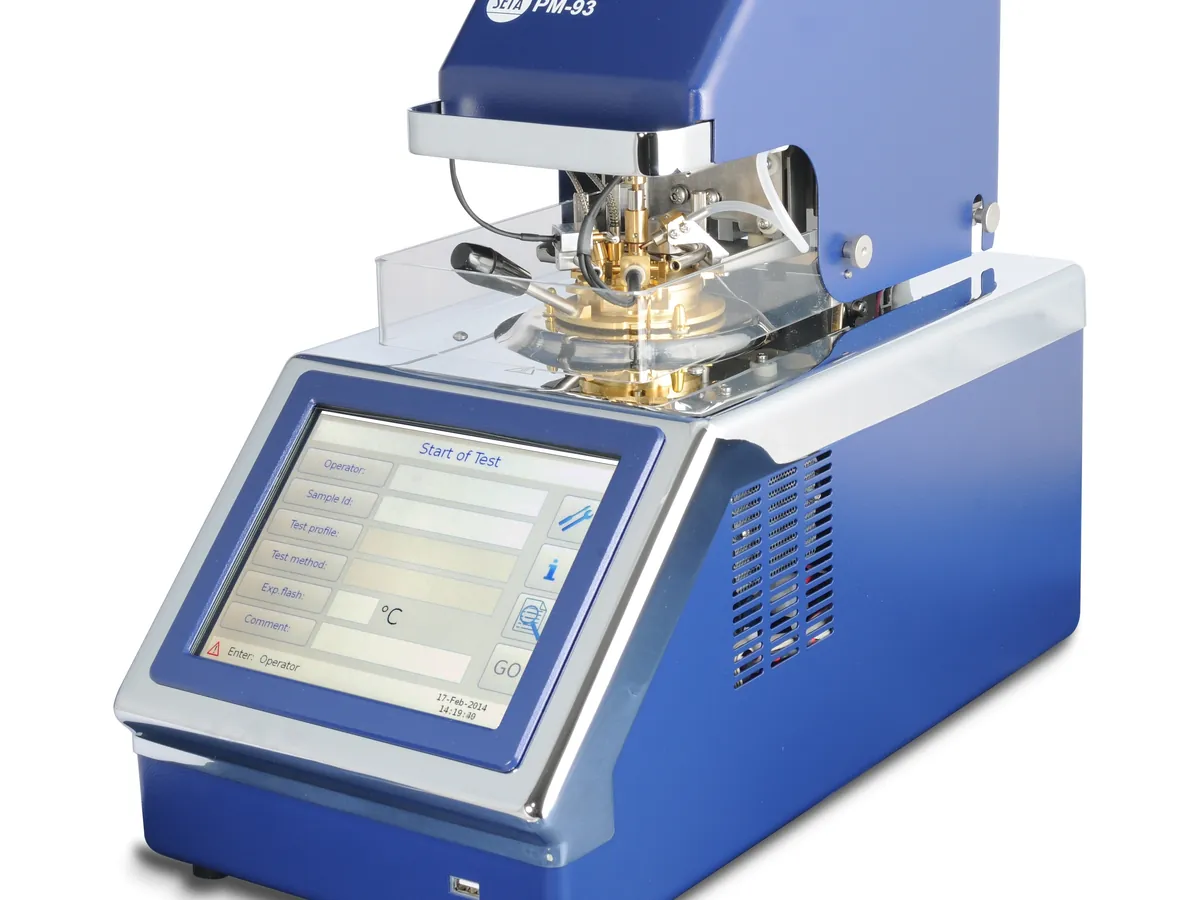
Reagents & standards
| Reagent | Grade / specification |
|---|---|
| Cleaning solvent | Suitable hydrocarbon solvent (for example petroleum spirit or toluene) followed by drying; no residue may remain |
| Ignition gas | Propane, butane or natural gas for a gas-flame igniter (not needed for electric igniters) |
| Verification CRM | Certified flash point reference material for the daily or periodic check |
Preparing the sample
- 01
Sample receipt
Sample in a tightly closed container, 85–95% full, kept cool.
- 02
Cool before opening
Open only when well below the expected flash point to keep light ends in.
- 03
Check for water
Look for free water; dry or treat the sample as the method allows.
- 04
Mix gently
Invert gently to mix without losing vapour.
- 05
Fill cup
Fill to the mark immediately and close the lid.
Procedure
- 1Take the sample in a clean, tight container filled to about 85–95% and do not store it in plastic that lets vapour escape.
- 2Keep the sample cool. Open the container only when it is well below the expected flash point (use the margin given in the current D93).
- 3If free water is present, decant or dry the sample as the method allows; water can foam or suppress the flash.
- 4Mix by gentle inversion. Do not shake hard or warm the sample.
- 5Fill the clean, dry cup to the filling mark, avoiding wetting the cup above the mark, and fit the lid straight away.
Standard preparation
- 1Run the flash point CRM at the frequency in your SOP and confirm the corrected result is within the certificate tolerance before testing samples.
Notes for analysts
- Barometric correction: at lower pressure the flash occurs at a lower temperature, so the correction is positive when P < 101.3 kPa. Use kPa; if the barometer reads in mmHg or hPa, convert first (1 hPa = 0.1 kPa).
- Many automatic testers apply the correction themselves; check that the instrument barometer is verified and that the correction is not applied twice.
- Fire safety: test in a draught-free position, never leave the test unattended, keep a CO₂ or dry powder extinguisher at hand, and make sure the tester's fire suppression is working.
- PMCC, Abel, Tag and open-cup results are not interchangeable; always report the method.
Method parameters (typical)
| Procedure | A (distillate fuels, clean oils); B for residual fuels and samples that form a surface film; C for biodiesel |
|---|---|
| Sample volume | Cup filled to the mark (about 75 mL) |
| Heating rate (Procedure A) | About 5–6 °C per minute |
| Stirring (Procedure A) | 90–120 rpm, stopped while the ignition source is applied |
| First ignition application | About 23 ± 5 °C below the expected flash point |
| Ignition interval | Every 1 °C up to an expected flash point of 110 °C; every 2 °C above |
| Ignition application | Ignition source lowered into the vapour space for about 1 s, then raised |
| Barometric pressure | Recorded at the time of test, in kPa |
| Reporting | Corrected flash point to the nearest 0.5 °C, stating the procedure |
System suitability & sequence
| Parameter | Limit |
|---|---|
| CRM check | Corrected result within certificate tolerance at the SOP frequency |
| Early flash | If the flash occurs at the first application, the test is invalid; repeat with fresh sample and a lower expected flash point |
| Duplicate agreement | Within the repeatability limit of the current method |
Typical sequence
- 1Verify tester with CRM (per SOP)
- 2Screening test if expected flash point unknown
- 3Definitive test on fresh portion
- 4Duplicate if required by the SOP
- 5Barometric correction and rounding
Calculation with a worked example
Where
- C
- Observed flash point (°C)
- P
- Ambient barometric pressure at the time of test (kPa)
- 101.3
- Standard atmospheric pressure (kPa)
Given
- Sample
- Diesel, Procedure A
- Observed flash point C
- 62.0 °C
- Barometric pressure P
- 95.0 kPa (lab at moderate altitude)
Working
- 1
101.3 − 95.0 = 6.3 kPa
- 2
0.25 × 6.3 = 1.575 °C
- 3
Corrected = 62.0 + 1.575 = 63.575 °C
- 4
Round to the nearest 0.5 °C: 63.575 is closer to 63.5 than to 64.0 → 63.5 °C
Flash point (PMCC, Procedure A) = 63.5 °C
What result passes
- Compare with the product specification minimum. For example, EN 590 diesel requires a flash point above 55 °C; national specifications (such as IS 1460 for diesel in India) set their own minimum — check the current edition.
- A result much lower than usual for the product suggests contamination with a lighter fuel and should be investigated.
Validation parameters (ICH Q2(R2))
| Parameter | Typical requirement |
|---|---|
| Trueness | Verified with CRMs near the specification limit |
| Precision | Repeatability and reproducibility as published in the current D93 / ISO 2719; lab check sample on a control chart |
| Robustness | Effect of sample handling (light-end loss) and draughts assessed during training |
Run this method in LimsPulse: specifications and STPs under version control, results calculated and checked against limits, and a signed Certificate of Analysis.