Conductivity meter
Measures how well a solution conducts electricity, which tells you how many ions it contains. In pharma QC it is the main test for the ionic purity of purified water and water for injection.
- Pharmaceutical
- Biotech
- Power generation
- Semiconductor
- Water treatment
- Food & beverage
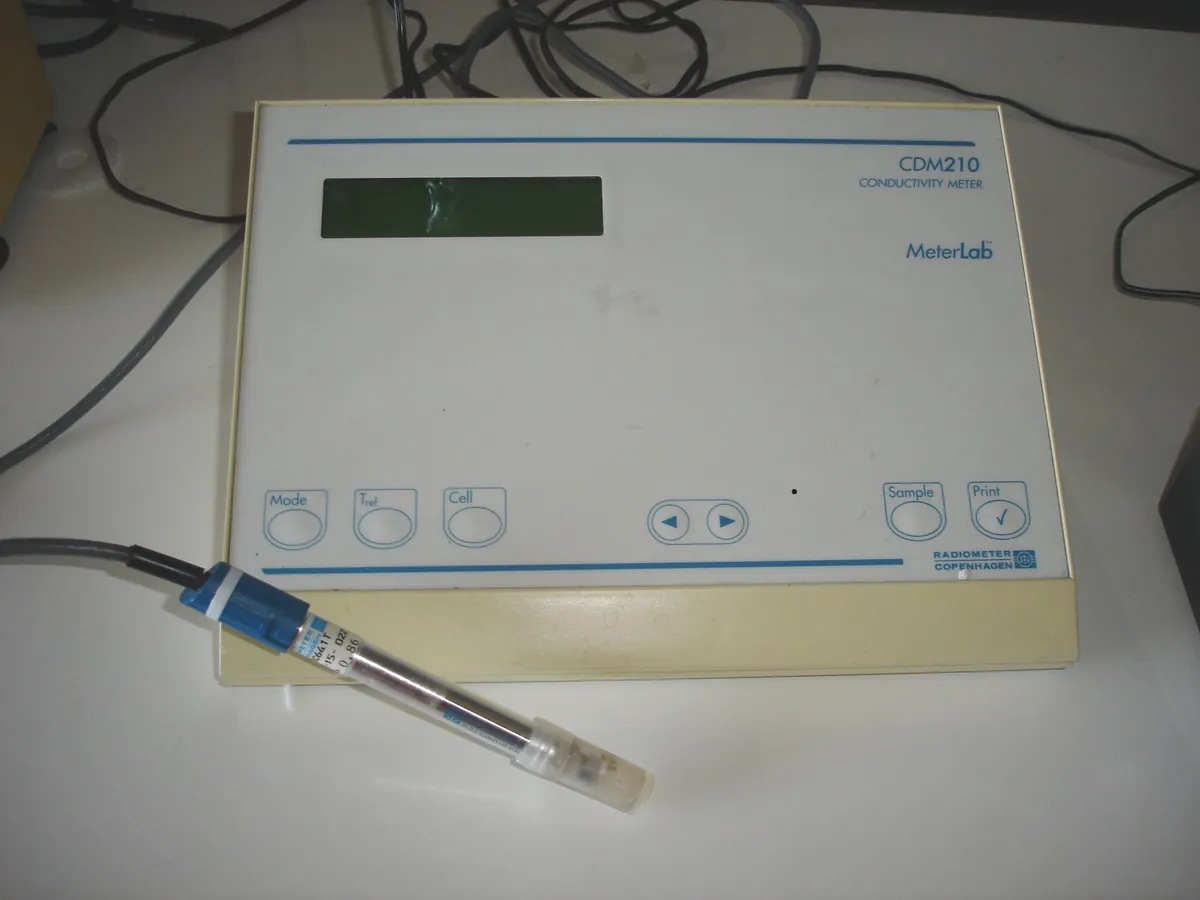
What is Conductivity meter?
Pure water conducts electricity very poorly. Dissolved salts, acids and bases split into ions, and these ions carry current. A conductivity meter applies an alternating voltage across two electrodes in the sample and measures the current that flows. The more ions, the higher the conductivity.
Conductivity is reported in microsiemens per centimetre (µS/cm). The 'per centimetre' comes from the cell constant, which describes the geometry of the electrodes. Very pure water reads below about 1 µS/cm; tap water is typically a few hundred µS/cm.
In a QC lab, the conductivity meter is used mainly for purified water and water for injection, following a three-stage approach in which the temperature of the water decides the limit. It is also used for cleaning-validation rinse water and some raw-material tests.
Used for
- Conductivity of purified water and water for injection (offline and online)
- Monitoring of water purification system performance
- Final rinse water checks in cleaning validation
- Conductometric titrations
- Some raw-material and excipient tests (for example conductivity of solutions)
How it works
- 01
Sample in cell
The cell is immersed in, or filled with, the sample without trapping air bubbles.
- 02
AC excitation
The meter applies a small alternating voltage across the electrodes.
- 03
Current measurement
Ions move between the electrodes; the meter measures the resulting current and calculates conductance.
- 04
Cell constant
Conductance is multiplied by the cell constant to give conductivity in µS/cm.
- 05
Temperature
A built-in sensor measures sample temperature; the value is reported raw or compensated, as the test requires.
Advantages
- Fast, simple and non-destructive
- Very sensitive to small amounts of ionic contamination
- Suitable for continuous online monitoring
- Low running cost
Limitations
- Does not tell you which ions are present
- Does not detect non-ionic impurities such as most organic compounds (TOC is used for those)
- Strongly temperature dependent; temperature must be measured accurately
- Low-conductivity samples absorb carbon dioxide from air, which raises the reading
- Cell must match the conductivity range (low cell constant for pure water)
2 calibration procedures
Methods that use Conductivity meter
Keep every Conductivity meter in control: usage logs, calibration and maintenance schedules, and automatic blocking of overdue instruments.