Conductivity meter
Measures how well a solution conducts electricity, which tells you how many ions it contains. In pharma QC it is the main test for the ionic purity of purified water and water for injection.
- Pharmaceutical
- Biotech
- Power generation
- Semiconductor
- Water treatment
- Food & beverage
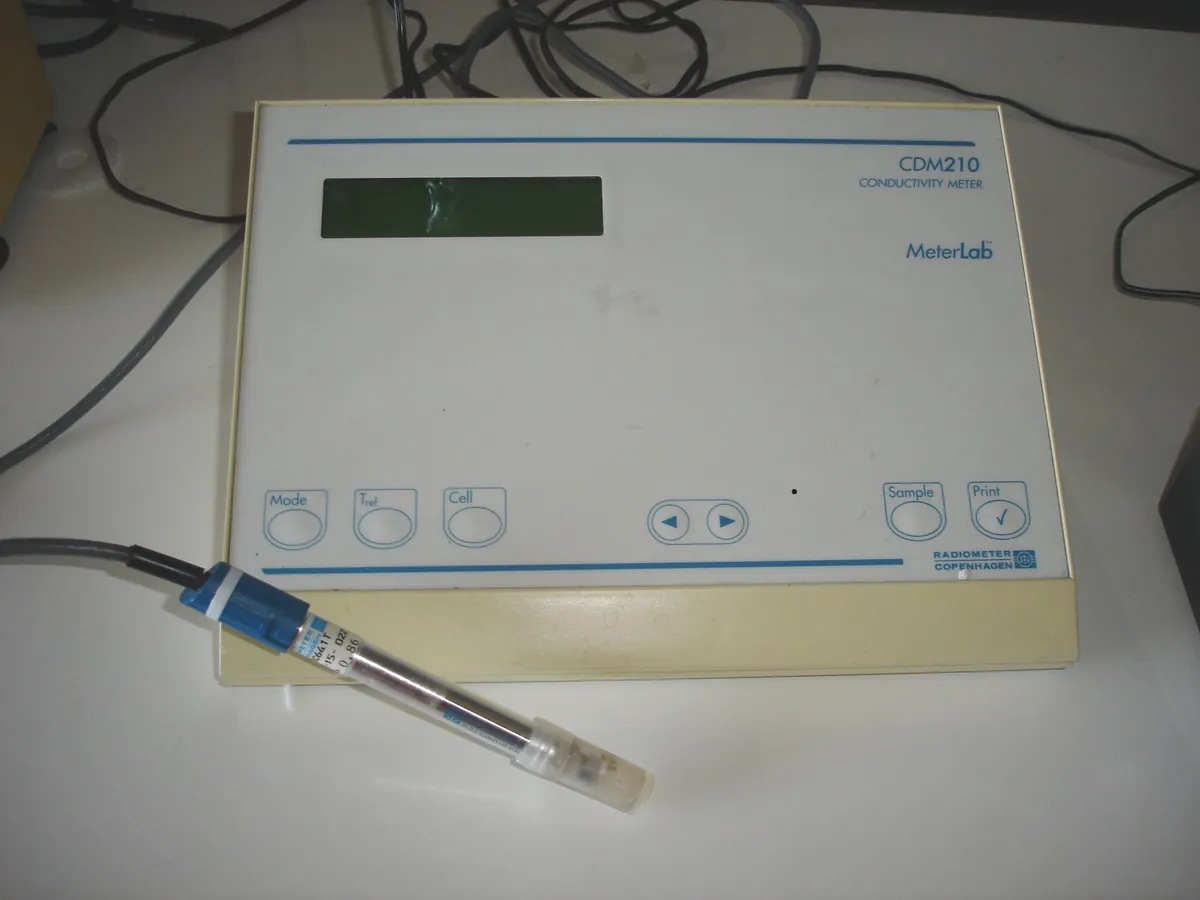
How Conductivity meter works
The meter measures the conductance (G, in siemens) between two electrodes, which is the reciprocal of resistance. Conductivity (κ) is the conductance multiplied by the cell constant (K = distance between electrodes ÷ electrode area, in cm⁻¹). Alternating current is used so the electrodes do not polarise. Because ion mobility rises by roughly 2% per °C, temperature is always measured with the conductivity.
The path of a sample
- 01
Sample in cell
The cell is immersed in, or filled with, the sample without trapping air bubbles.
- 02
AC excitation
The meter applies a small alternating voltage across the electrodes.
- 03
Current measurement
Ions move between the electrodes; the meter measures the resulting current and calculates conductance.
- 04
Cell constant
Conductance is multiplied by the cell constant to give conductivity in µS/cm.
- 05
Temperature
A built-in sensor measures sample temperature; the value is reported raw or compensated, as the test requires.
Main parts and what they do
Conductivity cell
Two (or four) electrodes, often stainless steel, titanium or platinised platinum, in a fixed geometry that defines the cell constant.
Temperature sensor
Pt100/Pt1000 or thermistor built into the cell; measures sample temperature.
Meter / transmitter
Applies AC excitation, measures conductance, applies the cell constant and temperature handling, and displays the result.
Flow-through or dip cell holder
Holds the cell in the sample; a flow cell reduces exposure to air for low-conductivity water.
Data output
Printer, LIMS or SCADA link for offline and online results.
Terms every analyst should know
Conductance (G)
The reciprocal of resistance, in siemens (S). Depends on both the solution and the cell size.
Conductivity (κ)
Conductance corrected for cell geometry: κ = K × G. Reported in µS/cm.
Cell constant (K)
Distance between electrodes divided by their area, in cm⁻¹. Cells of about 0.1 cm⁻¹ or lower suit pure water.
Temperature compensation
Converts a reading to the value expected at a reference temperature, usually 25 °C. USP <645> Stage 1 uses the non-compensated value.
Resistivity
The reciprocal of conductivity, in MΩ·cm. Ultrapure water at 25 °C is about 18.2 MΩ·cm (0.055 µS/cm).
Keep every Conductivity meter in control: usage logs, calibration and maintenance schedules, and automatic blocking of overdue instruments.