Conductivity of Purified Water
Tests purified water for ionic contamination using the three-stage USP <645> approach: a temperature-dependent limit at Stage 1, a stirred CO₂-equilibrated test at Stage 2, and a pH-dependent limit at Stage 3.
- Conductometry (non-temperature-compensated, three-stage test)
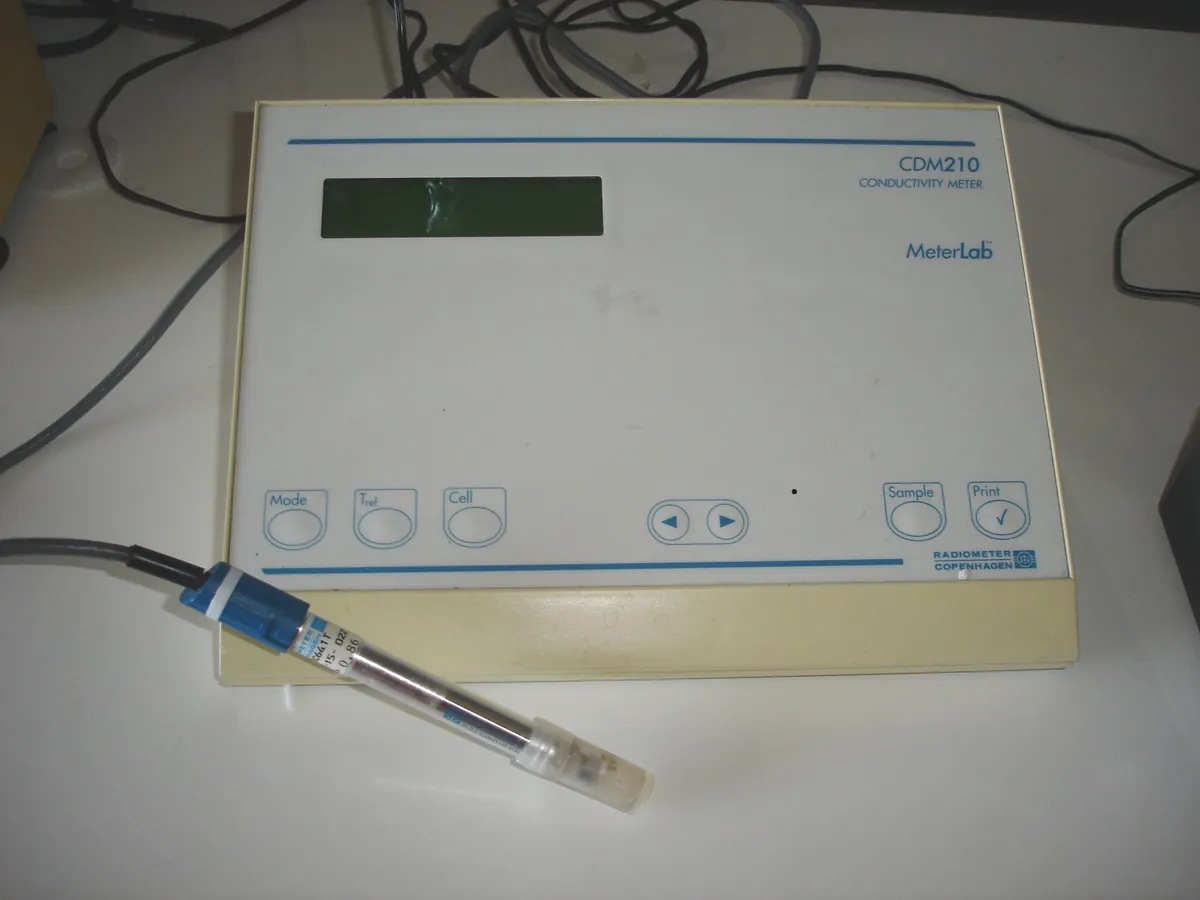
- Conductivity meter
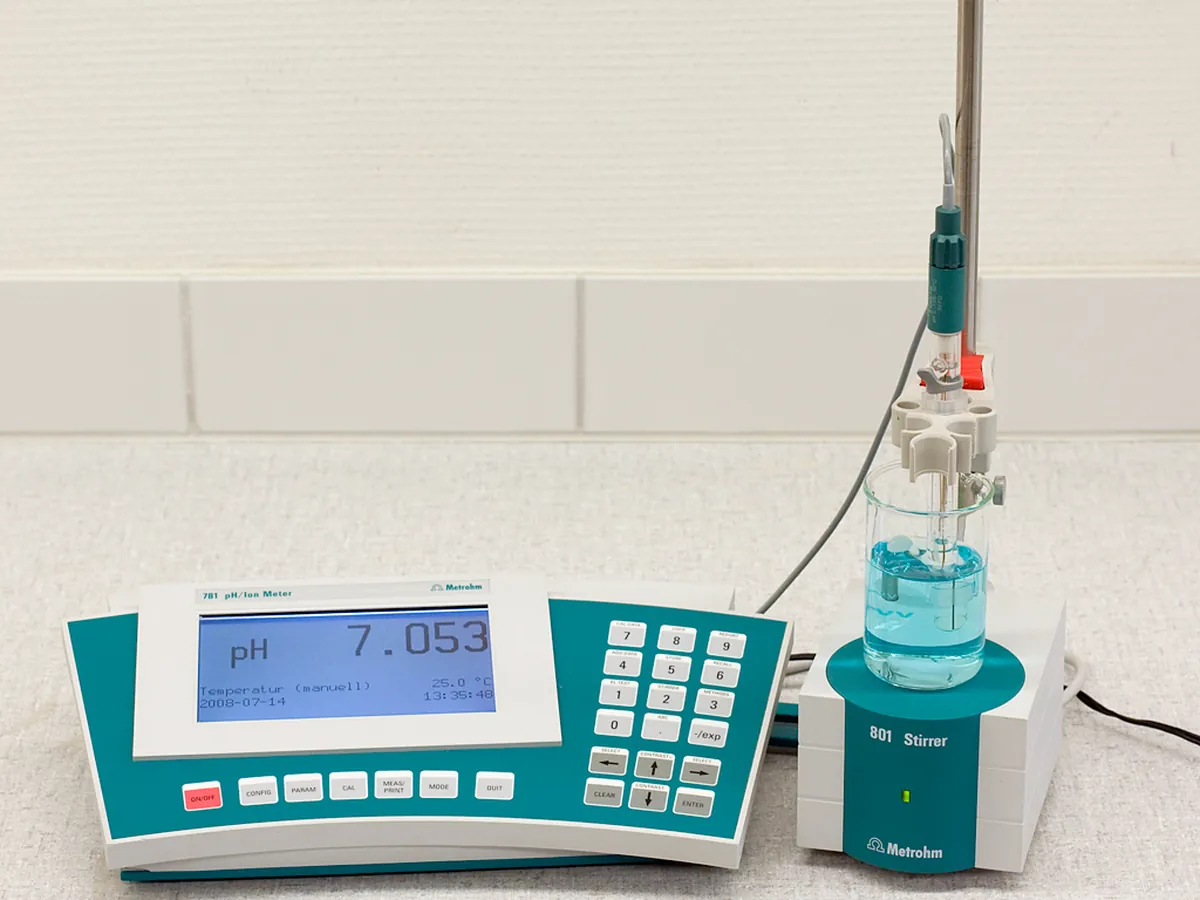
- pH meter
Reference: Typical method based on USP <645> and Ph. Eur. 2.2.38. Ph. Eur. Purified Water uses its own limit table. Always follow your approved specification and STP.
Why this method works
Pure water contains very few ions, so it conducts electricity very poorly. Dissolved salts and acids raise conductivity. Water also picks up carbon dioxide from air, which adds a small, harmless amount of conductivity. The three stages allow for this: Stage 1 is a quick test against a limit for the measured temperature; if it fails, Stage 2 lets the sample reach equilibrium with air at 25 °C; and Stage 3 uses the measured pH to judge whether the remaining conductivity comes from CO₂ or from real contamination.
Instruments used
Reagents & standards
| Reagent | Grade / specification |
|---|---|
| Conductivity standard | Certified KCl standard for cell verification |
| Saturated potassium chloride solution | For Stage 3 (about 0.3 mL per 100 mL of sample) |
| pH buffers | For pH meter calibration before Stage 3 |
Preparing the sample
- 01
Sample
Collect water in a clean container rinsed with the same water.
- 02
Stage 1
Measure non-compensated conductivity and temperature.
- 03
Stage 2
If Stage 1 fails: stir at 25 ± 1 °C until stable.
- 04
Stage 3
If Stage 2 fails: add saturated KCl and measure pH.
- 05
Decide
Compare with the limit for that stage; record the result.
Procedure
- 1Sampling: flush the sampling valve, rinse a clean container several times with the water, fill it completely and close it. Test promptly.
- 2Stage 1: with temperature compensation switched off, measure conductivity and temperature. Find the limit for the measured temperature in the Stage 1 table, using the next lower 5 °C step (for example 23.6 °C uses the 20 °C row). If the reading is not greater than the limit, the water passes.
- 3Stage 2 (only if Stage 1 fails): transfer at least 100 mL to a suitable container, bring to 25 ± 1 °C and stir vigorously. When the change in conductivity is not more than 0.1 µS/cm over 5 minutes, record it. If it is not greater than 2.1 µS/cm, the water passes.
- 4Stage 3 (only if Stage 2 fails): within about 5 minutes of the Stage 2 reading, keep the sample at 25 ± 1 °C, add 0.3 mL saturated KCl per 100 mL and measure pH to 0.1 unit. Look up the conductivity limit for that pH in the Stage 3 table. The water passes if the Stage 2 conductivity is not greater than that limit and the pH is within 5.0–7.0.
Standard preparation
- 1Verify the conductivity cell with a certified standard as defined in your SOP before use.
- 2Calibrate the pH meter before Stage 3.
Notes for analysts
- Never use a temperature-compensated value against the Stage 1 table; the table already allows for temperature.
- Measure promptly: carbon dioxide from air raises the conductivity of low-ionic water.
- Online sensors may be used for Stage 1 if they meet the chapter's instrument requirements; offline testing is then used to investigate.
- Conductivity does not detect organic contamination; total organic carbon (TOC) is tested separately.
Method parameters (typical)
| Conductivity mode | Non-temperature-compensated (raw) for Stages 1 and 2 |
|---|---|
| Cell constant | Low, typically 0.1 cm⁻¹ or less, known within ±2% |
| Meter resolution | 0.1 µS/cm or better |
| Temperature accuracy | ±2 °C or better (USP <645>) |
| Stage 1 limits (examples) | 15 °C: 1.0 µS/cm; 20 °C: 1.1 µS/cm; 25 °C: 1.3 µS/cm; 30 °C: 1.4 µS/cm. See the current chapter for the full table. |
| Stage 2 limit | 2.1 µS/cm at 25 ± 1 °C |
| Stage 3 | pH 5.0–7.0 and conductivity not greater than the pH-dependent limit in the current chapter |
System suitability & sequence
| Parameter | Limit |
|---|---|
| Cell constant / standard check | Within ±2% of the certified value, or as defined in your SOP |
| Temperature sensor | Verified against a reference thermometer |
Typical sequence
- 1Standard check × 1 (as required by your SOP)
- 2Sample: Stage 1
- 3Stage 2 only if Stage 1 fails
- 4Stage 3 only if Stage 2 fails
Calculation with a worked example
Where
- κ
- Non-temperature-compensated conductivity of the sample (µS/cm)
- K
- Cell constant from the latest calibration (cm⁻¹)
- G
- Measured conductance (µS)
- T
- Measured water temperature (°C)
Given
- K
- 0.10048 cm⁻¹
- G
- 9.20 µS
- T
- 23.6 °C
Working
- κ = 0.10048 × 9.20 = 0.924 µS/cm (the meter does this automatically)
- Temperature 23.6 °C → use the 20 °C row of the Stage 1 table
- Stage 1 limit at 20 °C = 1.1 µS/cm
- 0.92 µS/cm ≤ 1.1 µS/cm → passes Stage 1; Stages 2 and 3 are not needed
Conductivity = 0.92 µS/cm at 23.6 °C (non-compensated). Complies with Stage 1.
What result passes
- Complies if it passes Stage 1, or Stage 2, or Stage 3, as described in USP <645>.
- Water that fails Stage 3 does not comply. Apply the table in the current chapter or in your specification (Ph. Eur. Purified Water has a different limit table).
Validation parameters (ICH Q2(R2))
| Parameter | Typical requirement |
|---|---|
| Approach | Compendial method; verify instrument suitability (cell constant, meter accuracy, temperature) |
| Instrument accuracy | Meter checked with certified resistors or standards as your SOP requires |
| Sampling | Containers and sampling technique shown not to add ions |
Run this method in LimsPulse: specifications and STPs under version control, results calculated and checked against limits, and a signed Certificate of Analysis.