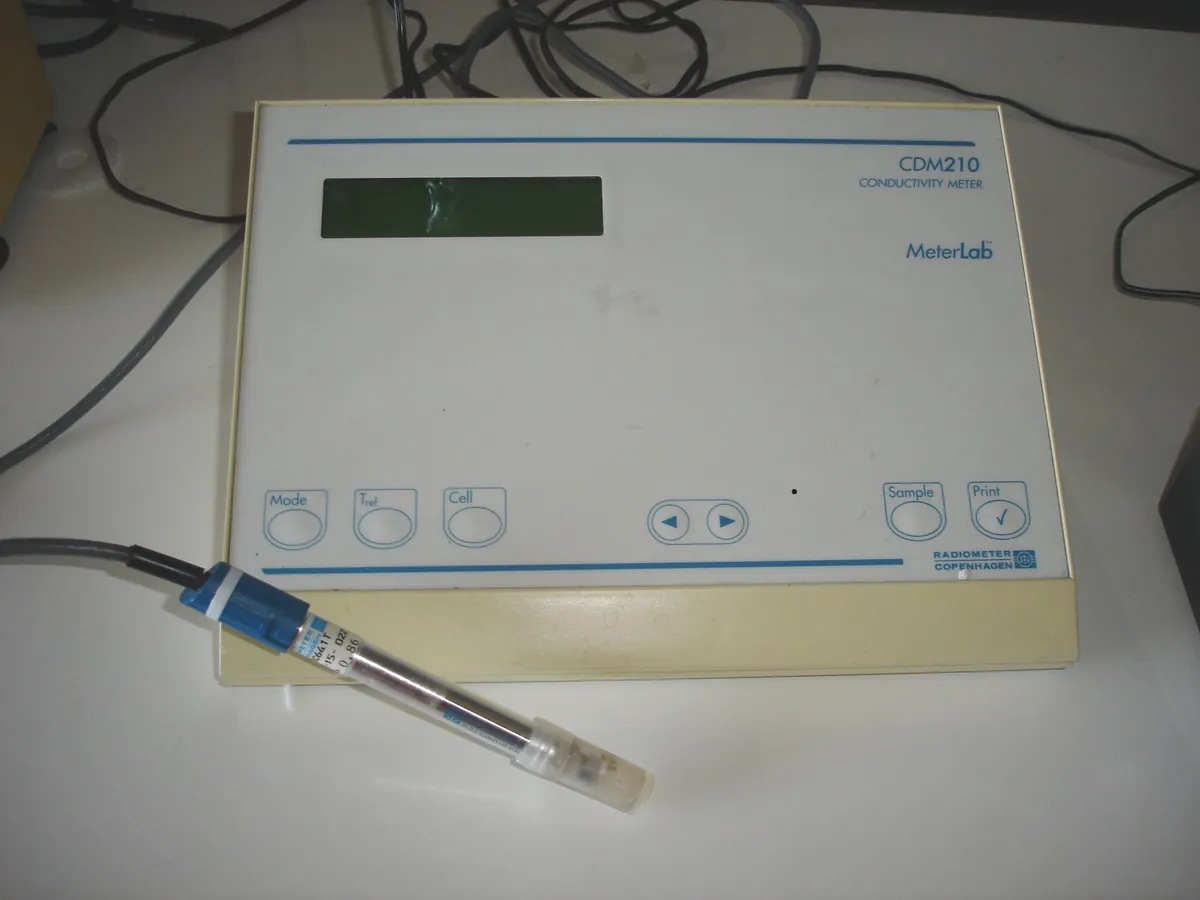
Conductivity meter
Measures how well a solution conducts electricity, which tells you how many ions it contains. In pharma QC it is the main test for the ionic purity of purified water and water for injection.
- Pharmaceutical
- Biotech
- Power generation
- Semiconductor
- Water treatment
- Food & beverage
Test your Conductivity meter knowledge
Multiple-choice questions
Pick an answer to see whether you are right and why.
Q1. Conductivity of water mainly indicates the amount of:
basicQ2. The usual unit for the conductivity of purified water is:
basicQ3. The cell constant is defined as:
basicQ4. A 146.9 µS/cm standard gives a measured conductance of 1469 µS. What is the cell constant?
intermediateQ5. In USP <645> Stage 1, which conductivity value is compared with the limit?
intermediateQ6. Water at 23.6 °C is tested for Stage 1. Which temperature row of the limit table is used?
intermediateQ7. Why does an offline purified water sample often read higher than the online sensor?
advancedQ8. Which cell constant is most suitable for purified water?
advanced
Viva questions
Think of your answer first, then open it to compare.
1. What is the difference between conductance and conductivity?
Conductance is what the meter actually measures between the electrodes (in siemens) and depends on cell size. Conductivity is conductance multiplied by the cell constant, so it is a property of the solution alone and can be compared between instruments (µS/cm).
2. Explain the three stages of the USP <645> water conductivity test.
Stage 1: measure non-compensated conductivity and temperature and compare with the limit for that temperature from the table. If it fails, Stage 2: stir a sample at 25 ± 1 °C until the reading is stable (CO₂ in equilibrium) and compare with 2.1 µS/cm. If it fails, Stage 3: add saturated KCl, measure pH, and compare the Stage 2 value with the limit for that pH from a second table. Failing Stage 3 means the water fails.
3. Why is temperature so important in conductivity measurement?
Ions move faster in warmer water, so conductivity rises by roughly 2% per °C. Without knowing the temperature you cannot compare results or choose the right limit. That is why temperature is always recorded with conductivity.
4. Conductivity passes but TOC fails for a purified water sample. Is that possible? Why?
Yes. Conductivity only responds to ions. Most organic contamination (for example from biofilm or resins) is non-ionic and does not change conductivity much, so it is detected by TOC. The two tests complement each other.
Keep every Conductivity meter in control: usage logs, calibration and maintenance schedules, and automatic blocking of overdue instruments.