Compression Testing Machine (CTM)
A rigid hydraulic press that crushes concrete cubes, cylinders and cement mortar cubes at a controlled loading rate and records the maximum load. The basic instrument of every concrete and cement lab.
- Construction materials testing
- Ready-mix concrete plants
- Cement plants
- Precast concrete
- Infrastructure and road projects
- Academic and research labs
What is CTM?
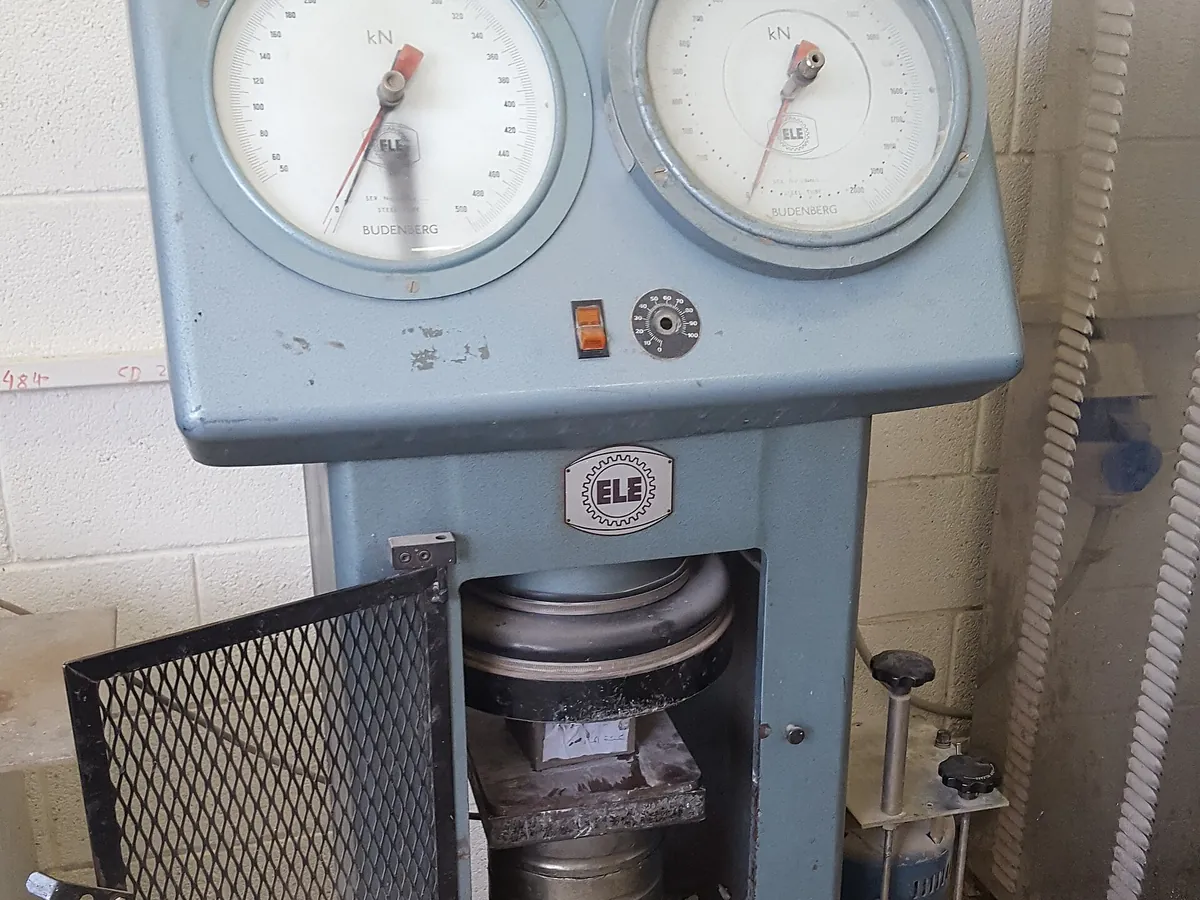
A compression testing machine (CTM) squeezes a specimen between two hardened steel platens until it fails. A hydraulic pump drives a ram upwards, and a pressure transducer or load cell measures the force. The highest force reached before the specimen breaks is the failure load.
Dividing the failure load by the loaded area gives the compressive strength in N/mm² (MPa). For a 150 mm concrete cube the loaded area is 22,500 mm², so a failure load of 675 kN corresponds to 30.0 N/mm². For a 70.6 mm cement mortar cube the area is about 5,000 mm².
Typical lab machines have a capacity of 1,000 to 3,000 kN. Most modern machines are 'automatic': the operator sets the loading rate (pace rate) and the controller keeps it constant, which is essential because strength results depend on how fast the load is applied. The machine is verified regularly with a proving ring or reference load cell so that the force it displays can be trusted.
Used for
- Compressive strength of concrete cubes (e.g. 150 mm) and cylinders at 7 and 28 days
- Compressive strength of cement mortar cubes (IS 4031 Part 6 / ASTM C109)
- Strength of masonry units such as bricks, blocks and paver blocks
- Strength of cores cut from hardened concrete
- Acceptance testing of ready-mix concrete deliveries
- Flexural and split-tensile tests with suitable attachments
How it works
- 01
Specimen placed
The cube is placed centrally with its cast faces against the platens (the trowelled top face is not loaded).
- 02
Seating
The upper platen's spherical seat tilts to sit evenly on the specimen face before loading starts.
- 03
Hydraulic loading
The pump drives the ram so that stress rises at the set pace rate, e.g. about 14 N/mm² per minute for concrete under IS 516.
- 04
Force measurement
A pressure transducer or load cell converts hydraulic pressure or strain into force, shown on the display.
- 05
Failure and peak hold
The specimen cracks and the load drops; the controller detects the drop and holds the peak value.
- 06
Result
Strength = peak load ÷ loaded area, reported to the nearest 0.1 or 0.5 N/mm² as the standard requires.
Advantages
- Simple, robust and quick: a cube test takes a few minutes
- Automatic pace-rate control removes operator influence on loading rate
- Digital readouts store peak load and calculate strength directly
- Large capacity covers concrete, mortar and masonry units
- Traceable force verification gives results that stand up in disputes
Limitations
- Measures only maximum load, not the full stress–strain behaviour
- Results are very sensitive to specimen preparation: uneven faces, poor capping or off-centre placing give low strengths
- Accuracy is lowest at the bottom of the range; small specimens on a large machine may fall below the verified range
- Heavy, needs a firm foundation and regular hydraulic maintenance
1 calibration procedure
Methods that use CTM
Keep every CTM in control: usage logs, calibration and maintenance schedules, and automatic blocking of overdue instruments.