Compression Testing Machine (CTM)
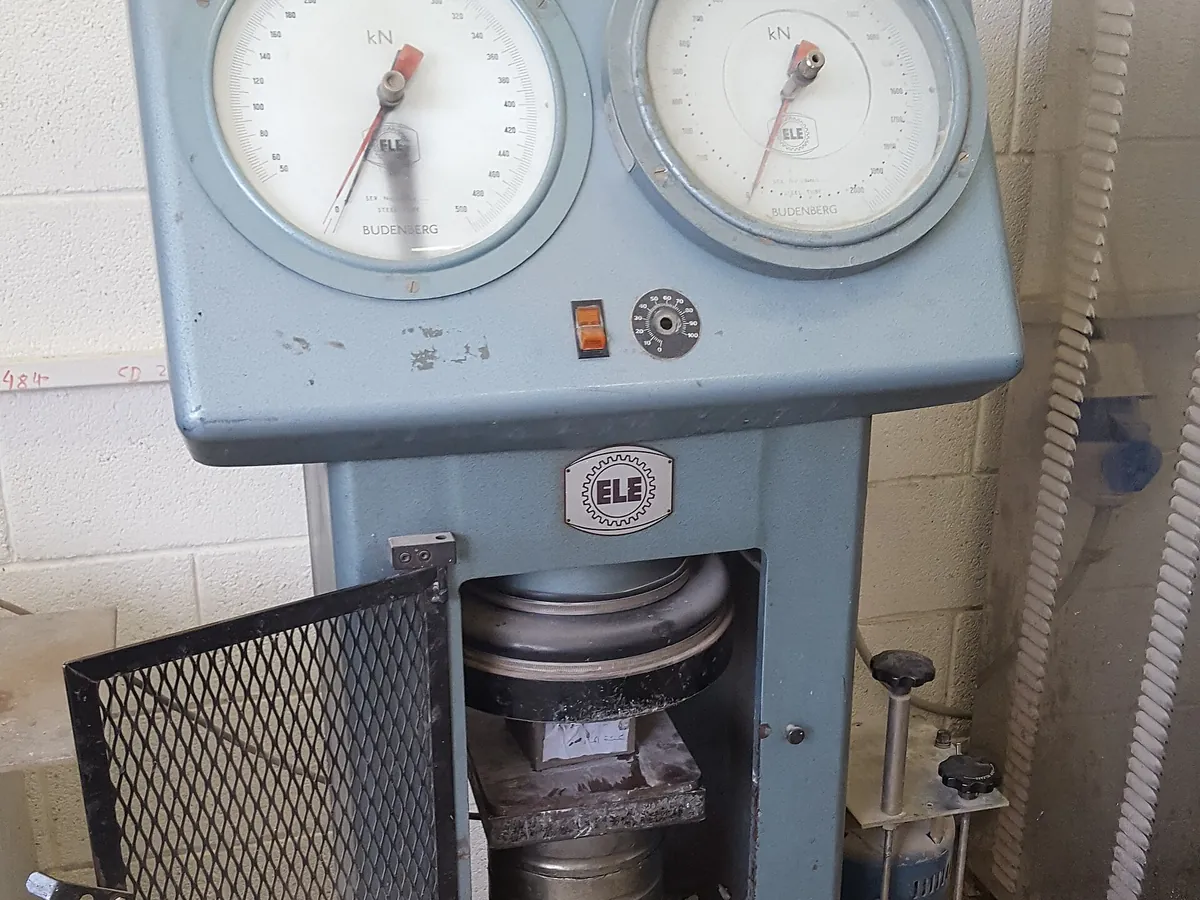
A rigid hydraulic press that crushes concrete cubes, cylinders and cement mortar cubes at a controlled loading rate and records the maximum load. The basic instrument of every concrete and cement lab.
- Construction materials testing
- Ready-mix concrete plants
- Cement plants
- Precast concrete
- Infrastructure and road projects
- Academic and research labs
Test your CTM knowledge
Multiple-choice questions
Pick an answer to see whether you are right and why.
Q1. A 150 mm concrete cube fails at 562.5 kN. What is its compressive strength?
basicQ2. Which face of a cast concrete cube should NOT be placed against a platen?
basicQ3. What happens to measured compressive strength if the loading rate is much faster than the standard requires?
intermediateQ4. Under IS 1828 Part 1 / ISO 7500-1, what is the approximate maximum relative error of indication for a Class 1 machine?
intermediateQ5. At a reference force of 1000 kN, a CTM's three readings average 1012 kN. What is its relative error of indication?
intermediateQ6. What is the purpose of the spherical seat on the upper platen?
advancedQ7. A CTM is verified from 200 kN to 2000 kN. A small mortar cube is expected to fail at about 150 kN on this range. What should you do?
advanced
Viva questions
Think of your answer first, then open it to compare.
1. How do you verify the load reading of a compression testing machine?
Place a calibrated proving ring or reference load cell centrally on the platen, pre-load the system, then apply at least five forces across the range in three series. Compare the machine reading with the true force at each point, calculate the relative error of indication and repeatability, and check they meet the class (for example Class 1, about ±1%) under IS 1828 Part 1 / ISO 7500-1 or ASTM E4.
2. What does a satisfactory cube failure look like, and what do unusual failures suggest?
A good cube failure shows roughly equal cracking on all four exposed faces, leaving an hourglass shape. Cracking on one side, tensile splits or a crushed corner suggest off-centre placing, uneven faces, a seized spherical seat or worn platens, and the result should be investigated.
3. Why are cubes tested immediately after removal from the curing tank, in a wet condition?
Standards require testing in the wet state so that all specimens are in the same moisture condition. Drying changes the measured strength (dry concrete often tests slightly stronger), so letting cubes dry for different times would add variation unrelated to the concrete.
Keep every CTM in control: usage logs, calibration and maintenance schedules, and automatic blocking of overdue instruments.