Construction materials testing
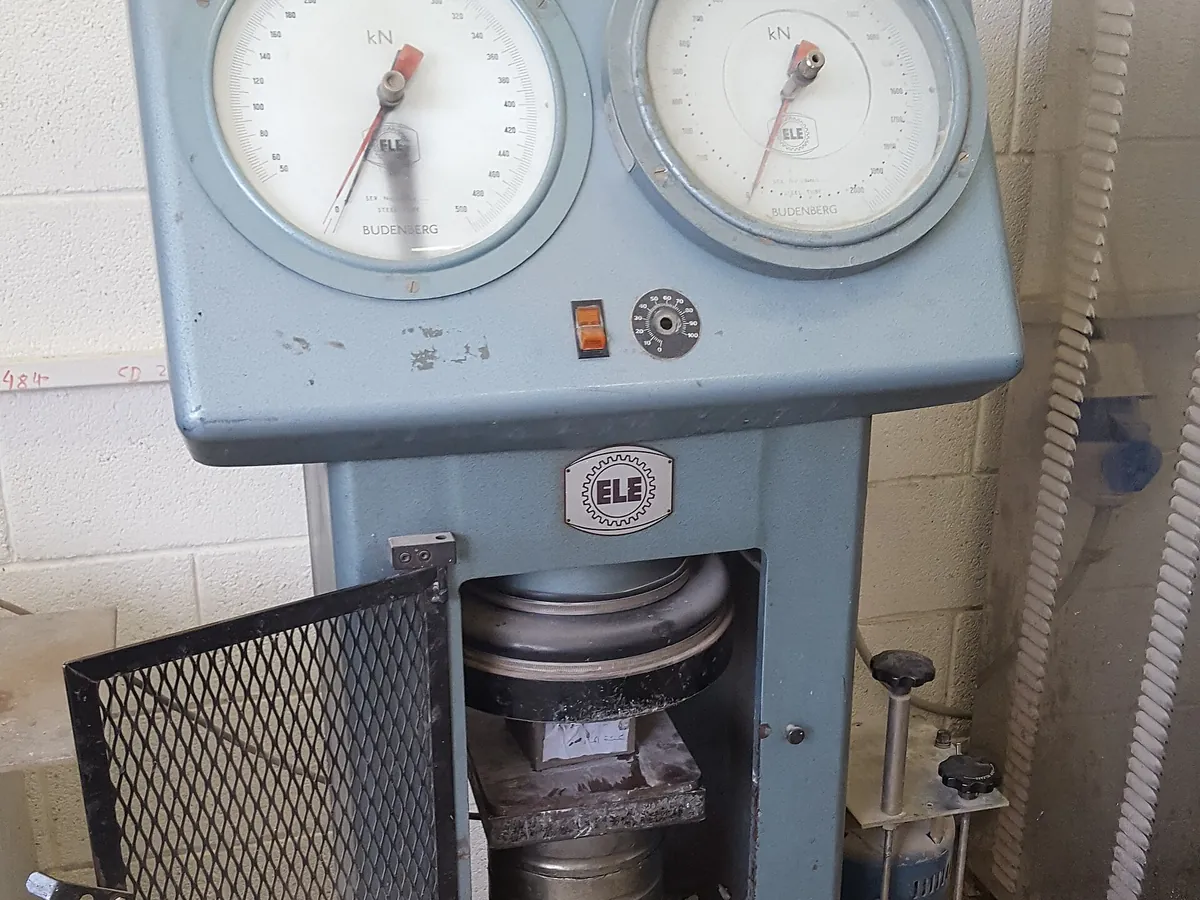
Compression Testing Machine (CTM)
A rigid hydraulic press that crushes concrete cubes, cylinders and cement mortar cubes at a controlled loading rate and records the maximum load. The basic instrument of every concrete and cement lab.
- Construction materials testing
- Ready-mix concrete plants
- Cement plants
- Precast concrete
- Infrastructure and road projects
- Academic and research labs
Follow your site SOP
This is a typical operating sequence for learning. Your instrument model and approved SOP take precedence.
STAGE 1
Before you start
- 1Check the force verification certificate is in date and the machine is labelled with its class and verified range.
- 2Clean both platens and wipe off grit or old concrete fragments.
- 3Take the specimens out of the curing tank just before testing and keep them wet; wipe off surface water and grit.
- 4Measure each cube's dimensions to the nearest mm (or 0.1 mm for cylinders) and record its mass if density is required.
- Do not test a specimen whose expected failure load is below the lower limit of the verified range of the selected range.
STAGE 2
Setting up
- 1Select the specimen type (cube / cylinder / mortar cube) and enter its dimensions so the controller calculates the area.
- 2Set the pace rate from the standard, e.g. about 14 N/mm²/min for concrete cubes (IS 516) or about 35 N/mm²/min for 70.6 mm mortar cubes (IS 4031 Part 6).
- 3Fit spacers so that the gap above the specimen is small, then place the cube centrally with a cast face upwards.
- 4Lower the upper platen (or raise the ram) until it just touches the specimen, letting the spherical seat align.
- Never put the trowelled (top) face of a cube against a platen; it is not flat enough.
STAGE 3
Testing
- 1Close the safety guard and start the test.
- 2Watch that the load rises smoothly at the set rate without shocks.
- 3Let the controller detect failure and stop; record the peak load.
- 4Inspect and record the failure pattern; photograph unusual failures.
- Stand clear of the platen area during loading; specimens can burst violently, especially high-strength concrete.
STAGE 4
After testing
- 1Release pressure and retract the ram fully.
- 2Remove broken concrete and sweep the platens and guard.
- 3Calculate strength = load ÷ area and the average of the set (usually three cubes).
- 4Record results with specimen ID, age, date cast and machine ID in the register or LIMS.
In LimsPulse · Calibration Management
Keep every CTM in control: usage logs, calibration and maintenance schedules, and automatic blocking of overdue instruments.