Compressive strength of cement (mortar cubes)
Measures the strength of the cement itself by crushing 70.6 mm cubes of a standard 1:3 cement–sand mortar at 3, 7 and 28 days. The 28-day strength gives the cement its grade (for example OPC 43 must reach at least 43 MPa).
- Construction materials
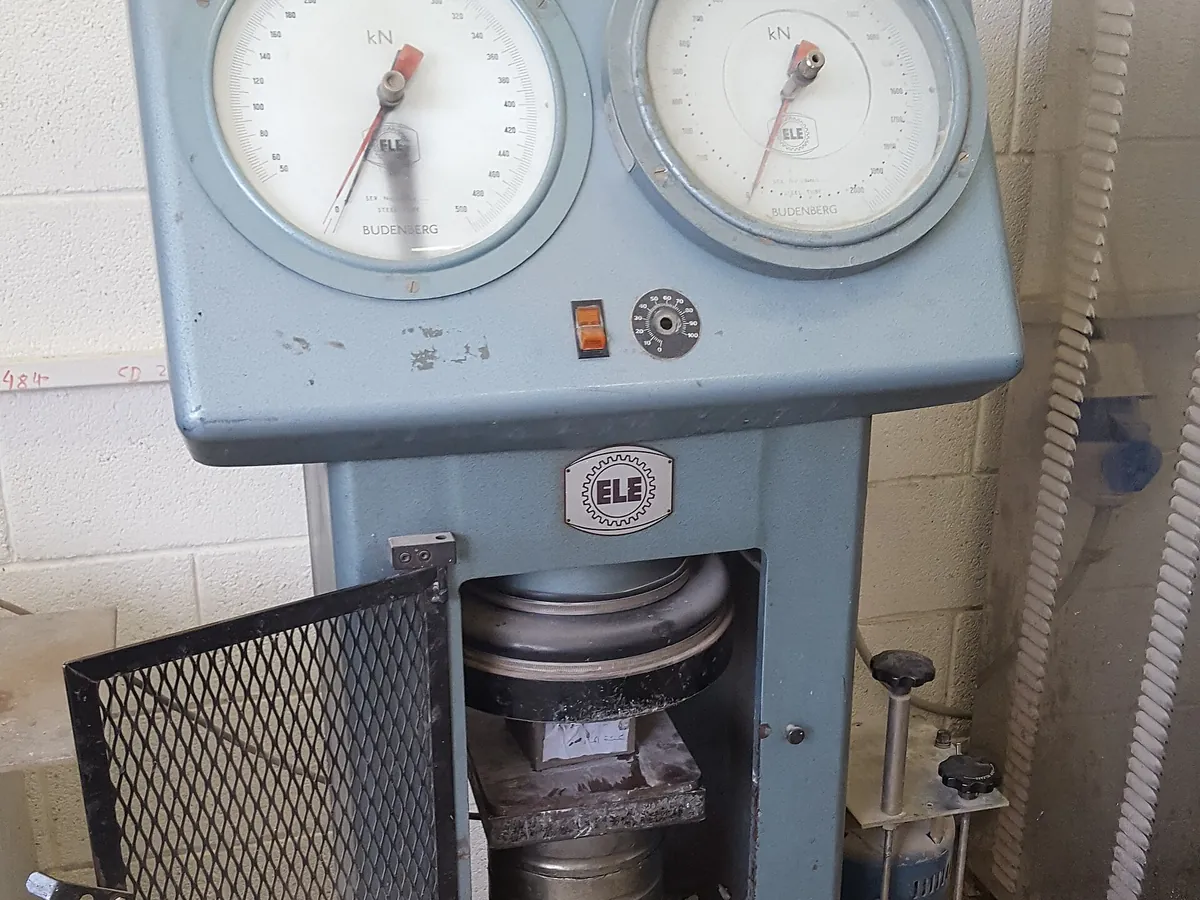
- 1:3 cement–standard sand mortar cubes, compression testing machine
- CTM
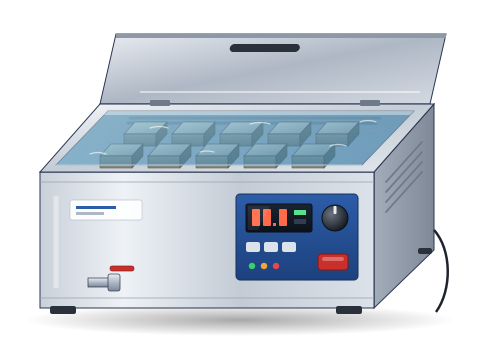
- Curing tank
- Analytical balance
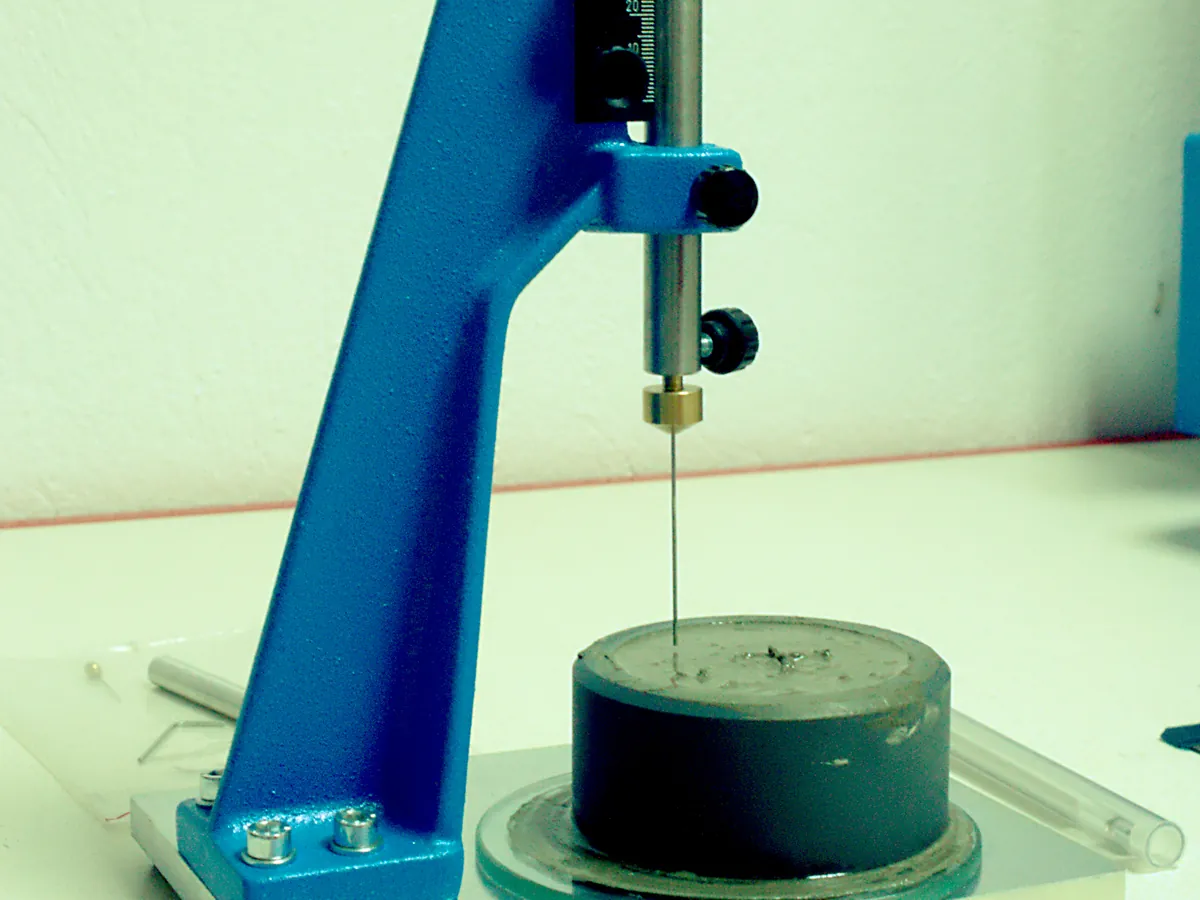
- Vicat
Reference: Based on IS 4031 (Part 6) with IS 650 standard sand; ASTM C109 is the 50 mm cube equivalent. Follow the current editions.
Why this method works
A mortar of one part cement to three parts standard (graded quartz) sand by mass is mixed with a fixed water content calculated from the normal consistency, compacted by vibration in 70.6 mm cube moulds (face area about 5000 mm²), and cured in water. On the test day the cubes are crushed in a compression testing machine at a steady loading rate. Compressive strength is the maximum load divided by the loaded face area.
Instruments used

Reagents & standards
| Reagent | Grade / specification |
|---|---|
| Cement | 200 g per cube |
| Standard sand | 600 g per cube, conforming to IS 650 (three grades in equal parts) |
| Water | (P/4 + 3.0)% of the combined mass of cement and sand |
| Mould oil | Thin coat on moulds and base plates |
Preparing the sample
- 01
Weigh
200 g cement, 600 g standard sand per cube.
- 02
Dry mix
Mix dry for about 1 min until uniform.
- 03
Add water
Add (P/4 + 3)% water; mix until uniform colour (3–4 min).
- 04
Vibrate
Place in mould on vibration machine; vibrate 2 min.
- 05
Moist store
24 h in moist room at 27 ± 2 °C, RH ≥ 90%.
- 06
Cure & test
Demould, cure in water; crush at 3, 7, 28 days.
Procedure
- 1Determine normal consistency P of the cement (IS 4031 Part 4).
- 2For each cube weigh 200 g cement and 600 g standard sand. Mix dry with a trowel for about one minute.
- 3Calculate water = (P/4 + 3.0)% of 800 g. For P = 29.0% this is 10.25% of 800 g = 82.0 g. Add the water and mix until the mortar has a uniform colour. Mixing time should typically be not less than 3 and not more than 4 minutes.
- 4Place the oiled mould on the vibration machine and fill it with the mortar, rodding lightly to remove large voids. Clamp the hopper/mould and vibrate for 2 minutes at the specified speed (typically 12 000 ± 400 vibrations per minute).
- 5Remove the mould, smooth the top surface with a trowel and mark the cube.
- 6Keep the moulds for 24 ± 1 hour in a moist room or cabinet at 27 ± 2 °C and RH of at least about 90%.
- 7Demould and submerge the cubes in clean water at 27 ± 2 °C in a curing tank until the test age. Change the water at the interval set in your SOP.
- 8At each age (typically 3 days ± 1 h, 7 days ± 2 h and 28 days ± 4 h), remove three cubes, wipe surface water and test them in the surface-dry condition.
- 9Place each cube with a cast (smooth mould) face on the platens, not the trowelled top face. Apply load without shock at a uniform rate (typically 35 N/mm² per minute in IS 4031 Part 6) until failure. Record the maximum load.
Notes for analysts
- ASTM C109 uses 50 mm cubes, graded standard sand and a fixed water–cement ratio for portland cement (with flow-based water for others). Results are not directly interchangeable with IS 4031 values.
- The European method (EN 196-1) uses 40 × 40 × 160 mm prisms. Always state which method was used on the report.
- Never test on the trowelled face; it is not flat and gives low results.
Method parameters (typical)
| Mortar | 1 cement : 3 standard sand (by mass) |
|---|---|
| Water | (P/4 + 3.0)% of cement + sand mass |
| Cube size | 70.6 mm (face area 4984 mm², about 50 cm²) |
| Compaction | Vibration machine, 2 min, about 12 000 ± 400 vibrations/min |
| Moist storage | 24 h at 27 ± 2 °C, RH ≥ 90% |
| Water curing | 27 ± 2 °C until test |
| Test ages | 3, 7 and 28 days (three cubes each) |
| Loading rate | Typically 35 N/mm²/min, uniform, without shock |
System suitability & sequence
| Parameter | Limit |
|---|---|
| Compression machine | Load verified (proving ring / load cell) within its calibration period; platens flat and clean; ball seat free |
| Moulds | Dimensions and squareness within tolerance |
| Curing water | Temperature logged daily (27 ± 2 °C) |
Typical sequence
- 1Normal consistency (P)
- 2Cast at least 9 cubes (3 per age)
- 3Test 3 cubes at 3 days, 3 at 7 days, 3 at 28 days
Calculation with a worked example
Where
- fc
- Compressive strength of the cube (MPa)
- P
- Maximum load at failure (kN)
- A
- Loaded face area (mm²) = 70.6 × 70.6 = 4984.36 mm²
Given
- Cement
- OPC 43 grade, 28-day test
- Cube 1 load
- 238 kN
- Cube 2 load
- 245 kN
- Cube 3 load
- 232 kN
- A
- 4984.36 mm²
Working
- 1
Cube 1: 238 × 1000 / 4984.36 = 47.75 MPa
- 2
Cube 2: 245 × 1000 / 4984.36 = 49.15 MPa
- 3
Cube 3: 232 × 1000 / 4984.36 = 46.55 MPa
- 4
Mean = (47.75 + 49.15 + 46.55) / 3 = 47.82 MPa
28-day compressive strength = 47.8 MPa, which meets the typical OPC 43 requirement of at least 43 MPa.
What result passes
- Typical IS 269 minimum compressive strengths (MPa) — OPC 33: 16 (3 d), 22 (7 d), 33 (28 d); OPC 43: 23 (3 d), 33 (7 d), 43 (28 d); OPC 53: 27 (3 d), 37 (7 d), 53 (28 d). Check the current edition; blended cements have their own requirements.
- Report the mean of three cubes. Your SOP may require a cube that differs greatly from the others to be investigated or excluded as allowed by the standard.
Validation parameters (ICH Q2(R2))
| Parameter | Typical requirement |
|---|---|
| Repeatability | Within-batch coefficient of variation for three cubes typically a few per cent |
| Main variables | Water content, compaction, curing temperature and loading rate |
| Inter-lab comparison | Proficiency testing schemes are commonly used for cement testing labs |
Run this method in LimsPulse: specifications and STPs under version control, results calculated and checked against limits, and a signed Certificate of Analysis.