Compressive strength of concrete cubes
The standard test of concrete quality. Cubes are cast from fresh concrete, cured in water and crushed at 7 and 28 days. Strength is the failure load divided by the loaded area, and the 28-day results are compared with the specified characteristic strength (the grade, e.g. M25 = 25 MPa).
- Construction materials
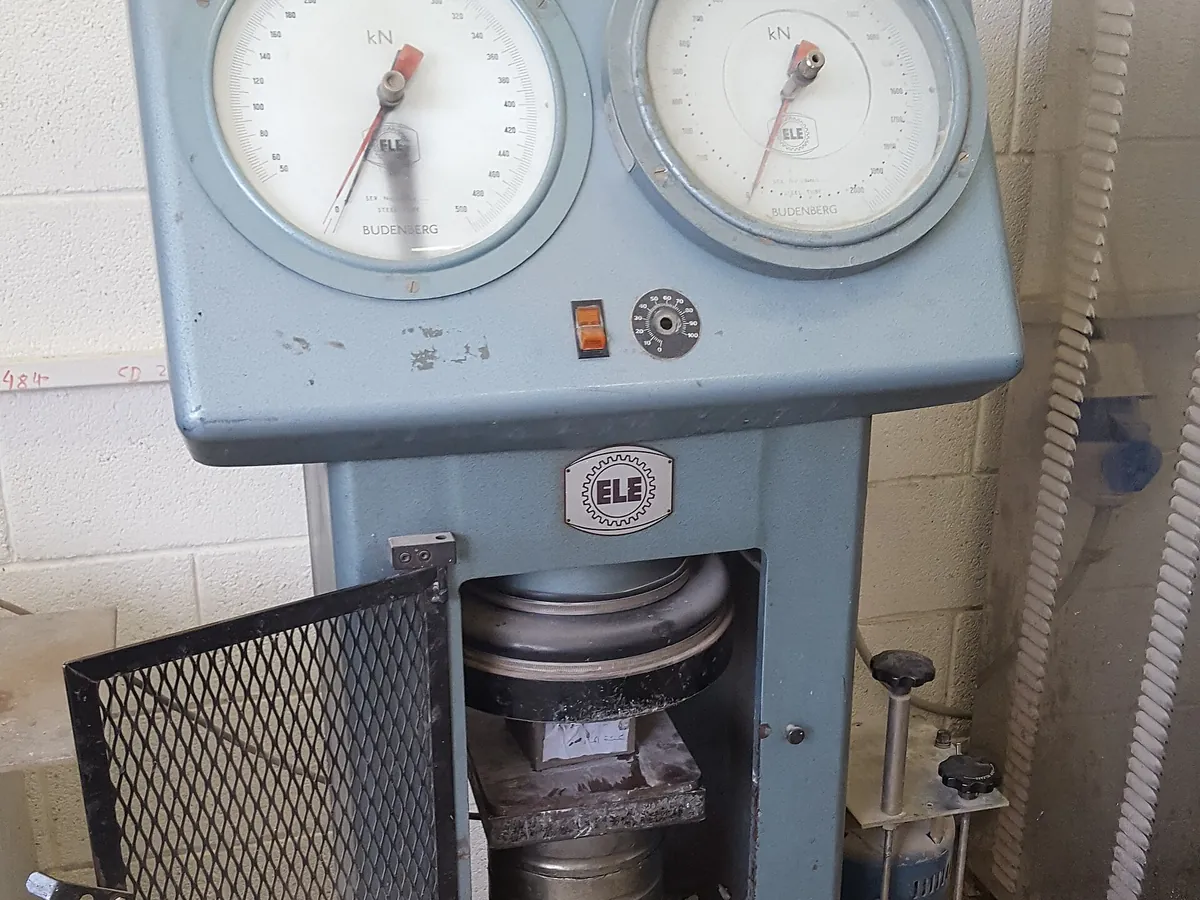
- Compression testing machine
- CTM
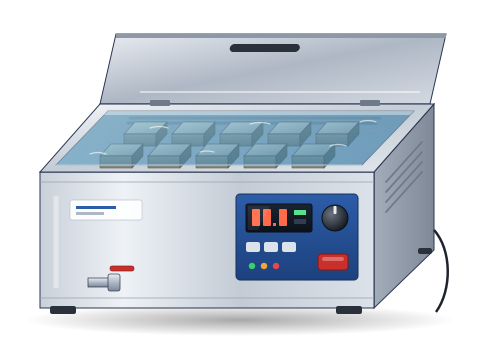
- Curing tank
- Analytical balance
Reference: Based on IS 516 (methods of tests for strength of concrete), IS 1199 for sampling and IS 456 for sampling frequency and acceptance. ASTM C39 is the cylinder equivalent.
Why this method works
Concrete gains strength as cement hydrates. Standard 150 mm cubes made and cured in a controlled way give a measure of the potential strength of the concrete supplied. The cube is loaded between the steel platens of a compression testing machine at a steady rate until it fails. Compressive strength (MPa, equal to N/mm²) = maximum load / cross-sectional area. Because results vary, acceptance is judged on the average of three cubes (one sample) and on groups of samples, not on a single cube.
Instruments used

Reagents & standards
| Reagent | Grade / specification |
|---|---|
| Fresh concrete sample | Representative sample taken at the point of placing as per IS 1199 |
| Mould oil | Thin film on mould faces and base plate |
| Curing water | Clean water at 27 ± 2 °C |
Preparing the sample
- 01
Sample
Take a representative sample at the point of placing.
- 02
Fill moulds
Fill 150 mm moulds in three layers of about 50 mm.
- 03
Compact
Tamp each layer at least 35 strokes, or vibrate.
- 04
Store 24 h
Cover and keep at 27 ± 2 °C, undisturbed, for 24 h.
- 05
Cure
Demould, mark and cure in water at 27 ± 2 °C.
- 06
Crush
Test three cubes at 7 days and three at 28 days.
Procedure
- 1Clean and oil 150 mm cube moulds. Check that joints are tight and the base plate is bolted.
- 2Take the concrete sample as per IS 1199 at the point of placing and remix it briefly.
- 3Fill each mould in three layers of about 50 mm. Compact each layer by hand with the tamping bar (at least 35 strokes per layer for a 150 mm cube, spread evenly) or by vibration until no more air bubbles rise. Do not over-vibrate.
- 4Strike off the top level with a trowel. Label each cube with a unique ID, date, grade and location of pour.
- 5Store the moulds on site or in the lab under damp sacking or a cover at about 27 ± 2 °C, protected from vibration, for 24 ± ½ hour.
- 6Demould and submerge the cubes in clean water at 27 ± 2 °C in a curing tank until the test age. Transport site cubes to the lab carefully, kept moist.
- 7At 7 days and 28 days, remove three cubes per age, wipe off surface water and grit, and test while still wet. Measure the dimensions and weigh each cube.
- 8Place the cube centrally so the load is applied to two opposite cast faces (not the trowelled top). Bring the upper platen down to bear evenly through the ball seat.
- 9Apply load without shock and increase it at a steady rate — IS 516 has traditionally specified about 140 kg/cm² per minute (about 14 N/mm² per minute); follow the current edition and your machine settings — until the cube fails. Record the maximum load and the failure pattern.
Notes for analysts
- Satisfactory failure: all four exposed faces crack about equally, leaving an hourglass (two cones). Unusual failures (one side splitting, tensile cracks) suggest uneven loading or poor specimens; note them on the report.
- Record cube mass and dimensions; a low density may explain a low strength (poor compaction).
- The test measures the quality of concrete supplied and cured under standard conditions, not the in-place strength of the structure.
Method parameters (typical)
| Specimen | 150 mm cube (100 mm cubes allowed when aggregate is ≤ 20 mm, per standard); ASTM uses 150 × 300 mm or 100 × 200 mm cylinders |
|---|---|
| Compaction | Three layers, ≥ 35 strokes per layer with 16 mm bar, or vibration |
| Initial storage | 24 ± ½ h at 27 ± 2 °C, covered |
| Curing | Water at 27 ± 2 °C until test |
| Test ages | 7 days and 28 days (3 cubes each); other ages as specified |
| Loading rate | Steady, without shock; typically about 14 N/mm² per minute in IS 516 |
| Cube area | 150 × 150 = 22 500 mm² (use measured dimensions where required) |
System suitability & sequence
| Parameter | Limit |
|---|---|
| Compression testing machine | Load verified with a proving ring or load cell within its calibration period (often yearly); platens flat; ball seat moves freely |
| Cube moulds | Internal dimensions, flatness and squareness within tolerance |
| Curing tank | Water temperature recorded daily, 27 ± 2 °C |
Typical sequence
- 1Cast 6 cubes per sample (3 for 7 days, 3 for 28 days); extra cubes if early-age or stripping tests are needed
- 2Test 3 cubes at 7 days
- 3Test 3 cubes at 28 days and evaluate acceptance
Calculation with a worked example
Where
- fc
- Compressive strength of one cube (MPa = N/mm²)
- P
- Maximum load at failure (kN)
- A
- Loaded area (mm²); 150 × 150 = 22 500 mm²
Given
- Grade
- M25 (fck = 25 MPa), 28-day test
- Cube A
- 640 kN
- Cube B
- 610 kN
- Cube C
- 675 kN
- A
- 22 500 mm²
Working
- 1
Cube A: 640 × 1000 / 22 500 = 28.44 MPa
- 2
Cube B: 610 × 1000 / 22 500 = 27.11 MPa
- 3
Cube C: 675 × 1000 / 22 500 = 30.00 MPa
- 4
Mean = (28.44 + 27.11 + 30.00) / 3 = 28.52 MPa
- 5
±15% band around the mean: 0.85 × 28.52 = 24.24 MPa to 1.15 × 28.52 = 32.80 MPa
- 6
Deviations from mean: A −0.3%, B −4.9%, C +5.2% — all within ±15%, so the sample is valid
- 7
Individual check: 28.52 ≥ fck − 4 = 21 MPa (M20 and above, typical IS 456 rule)
Sample 28-day strength = 28.5 MPa. The three cubes agree within ±15%, so the sample result is valid. Final acceptance is judged on the mean of four consecutive non-overlapping samples (see acceptance).
What result passes
- Sample result: the strength of one sample is the average of its three cubes. Typically (IS 456), the individual cube results should not vary by more than ±15% of that average; otherwise the sample is treated as invalid and investigated.
- Typical IS 456 acceptance for M20 and above (check the current edition and amendments): the mean of any four non-overlapping consecutive sample results should be at least fck + 0.825 × established standard deviation (rounded to the nearest 0.5 MPa) or fck + 4 MPa, whichever is greater; and every individual sample result should be at least fck − 4 MPa. For M15 the corresponding margins are typically 3 MPa.
- 7-day results are an early indicator only. OPC concrete typically reaches about 65–70% of its 28-day strength at 7 days, but this depends on cement type, mineral admixtures and temperature.
- Concrete that fails the acceptance criteria is investigated — for example with core tests and non-destructive tests — before any decision on the structure.
Validation parameters (ICH Q2(R2))
| Parameter | Typical requirement |
|---|---|
| Within-test variation | Three cubes from one sample typically agree within a few per cent when cast and cured well |
| Main error sources | Poor compaction, honeycombing, uneven or trowelled faces under load, wrong curing temperature, drying before test, eccentric loading |
| Cube vs cylinder | Cylinder strength is typically about 0.8 × cube strength; never mix the two without stating the specimen type |
Run this method in LimsPulse: specifications and STPs under version control, results calculated and checked against limits, and a signed Certificate of Analysis.