Colony counter
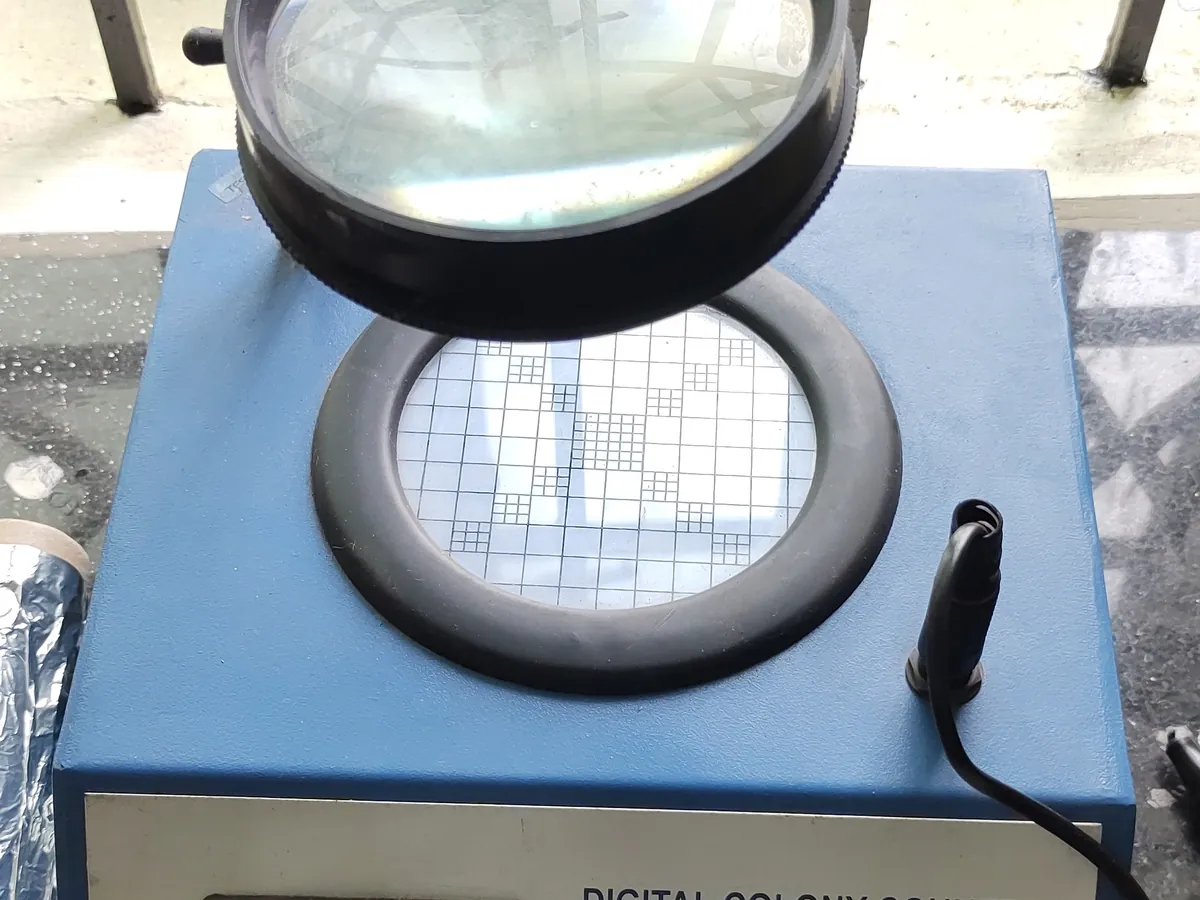
Helps the analyst count colonies on agar plates and membranes accurately, either by a lit magnifier with a counting pen (manual) or by a camera and image analysis software (automated).
- Pharmaceutical
- Biotech
- Food & beverage
- Water testing
- Cosmetics
- Research laboratories
What is Colony counter?
Counting colonies is the final step of most quantitative microbiology tests: microbial limits, water counts, environmental monitoring and growth promotion. A colony counter makes the count easier and more reliable. The simplest type is a back-lit or dark-field viewing stage with a magnifying lens and a pen or pressure pad that marks and counts each colony as it is touched.
Automated counters photograph the plate under controlled lighting and use software to detect colonies by size, shape and colour contrast. They save time, give an image record of each plate and reduce counting fatigue. Because the image and result are electronic GMP records, the software must be validated and comply with data integrity rules (audit trail, user access, secure storage).
Whatever the type, the count is only as good as the plate. Spreading colonies, merged colonies, debris, product particles and very small colonies all need analyst judgement. Counters are therefore checked against manual counts by trained analysts, and counts outside the countable range are handled as the method describes.
Used for
- TAMC / TYMC plates in microbial enumeration tests
- Membranes from water and filtration tests
- Settle, contact and air sampler plates in environmental monitoring
- Growth promotion and method suitability recovery counts
- Preservative efficacy and disinfectant efficacy tests
How it works
- 01
Place plate
The plate or membrane is placed on the lit stage, lid removed or inverted as per the SOP.
- 02
Illuminate
Back-light or dark-field lighting increases contrast between colonies and agar.
- 03
Magnify / capture
A lens magnifies the plate (manual) or a camera captures an image (automated).
- 04
Mark / detect
The analyst marks each colony, or software detects colonies by contrast, size and shape.
- 05
Review & record
The analyst checks the count, edits software marks if needed and records the result.
Advantages
- Reduces counting errors and double counting
- Magnification and lighting help see small or pale colonies
- Automated systems give fast counts and a permanent image record
- Simple to use and to maintain
Limitations
- Merged, spreading or overlapping colonies are hard to count, by eye or by software
- Software may count bubbles, debris or product particles as colonies
- Automated counters need validation and computer system controls
- Accuracy falls at high colony numbers (above the countable range)
Methods that use Colony counter
Keep every Colony counter in control: usage logs, calibration and maintenance schedules, and automatic blocking of overdue instruments.