Cloud and Pour Point Apparatus
Cools a fuel or oil in a standard glass test jar through a series of cold baths and examines it at set intervals. The cloud point is where wax crystals first appear; the pour point is the lowest temperature at which the sample still flows.
- Petroleum refining
- Lubricant blending
- Fuel distribution in cold climates
- Crude oil production and pipelines
- Independent testing laboratories
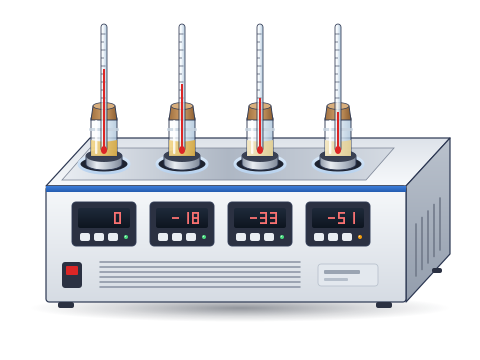
What is Cloud & pour point tester?
Diesel, heating oils and lubricants contain paraffin waxes that crystallise as the liquid gets cold. First the fuel turns hazy (the cloud point); as cooling continues, the wax crystals grow into a network that stops the liquid flowing (around the pour point). Wax can block fuel filters and lines in cold weather, so fuel and oil specifications set seasonal limits on these cold-flow properties.
The manual apparatus (ASTM D2500 / ISO 3015 for cloud point, ASTM D97 / ISO 3016 for pour point, IS 1448 Part 10) is simple: a flat-bottomed glass test jar with a thermometer held in a cork, a metal jacket with a disc and gasket, and a set of cooling baths held at fixed temperatures such as 0 °C, −18 °C, −33 °C and −51 °C. The jar is moved to colder baths in steps as the sample cools, so the cooling rate stays within the method range.
Automatic analysers use a Peltier or mechanical refrigeration system and detect the cloud point optically (light scattering) and the pour point by tilting the jar or by a moving sensor. They remove operator judgement and reduce the need for alcohol cooling baths, but they must be shown to give results equivalent to the reference method.
Used for
- Cloud point of diesel, biodiesel and heating oil for summer and winter grades
- Pour point of lubricating oils, base oils and fuel oils
- Pour point of crude oil for pipeline and storage handling
- Evaluating cold-flow improver additives
- Transformer oil cold-flow properties
How it works
- 01
Condition sample
Cloud point: warm the sample to at least 14 °C above the expected cloud point and remove water. Pour point: heat to a set temperature (typically at least 45 °C) to dissolve wax crystals and erase thermal history.
- 02
Fill jar
Pour sample into the test jar to the mark and fit the cork with the correct thermometer at the correct depth.
- 03
Stepwise cooling
Place the jar in its jacket in the first cold bath and transfer to colder baths when the sample reaches the set changeover temperatures.
- 04
Inspect (cloud)
At each 1 °C, remove the jar quickly and look at the bottom for a haze; record the temperature at which it first appears.
- 05
Inspect (pour)
Starting about 9 °C above the expected pour point, tilt the jar at each 3 °C multiple to see if the surface moves.
- 06
Endpoint (pour)
When the sample does not move with the jar held horizontal for 5 s, record that temperature and add 3 °C to obtain the pour point.
Advantages
- Simple, low-cost manual apparatus
- Long-established methods referenced in nearly all fuel and oil specifications
- Automatic models give objective endpoints and run unattended
- Small sample (about 45 mL per test jar)
Limitations
- Manual endpoints depend on operator vision and technique
- Pour point is reported only in 3 °C steps
- Cloud point method needs a transparent sample (in a 40 mm layer); dark samples cannot be tested by D2500
- Results are sensitive to sample thermal history (prior heating) and water content
- Neither value fully predicts filter blocking in vehicles; CFPP tests are used for that
1 calibration procedure
Methods that use Cloud & pour point tester
Keep every Cloud & pour point tester in control: usage logs, calibration and maintenance schedules, and automatic blocking of overdue instruments.