Cloud and Pour Point Apparatus
Cools a fuel or oil in a standard glass test jar through a series of cold baths and examines it at set intervals. The cloud point is where wax crystals first appear; the pour point is the lowest temperature at which the sample still flows.
- Petroleum refining
- Lubricant blending
- Fuel distribution in cold climates
- Crude oil production and pipelines
- Independent testing laboratories
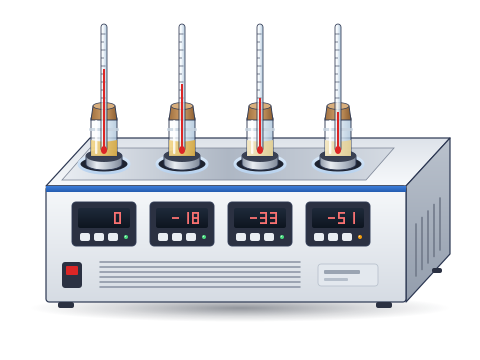
How Cloud & pour point tester works
The sample is cooled at a controlled rate. For cloud point, the bottom of the jar is inspected at every 1 °C for the first haze of wax crystals. For pour point, the jar is tilted at every 3 °C to see whether the sample still moves; the pour point is 3 °C above the temperature at which it no longer moves when held horizontal for 5 s.
The path of a sample
- 01
Condition sample
Cloud point: warm the sample to at least 14 °C above the expected cloud point and remove water. Pour point: heat to a set temperature (typically at least 45 °C) to dissolve wax crystals and erase thermal history.
- 02
Fill jar
Pour sample into the test jar to the mark and fit the cork with the correct thermometer at the correct depth.
- 03
Stepwise cooling
Place the jar in its jacket in the first cold bath and transfer to colder baths when the sample reaches the set changeover temperatures.
- 04
Inspect (cloud)
At each 1 °C, remove the jar quickly and look at the bottom for a haze; record the temperature at which it first appears.
- 05
Inspect (pour)
Starting about 9 °C above the expected pour point, tilt the jar at each 3 °C multiple to see if the surface moves.
- 06
Endpoint (pour)
When the sample does not move with the jar held horizontal for 5 s, record that temperature and add 3 °C to obtain the pour point.
Main parts and what they do
Test jar
Flat-bottomed clear glass cylinder with a fill mark at about 54 mm height (about 45 mL).
Thermometers
Specified high-cloud/pour and low-cloud/pour thermometers (or calibrated digital probes) held in a cork at a fixed depth.
Cork
Fits the jar and holds the thermometer centrally.
Jacket
Metal cylinder with a cork or felt disc at the bottom and a gasket ring, holding the jar in each bath with an air gap.
Cooling baths
Insulated baths held at fixed temperatures (for example 0, −18, −33, −51 and −69 °C) using refrigeration or a coolant.
Refrigeration unit
Mechanical compressor or cascade system that holds bath temperatures; Peltier cooling in many automatic analysers.
Optical / tilt sensors (automatic)
Detect haze by light scattering and flow by jar tilting or a moving probe.
Terms every analyst should know
Cloud point
The temperature at which a haze of wax crystals first appears at the bottom of the jar when cooled under test conditions. Reported to the nearest 1 °C.
Pour point
The lowest temperature at which the sample is still seen to move under the test conditions. Always a multiple of 3 °C in D97.
Stepwise baths
Rather than one bath that cools continuously, the jar moves through fixed-temperature baths, which gives a controlled cooling rate that becomes slower as the sample gets colder.
Thermal history
Previous heating or cooling affects wax crystal formation. Pre-heating to a fixed temperature makes results comparable.
Upper and lower pour point
Some residual fuels and crudes give different pour points depending on heat treatment; D97 describes procedures for these.
Keep every Cloud & pour point tester in control: usage logs, calibration and maintenance schedules, and automatic blocking of overdue instruments.