Cloud Point and Pour Point of Petroleum Products
When a fuel or oil is cooled, waxes start to crystallise. The cloud point is the temperature at which a haze of wax crystals first appears; it predicts when filters may start to block. The pour point is the lowest temperature at which the oil still flows; below it the oil gels. Together they tell you whether a product will work in cold weather.
- Petroleum, oil & gas
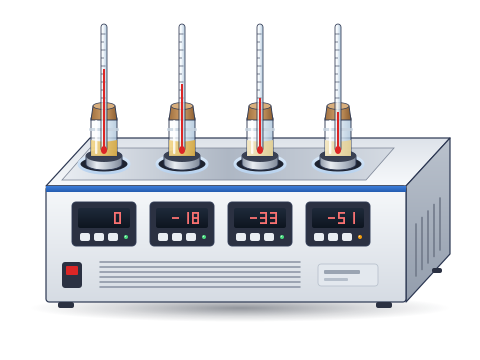
- Manual cooling in a jacketed test jar in staged cold baths (ASTM D2500 / ASTM D97) or an automatic cold-flow analyser
- Cloud & pour point tester
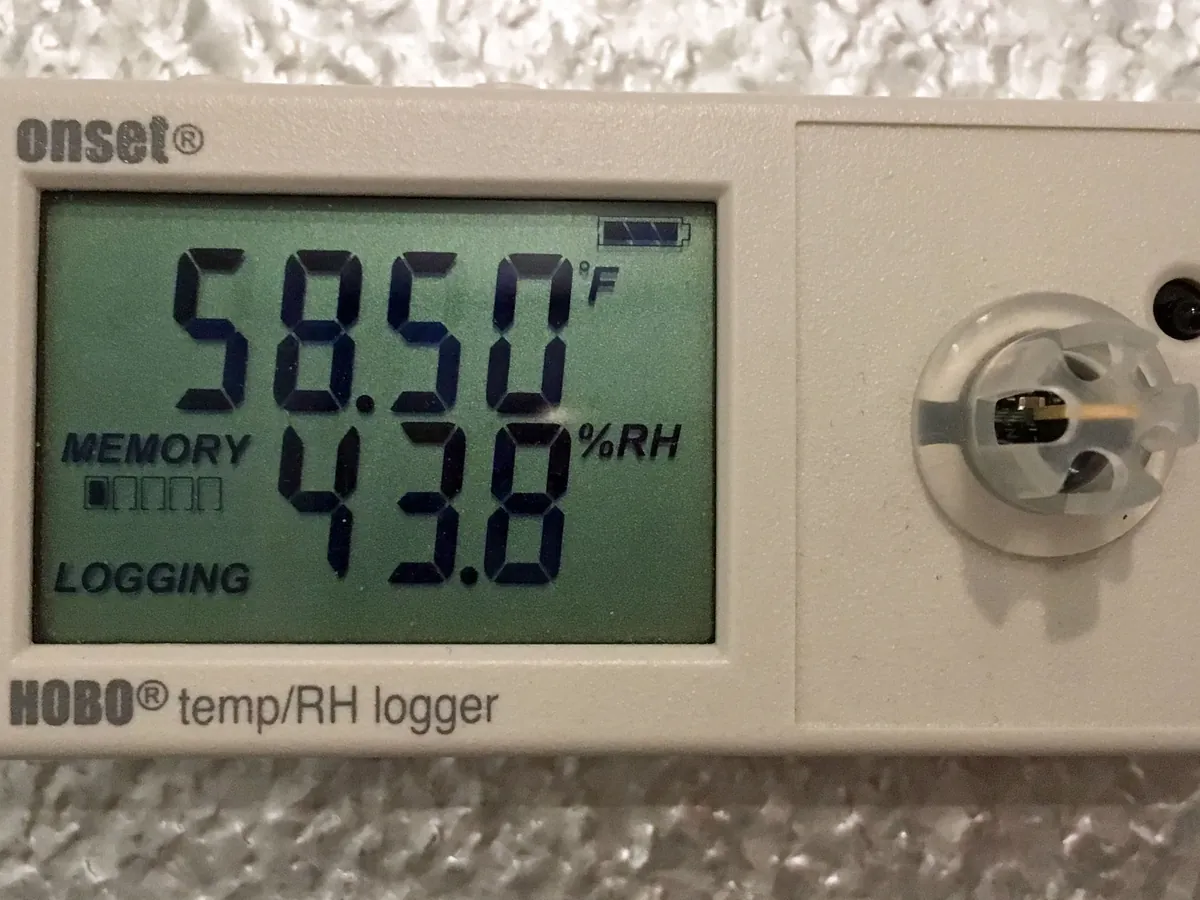
- Thermometer / logger
Reference: Typical method based on ASTM D2500 (cloud point) and ASTM D97 (pour point), with the corresponding IS 1448 parts and IP methods. Automatic methods (for example ASTM D5773 for cloud point, D5950 for pour point) are widely used. Follow your lab SOP and the current editions.
Why this method works
Cloud point: a clear sample in a flat-bottomed test jar is cooled in steps and inspected at every 1 °C. The temperature at which a haze first appears at the bottom of the jar is the cloud point. Pour point: the sample is first heated to dissolve any wax and remove its thermal history, then cooled at a controlled rate. At every test temperature that is a multiple of 3 °C the jar is tilted; when the oil does not move for 5 seconds with the jar held horizontal, 3 °C is added to that temperature and the result is reported as the pour point.
Instruments used
Reagents & standards
| Reagent | Grade / specification |
|---|---|
| Cooling media | Ice and salt, solid CO₂ with acetone/alcohol, or a refrigerated bath at the staged temperatures |
| Thermometers | Calibrated ASTM-type cloud and pour thermometers (or calibrated digital probes) |
| Drying agent | For cloud point, wet samples can be dried (for example with anhydrous sodium sulphate) and filtered, as allowed by the method |
Preparing the sample
- 01
Heat
Warm the sample to dissolve wax and erase history.
- 02
Fill jar
Pour to the mark; fit thermometer and cork.
- 03
Cool in stages
Move the jacket to colder baths as the sample cools.
- 04
Inspect
Cloud: every 1 °C. Pour: tilt every 3 °C.
- 05
Record
First haze = cloud point; no flow + 3 °C = pour point.
Procedure
- 1Cloud point (D2500): the sample must be transparent in a 40 mm layer. Remove water if needed, then bring the sample to at least about 14 °C above the expected cloud point.
- 2Pour the sample into the test jar to the mark, close it with a cork carrying the thermometer with the bulb resting on the bottom, and place the jar in its jacket in the first cooling bath.
- 3At each 1 °C fall, remove the jar quickly (no more than about 3 seconds) and inspect the bottom for a haze. Move to the next colder bath at the temperatures the method gives. The first distinct haze is the cloud point.
- 4Pour point (D97): heat the sample in the test jar to the temperature the method gives (for most samples at least about 45 °C, or a set margin above the expected pour point) to dissolve wax.
- 5Cool the jar in the jacket and baths. Starting at a test temperature about 9 °C above the expected pour point, tilt the jar at each multiple of 3 °C just enough to see whether the oil moves, and return it within about 3 seconds.
- 6When the oil shows no movement while the jar is held horizontal for 5 seconds, record that temperature. Add 3 °C: this is the pour point.
- 7Report cloud point to the nearest 1 °C and pour point as a multiple of 3 °C, quoting the method.
Standard preparation
- 1No chemical standards. Verify thermometers or probes at the ice point and against a reference thermometer as per the apparatus calibration schedule.
- 2Automatic analysers are checked with reference fuels of known cloud and pour point.
Notes for analysts
- Cloud point is always at or above pour point; wax first appears, then builds a gel network that stops flow.
- Pour-point depressant additives lower the pour point but usually do not change the cloud point much.
- Reheating a sample that was already cooled can change its pour point; always start from the preheating step.
- Cloud point does not apply to dark or opaque oils (they must be transparent in a 40 mm layer).
Method parameters (typical)
| Cloud point inspection interval | Every 1 °C |
|---|---|
| Pour point inspection interval | Every 3 °C (results are multiples of 3 °C) |
| No-flow criterion | No movement for 5 s with the jar horizontal |
| Staged bath temperatures | As given in the current method (for example 0, −18, −33, −51 and −69 °C) |
| Removal time from jacket | No more than about 3 s per inspection |
System suitability & sequence
| Parameter | Limit |
|---|---|
| Thermometer verification | Within the calibration tolerance (see apparatus calibration) |
| Duplicate tests | Agree within method repeatability (often 2 °C for cloud point, 3 °C for pour point — check current method) |
Typical sequence
- 1Thermometer check
- 2Cloud point (if required)
- 3Pour point on a fresh portion
- 4Duplicate on a fresh portion where the SOP requires
Calculation with a worked example
Where
- T(no flow)
- Test temperature (a multiple of 3 °C) at which the oil showed no movement for 5 s with the jar horizontal
Given
- Last flow observed
- −15 °C (oil moved when tilted)
- First no-flow temperature
- −18 °C
Working
- 1
Pour point = −18 + 3 = −15 °C
Pour point = −15 °C (equal to the last temperature at which the oil still flowed)
What result passes
- Compare with the product specification. Many diesel specifications set seasonal or regional limits for cold-flow properties (cloud point, pour point or cold filter plugging point, CFPP); check the current grade.
- Lubricant specifications often give a maximum pour point (for example −6 °C or lower, depending on grade and climate).
Validation parameters (ICH Q2(R2))
| Parameter | Typical requirement |
|---|---|
| Precision | Repeatability and reproducibility as stated in the current methods |
| Correlation | Automatic analyser results checked against the manual method on representative samples |
Run this method in LimsPulse: specifications and STPs under version control, results calculated and checked against limits, and a signed Certificate of Analysis.