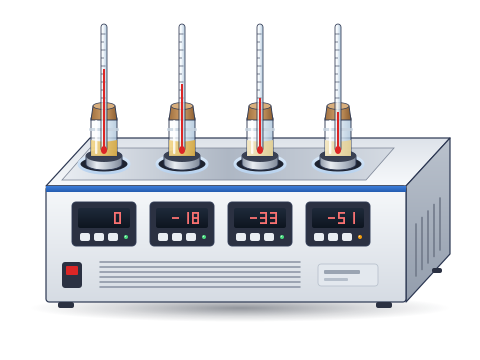
Cloud and Pour Point Apparatus
Cools a fuel or oil in a standard glass test jar through a series of cold baths and examines it at set intervals. The cloud point is where wax crystals first appear; the pour point is the lowest temperature at which the sample still flows.
- Petroleum refining
- Lubricant blending
- Fuel distribution in cold climates
- Crude oil production and pipelines
- Independent testing laboratories
Test your Cloud & pour point tester knowledge
Multiple-choice questions
Pick an answer to see whether you are right and why.
Q1. The cloud point is the temperature at which…
basicQ2. In ASTM D97, pour point checks are made at intervals of…
basicQ3. An oil shows no movement when held horizontal for 5 s at −15 °C. What is its pour point?
intermediateQ4. Why is a pour point sample pre-heated before cooling?
intermediateQ5. Water in a diesel sample can make the cloud point appear…
intermediateQ6. Why can ASTM D2500 not be used to measure the cloud point of a dark fuel oil?
advanced
Viva questions
Think of your answer first, then open it to compare.
1. Why are several cooling baths at fixed temperatures used instead of one very cold bath?
Moving the jar through baths at set temperatures controls the cooling rate, keeping it within the method range. A single very cold bath would cool the sample too quickly near its cloud or pour point and give different results.
2. What safety hazards exist with cloud and pour point testing?
Cold baths and jackets can cause cold burns; alcohol coolants and fuels are flammable; mercury thermometers can break. Wear insulated gloves and glasses, keep baths covered and away from ignition sources, and keep a mercury spill kit if needed.
3. Why can rough handling of the jar during pour point checks give a falsely low pour point?
As wax crystals grow they form a fragile network that stops flow. Tilting too far, too often or for too long breaks the network, so the sample keeps flowing to a lower temperature than it would undisturbed.
Keep every Cloud & pour point tester in control: usage logs, calibration and maintenance schedules, and automatic blocking of overdue instruments.