Petroleum testing
Cloud and Pour Point Apparatus
Cools a fuel or oil in a standard glass test jar through a series of cold baths and examines it at set intervals. The cloud point is where wax crystals first appear; the pour point is the lowest temperature at which the sample still flows.
- Petroleum refining
- Lubricant blending
- Fuel distribution in cold climates
- Crude oil production and pipelines
- Independent testing laboratories
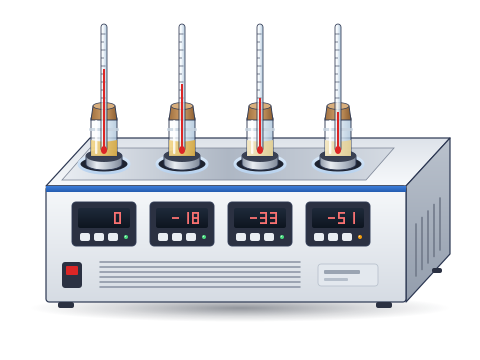
Follow your site SOP
This is a typical operating sequence for learning. Your instrument model and approved SOP take precedence.
STAGE 1
Before you start
- 1Check that each bath is at its set temperature using the bath thermometers.
- 2Check thermometer calibration status and that the mercury or spirit column is unbroken.
- 3Dry the sample if it contains water (water freezes and looks like wax).
- 4Clean and dry test jars, corks and jackets.
- Alcohol coolant baths are flammable; keep heat sources away.
STAGE 2
Preparing the sample
- 1Cloud point: bring the sample to at least 14 °C above the expected cloud point and filter through dry lint-free paper if needed.
- 2Pour point: heat the sample in the jar to the temperature the method specifies (typically 45 °C or more) without stirring vigorously.
- 3Fill the jar to the mark and insert the cork and thermometer so the bulb is at the specified position (resting on the bottom for cloud point; just below the surface for pour point).
STAGE 3
Cooling and inspecting
- 1Place the jar in its jacket in the first bath; move it to the next colder bath when the sample reaches the method changeover temperature.
- 2Cloud: at each 1 °C, remove the jar, look at the bottom for haze and return it within about 3 s.
- 3Pour: from 9 °C above the expected pour point, at each 3 °C multiple, tilt the jar just enough to see whether the surface moves; return it within 3 s.
- 4Record the cloud point when haze first appears, or the pour point as the no-flow temperature + 3 °C.
- Handle jars quickly and gently; disturbing the sample breaks the wax structure and gives low pour points.
STAGE 4
After testing
- 1Let the jar warm to room temperature before cleaning; do not put a cold jar into hot water.
- 2Clean jars with a suitable solvent and dry.
- 3Record results with the method, thermometers and bath temperatures used.
- Cold metal jackets and bath lids can cause cold burns; wear insulated gloves.
In LimsPulse · Calibration Management
Keep every Cloud & pour point tester in control: usage logs, calibration and maintenance schedules, and automatic blocking of overdue instruments.